Question
Consider the following elements:
Ca, Cl, Na, I, Li, Ba, Sr, K, Br.
Separate these elements into three groups (families) of similar properties. State one property in each case on the basis of which you have made your choice.
Answer

  1. Lithium (Li), sodium (Na) and potassium (K) are three metals of group 1 having a valency of 1.
  2. Calcium (Ca), strontium (Sr) and barium (Ba) are three metals of group 2 having a valency of 2.
  3. Chlorine (Cl), bromine (Br) and iodine (I) are three non-metals of group 17 which are known as halogens, and have seven valence electrons.

Need a full question paper?

Generate a complete, print-ready paper with questions like this in minutes — across 16+ boards, with answer keys.

Start Generating Free

Similar questions

At what distance should an object be placed from a convex lens of focal length 18cm to obtain an image at 24cm from it on the other side? What will be the magnification produced in this case?
Write the number of periods the modern periodic table has. How do the valency and metallic character of elements vary on moving from left to right in a period? How do the valency and atomic size of elements vary down a group?

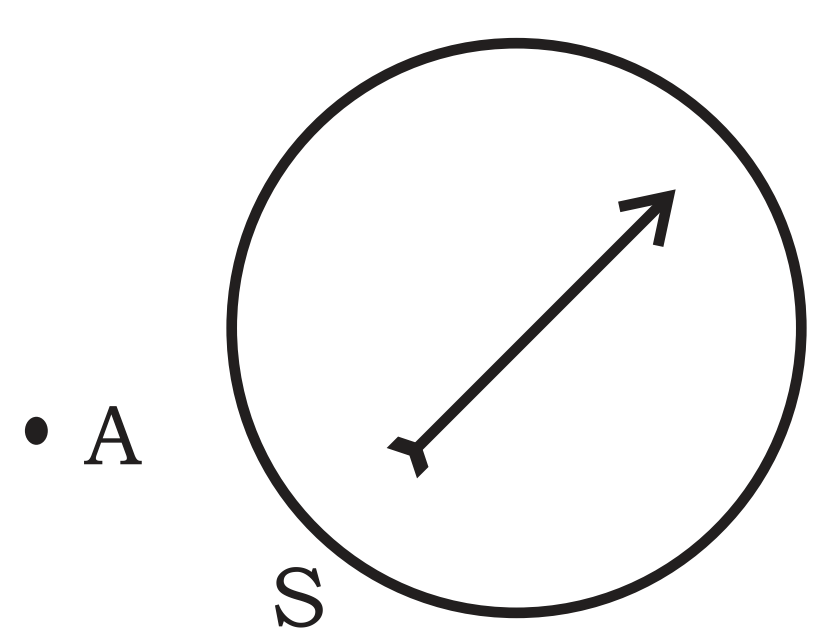
A magnetic compass needle is placed in the plane of paper near point A as shown in Figure. In which plane should a straight current carrying conductor be placed so that it passes through A and there is no change in the deflection of the compass? Under what condition is the deflection maximum and why?
A diverging mirror of radius of curvature 40cm forms an image which is half the height of the object. Find the object and image positions.
What is a good source of energy?
The surface of water in a lake appears green due to a layer of tiny free-floating organisms X on its surface. The lake water also contains organisms like water beetle, fish and tadpole. The sun shines over the lake water and provides energy for the functioning of this lake ecosystem.
  1. What could organisms X be?
  2. Write a food chain comprising of all the four organisms mentioned.
  3. What is the general name of the food chains like the one written above?
  4. Name (i) secondary consumer (ii) producer (iii) tertiary consumer, and (iv) primary consumer, in the above food chain.
  5. If the tertiary consumer gets 0.2 J of energy from the secondary consumer, then how much energy was radiated by the sun to the producer?
A spherical mirror produces an image of magnification −1 on a screen placed at a distance of 40 cm from the mirror:
  1. Write the type of mirror.
  2. What is the nature of the image formed?
  3. How far is the object located from the mirror?
  4. Draw the ray diagram to show the image formation in this case.
A student uses a lens of focal length -50cm. What is the nature of the lens and its power?
A short-sighted person has a near point of 15cm and a far point of 40cm.
  1. Can he see clearly an object at a distance of:
  1. 5cm?
  2. 25cm?
  3. 50cm?
  1. To see clearly an object at infinity, what kind of spectacle lenses does he need?
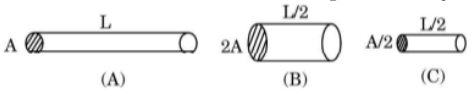
$i.$ In the following figure, three cylindrical conductors $A, B$ and $C$ are shown along with their lengths and areas of cross$-$section. If these three conductors are made of the same material and $R_A, R_B$ and $R_C$ be their respective resistances$,$ then find $(a) \frac{R_A}{R_B},$ and $(b) \frac{R_A}{R_C}$.

Image
$ii.$ If the conductor $A$ is made of copper and the conductor $C$ is made of constantan $($alloy of copper and nickel$),$ then which one of the two will have more electrical resistance and why?