MCQ
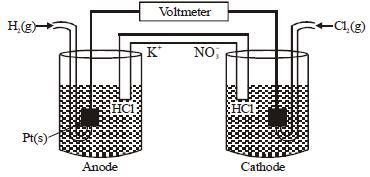
Consider the following Galvanic cell (Image) By what value the cell voltage change when concentration of ions in anodic and cathodic compartments both increased by factor of $10$ at $298\, K.$
- A$+0.0591$
- B$-0.0591$
- ✓$-0.1182$
- D$0$
$H_{2}+C l_{2} \rightarrow 2 H^{+}+2 C l^{-}$
The expression for the cell potential at $298 K$ is $E_{c e l l}=E_{c e l l}^{0}-\frac{0.0591}{2} \log \frac{\left|H^{+}\right|^{2}|C l^-|^{2}}{P_{H_{2}} P_{C l_{2}}}$
When, concentration of ions in anodic and cathodic
compartment both increased by factor of $10,$ the expression for the cell potential becomes,
$E_{\text {cell }}=E_{\text {cell }}^{0}-\frac{0.0591}{2} \log \frac{\left(10 \times\left[H^{+}\right]\right)^{2} \times\left(10 \times[C l^-)^{2}\right.}{P_{H_{2}} P_{C l_{2}}}$
$E_{\text {cell }}=E_{\text {cell }}^{0}-\frac{0.0591}{2} \log \left(10000 \times \frac{\left.\left[H^{+}\right]^{2} \mid C l-\right]^{2}}{P_{H_{2}} P_{C l_{2}}}\right)$
$E_{ cell }=E_{ cell }^{0}-\frac{0.0591}{2} \log \frac{\left.\mid H^{+}\right]^{2}[C l-]^{2}}{P_{H_{2}} P_{C l_{2}}}-\frac{0.0591}{2} \times 4$
$E_{ cell }=E_{ cell }^{0}-\frac{0.0591}{2} \log \frac{\left.\mid H^{+}\right]^{2}\left[C l-\left.\right|^{2}\right.}{P_{H_{2}} P_{C l_{2}}}-0.1182 \ldots$
The increase in the cell potential can be obtained by subtracting above equations. The increase in the cell potential is
$E_{\alpha e l l}^{0}-\frac{0.0591}{2} \log \frac{\left[H^{+}\right]^{2}\left[C l^{-}\right]^{2}}{P_{H_{2}} P_{C l_{2}}}-0.1182-\left[E_{\text {cell }}^{0}-\frac{0.0591}{2} \log \frac{\left[H^{+}\right]^{2}\left[C l^{-}\right]^{2}}{P_{H_{2}} P_{C l_{2}}}\right]$
Hence, the increase in the cell potential is $-0.1182 V$.
Generate a complete, print-ready paper with questions like this in minutes — across 16+ boards, with answer keys.
$Ca_3(PO_4)_2 + SiO_2 + C + O_2 + H_2O \to CaSiO_3 + CO_2 + H_3PO_4$
If $1.0\ kg$ each of calcium phosphate and silica are used with excess of $C$ , $O_2$ and $H_2O$ , what is maximum quantity of phosphoric acid that can be produced. $(Ca = 40, P = 31, Si = 28)$
