Question
Consider the following Linear Programming Problem:
Minimise Z = x + 2y
Subject to $2 x+y \geq 3, x+2 y \geq 6, x, y \geq 0$
Show graphically that the minimum of Z occurs at more than two points
Answer

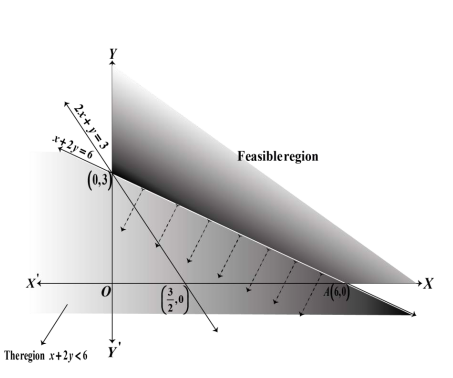
The feasible region determined by the constraints$2 x+y \geq 3, x+2 y \geq 6, x \geq 0, y \geq 0$ is as shown.
Image
The corner points of the unbounded feasible region are A(6, 0) and B(0, 3) The values of Z at these corner points are as follows:

 Corner point Value of the objective function z = x + 2y
 A(6, 0) 6
 B(0, 3) 6

We observe the region x + 2y < 6 have no points in common with the unbounded feasible region. Hence the minimum value of z = 6
It can be seen that the value of Z at points A and B is same. If we take any other point on the line x + 2y = 6 such as (2,2) on line x+ y = 6 then Z = 6
Thus, the minimum value of Z occurs for more than 2 points, and is equal to 6.

Need a full question paper?

Generate a complete, print-ready paper with questions like this in minutes — across 16+ boards, with answer keys.

Start Generating Free

Similar questions

Find the inverse of $5$ under multiplication modulo $11$ on $Z_{11}.$
Prove that:$\tan^{-1}\Bigg|\frac{\sqrt{\text{1 + x}}-{\sqrt{\text{1 - x}}}}{\sqrt{\text{1 + x}}+{\sqrt{\text{1 - x}}}}\Bigg|=\frac{\pi}{4}-\frac{1}{2}\cos^{-1}\text{x},-\frac{1}{\sqrt{2}}\leq\text{x}\leq1$.
If D is the mid-point of side BC of a triangle ABC such that $\overrightarrow{\text{AB}}+\overrightarrow{\text{AC}}=\lambda\overrightarrow{\text{AD}}$, write the value of $\lambda$.
Differentiate the function with respect to x :  $2 \sqrt{\cot \left(x^{2}\right)}$
Let $\vec{\text{a}}=\hat{\text{i}}+\hat{\text{j}}+\hat{\text{k}},\vec{\text{b}}=\hat{\text{i}}$ and $\vec{\text{c}}=\text{c}_1\hat{\text{i}}+\text{c}_2\hat{\text{j}}+\text{c}_3\hat{\text{k}}.$ Then,
If $C_2 = -1$ and $C_3 = 1,$ show that no value of $C_1$ can make $\vec{\text{a}},\vec{\text{b}}$ and $\vec{\text{c}}$ coplanar.
If f(x) is an odd function, then write whether f'(x) is even of odd.
Find the principal values of the following:
$\text{cosec}^{-1}\Big(2\cos\frac{2\pi}{3}\Big)$
If $\text{x}=\text{a}(\theta-\sin\theta)\text{ and},\text{y}=\text{a}(1+\cos\theta),$ find $\frac{\text{dy}}{\text{dx}}\text{ at }\theta=\frac{\pi}{3}$
Prove that: $\cos ^{-1} \frac{12}{13}+\sin ^{-1} \frac{4}{5}=\tan ^{-1} \frac{63}{16}$
In the following, find the value of the constant k so that the given function is continuous at the indicated point:
$\text{f(x)}=\begin{cases}\text{k}(\text{x}^2-2\text{x}),&\text{if}\text{ x}<0\\\cos\text{x},&\text{if}\text{ x}\geq0\end{cases}\text{at x} = 0$