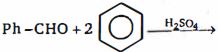
MCQ
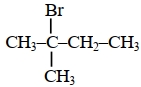
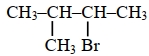
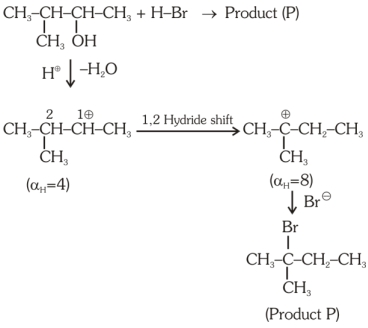
Consider the following reaction and identify the product $(P)$.
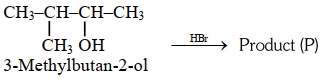
- A
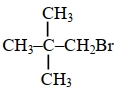
- ✓
- C$CH _3 CH = CH - CH _3$
- D
Generate a complete, print-ready paper with questions like this in minutes — across 16+ boards, with answer keys.
| (a) Pure nitrogen | (i) Chlorine |
| (b) Haber process | (ii) Sulphuric acid |
| (c) Contact process | (iii) Ammonia |
| (d) Deacon's process | (iv) Sodium azide or Barium azide |
Which of the following is the correct option ?
$(a)\quad (b)\quad (c) \quad (d)$
$2 X + Y \xrightarrow{i} P$
the rate of reaction is $\frac{ d [ P ]}{ dt }=k[ X ]$. Two moles of $X$ are mixed with one mole of $Y$ to make $1.0 L$ of solution. At $50 s , 0.5$ mole of $Y$ is left in the reaction mixture. The correct statement(s) about the reaction is(are)
(Use: $\ln 2=0.693$ )
$(A)$ The rate constant, $k$, of the reaction is $13.86 \times 10^{-4} s ^{-1}$.
$(B)$ Half-life of $X$ is $50 s$.
$(C)$ At $50 s ,-\frac{ d [ X ]}{ dt }=13.86 \times 10^{-3} mol L ^{-1} s ^{-1}$.
$(D)$ At $100 s ,-\frac{ d [ Y ]}{ dt }=3.46 \times 10^{-3} mol L ^{-1} s ^{-1}$.