Question
Consider the following structure:
$\ \ \ \ \ \ \ \ \ \ \ \ \ \ \ \ \ \ \ \ \ \ \ \ \ \ \ \ \ {\text{O}}\\\ \ \ \ \ \ \ \ \ \ \ \ \ \ \ \ \ \ \ \ \ \ \ \ \ \ \ \ \ \ \|\\\ ^1\text{C}_3-\ ^2\text{CH}_2-\ ^3\text{C}-\ ^4\text{C}_2-\ ^5\text{C}\equiv\ ^6\text{CH}$
  1. How many σ and π-bonds are present in this compound?
  2. Arrange carbon no. 2, 3, 5 in decreasing order of s-character.
  3. Which atoms have same hybrid state?

Answer

$\ \ \ \ \ \ \ \ {\text{H}\ \ \ \ \text{H}\ \ \ \ \ \text{O}\ \ \ \ \ \text{H}}\\ \ \ \ \ \ \ \ \ \ |\ \ \ \ \ \ |\ \ \ \ \ \ \|\ \ \ \ \ \ \ | \\\text{H}-\text{C}-\text{C}-\text{C}-\text{C}-\text{C}\equiv\text{CH}\\\ \ \ \ \ \ \ \ \ |\ \ \ \ \ \ \ |\ \ \ \ \ \ \ \ \ \ \ \ \ \ | \\\ \ \ \ \ \ \ \ \text{H}\ \ \ \ \ \text{H}\ \ \ \ \ \ \ \ \ \ \ \ \text{H}$
  1. $14\sigma$ and $3\pi$ bonds.
  2. ii. $5>3>2$ is decreasing order of $s$-character of carbon atoms, i.e. $s p>s p^2>s p^3 s p$ has $50 \% s$-character, $s p$ has $33 \%$ s-character, sp has $25 \%$ s-character.
  3. Carbon number 1, 2, 4 are $\mathrm{sp}^3$ hybridised. Carbon number 5 and 6 are sp hybridised.

Need a full question paper?

Generate a complete, print-ready paper with questions like this in minutes — across 16+ boards, with answer keys.

Start Generating Free

Similar questions

A sample of HI(g) is placed in flask at a pressure of 0.2 atm. At equilibrium the
partial pressure of HI(g) is 0.04 atm.
What is $\text{K}_\text{p}$ for the given equilibrium?
$\text{2HI (g)}\rightleftharpoons\text{H}_2\text{ (g) + I}_2\text{ (g)}$
The following data are obtained when dinitrogen and dioxygen react together to form different compounds:
Fill in the blanks in the following conversions:
  1. 1km = ...................... mm = ...................... pm.
  2. 1mg = ...................... kg = ...................... ng.
  3. 1mL = ...................... L = ...................... $\text{dm}^3$.
What is the hybrid state of:
i. B in $\mathrm{BF}_3$.
ii. Al in $\mathrm{AlCl}_3$,
iii. Be in $\mathrm{BeCl}_2$,
iv. C in $\mathrm{CO}_2$ and $\mathrm{C}_2 \mathrm{H}_4$,
v. S in $\mathrm{SO}_2$ and $\mathrm{SO}_3$ ?
Which of the following sets of orbitals are degenerate and why?
i. $1 \mathrm{~s}, 2 \mathrm{~s}$ and 3 s in Mg -atom.
ii. $2 p_x, 2 p_y$ and $2 p_z$ in C -atom.
iii. $3 \mathrm{~s}, 3 \mathrm{p}_{\mathrm{x}}$ and 3 d -orbitals in H -atom.
221.4J is needed to heat 30 g of ethanol from $15^{\circ} C$ to $18^{\circ} C$. Calculate (a) specific heat capacity, and (b) molar heat capacity of ethanol.
If a given sample of water has degree of hardness equal to $46$ ppm. If entire hardness is due to $MgSO_4,$ how much $MgSO_4,$ is present per kg of water?
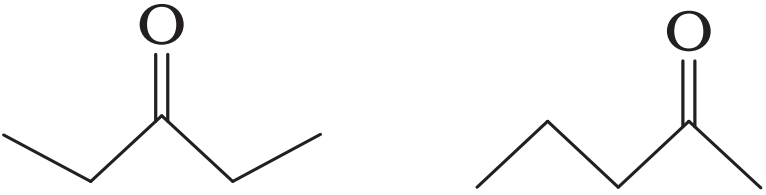
What is the relationship between the members of following pairs of structures? Are they structural or geometrical isomers or resonance contributors?
Calculate the molar solubility of $Ni ( OH )_2$ in 0.10 M NaOH . The ionic product of $Ni ( OH )_2$ is $2.0 \times 10^{-15}$.
What is meant by entropy? Predict the sign of entropy change in each of the following:
  1. $\left.\mathrm{H}_2 \text { (at } 298 \mathrm{~K}, 1 \mathrm{~atm}\right) \rightarrow \mathrm{H}_2 \text { (at } 298 \mathrm{~K}, 10 \text { atm) }$
  2. $\mathrm{H}_2 \mathrm{O}(\text { at } 298 \mathrm{~K}, 1 \mathrm{~atm}) \rightarrow \mathrm{H}_2 \mathrm{O} \text { (at } 330 \mathrm{~K}, 1 \text { atm) }$
  3. $2 \mathrm{NH}_4 \mathrm{NO}_3(\mathrm{~s}) \rightarrow 2 \mathrm{~N}_2(\mathrm{~g})+4 \mathrm{H}_2 \mathrm{O}(\mathrm{g})+\mathrm{O}_2(8)$
  4. Crystallization of copper sulphate from its saturated solution.
  5. $2\text{SO}_2(\text{g})+\text{O}_2(\text{g})\rightleftharpoons2\text{SO}_3(\text{g}).$
Balance the following equations:
  1. $H_3PO3 → H_3PO_4+ PH_3$
  2. $Ca + H_2O → Ca(OH)_2 +H_2$
  3. $Fe_2(SO_4)_3+ NH_3 + H_2O → Fe(OH)_3 + (NH_4)_2SO_4$
  4. $Cl_2+ NaOH → NaCl + NaClO_3 + H_2O$