MCQ
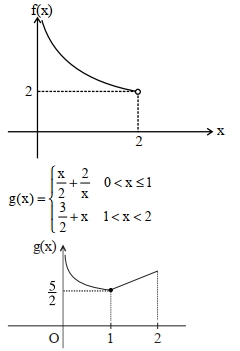
Consider the function $\mathrm{f}:(0,2) \rightarrow \mathrm{R}$ defined by $f(x)=\frac{x}{2}+\frac{2}{x}$ and the function$ g(x)$ defined by $g(x)=\left\{\begin{array}{cc}\min \{f(t)\}, & 0 < t \leq x \text { and } 0 < x \leq 1 \\ \frac{3}{2}+x, & 1 < x< 2\end{array}\right.$. Then
  •  $g$ is continuous but not differentiable at $x=1$
  • B
    $\mathrm{g}$ is not continuous for all $\mathrm{x} \in(0,2)$
  • C
     $g$ is neither continuous nor differentiable at $x=1$
  • D
     $g$ is contimuous and differentiable for all $\mathrm{x} \in(0,2)$
Answer

Correct option: A.
 $g$ is continuous but not differentiable at $x=1$
a
$ f:(0,2) \rightarrow R ; f(x)=\frac{x}{2}+\frac{2}{x} $

$ f^{\prime}(x)=\frac{1}{2}-\frac{2}{x^2}$

$\therefore \mathrm{f}(\mathrm{x})$ is decreasing in domain.

Need a full question paper?

Generate a complete, print-ready paper with questions like this in minutes — across 16+ boards, with answer keys.

Start Generating Free

Similar questions

The value of $\int_1^3 {\sqrt {3 + {x^3}} \,dx} $ lies in the interval
The sum of squares of all possible values of $k$, for which area of the region bounded by the parabolas $2 \mathrm{y}^2=\mathrm{kx}$ and $\mathrm{ky}^2=2(\mathrm{y}-\mathrm{x})$ is maximum, is equal to :
Let $f(1) = -2$ and $f'(x)  \ge 4.2$ for $1 \le x \le 6$. The possible value of $f(6)$ lies in the interval
Let $K$ be the set of all real values of $x$ where the function $f\left( x \right) = \sin \,\left| x \right| - \left| x \right| + 2\,\left( {x - \pi } \right)\,\cos \,\left| x \right|$ is not differentiable. Then the set $K$ is equal to
The objective function Z = 4x + 3y can be maximised subjected to the constraints $ 3\text{x}+4\text{y}\leq24,$ $8\text{x}+6\text{y}\leq48,$ $\text{x}\leq5,\text{y}\leq6;\text{x},\text{y}\leq0.$
If $y = {e^{x + {e^{x + {e^{x + ....\infty }}}}}}$, then ${{dy} \over {dx}} = $
If $|a \times b|\, = 4$ and $|a\,.\,b|\, = 2$, then $|a{|^2}\,\,|b{|^2} = $
If an error of $k\ %$ is made in measuring the radius of a sphere, then percentage error in its volume is:
If $y = tan x \,\,tan 2x\,\, tan 3x$ then $\frac{{dy}}{{dx}}$ has the value equal to :
Let $f : R \rightarrow R$ and $g : R \rightarrow R$ be two non-constant differentiable functions. If $f^{\prime}(x)=\left(e^{(f(x)-g(x))}\right) g^{\prime}(x)$ for all $x \in R$, and $f(1)=g(2)=1$, then which of the following statement (s) is (are) $TRUE$? 

$(A)$ $f (2)<1-\log _{ e } 2$  $(B)$ $f (2)>1-\log _{ e } 2$  $(C)$ $g(1)>1-\log _e 2$  $(D)$ $g(1)<1-\log _e 2$