MCQ
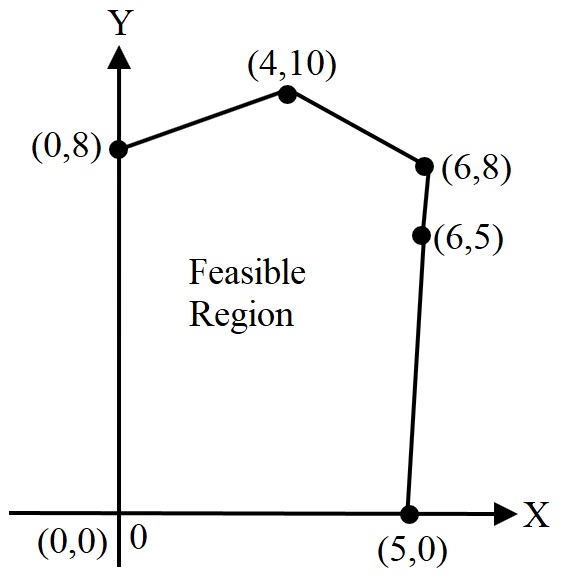
The objective function Z = 4x + 3y can be maximised subjected to the constraints $ 3\text{x}+4\text{y}\leq24,$ $8\text{x}+6\text{y}\leq48,$ $\text{x}\leq5,\text{y}\leq6;\text{x},\text{y}\leq0.$
  • A
    At only one point
  • B
    At two points only.
  • At an infinite number of points.
  • D
    None of these

Answer

Correct option: C.
At an infinite number of points.

Need a full question paper?

Generate a complete, print-ready paper with questions like this in minutes — across 16+ boards, with answer keys.

Start Generating Free

Similar questions

Let $[t]$ denote the largest integer less than or equal to $t$. If

$\int_0^3\left(\left[x^2\right]+\left[\frac{x^2}{2}\right]\right) d x=a+b \sqrt{2}-\sqrt{3}-\sqrt{5}+c \sqrt{6}-\sqrt{7},$ where $a, b, c \in z$, then $a+b+c$ is equal to.........

The feasible, region for an $\text{LPP}$ is shown shaded in the figure. Let $Z = 3x - 4y$ be the objective function. a minimum of $Z$ occurs at:
The solution of the differential equation $\text{x}\frac{\text{dy}}{\text{dx}}=\text{y}+\text{x}\ \tan\frac{\text{y}}{\text{x}}$ is :
If a point $R (4, y, z)$ lies on the line segment joining the points $P (2, -3, 4)$ and $Q (8, 0, 10)$, then the distance of $R$ from the origin is
Let $\alpha $, $\beta$ $\gamma$, $\delta$ are distinct imaginary roots of

$z^5=1$ then value of $\left| {\begin{array}{*{20}{c}}
  {{e^\alpha }}&{{e^{2\alpha }}}&{{e^{3\alpha  + 1}}}&{ - {e^{ - \delta }}} \\ 
  {{e^\beta }}&{{e^{2\beta }}}&{{e^{3\beta  + 1}}}&{ - {e^{ - \delta }}} \\ 
  {{e^\gamma }}&{{e^{2\gamma }}}&{{e^{3\gamma  + 1}}}&{ - {e^{ - \delta }}} 
\end{array}} \right|$

The function $f(x) = ({x^2} - 1)|{x^2} - 3x + 2| + \cos (|x|)$ is not differentiable at
The area bounded by the lines $|x| + |y| = 1$ is:
If $\tan^{-1}\text{x}-\tan^{-1}\text{y}=\tan^{-1}\text{A},$ then $A$ is equal to:
The probability distribution of a random variable $X$ is:
$X$ $ 0$ $1$ $2$ $3$ $4$
$P(X)$ $ 0.1$ $ k$ $ 2k$ $ k$ $0.1$
where $k$ is some unknown constant.
The probability that the random variable $X$ takes the value $2$ is:
If ${\left| {\,\begin{array}{*{20}{c}}4&1\\2&1\end{array}\,} \right|^2} = \left| {\,\begin{array}{*{20}{c}}3&2\\1&x\end{array}\,} \right| - \left| {\,\begin{array}{*{20}{c}}x&3\\{ - 2}&1\end{array}\,} \right|$, then $ x =$