MCQ
Consider the points lying on a straight line joining two fixed opposite charges. Between the charges there is
  • A
    No point where electric field is zero
  • B
    Only one point where potential is zero
  • C
    All the charges are in unstable equilibrium
  • Both $(a)$ and $(b)$

Answer

Correct option: D.
Both $(a)$ and $(b)$
d
(d) When two opposite charge separated by a certain distance then at two points potential is zero. One point exist between the charges and other exists outside them. Also no point, exists between the opposite charges. Where electric field is zero.

Need a full question paper?

Generate a complete, print-ready paper with questions like this in minutes — across 16+ boards, with answer keys.

Start Generating Free

Similar questions

Which of the following in a hydrogen atom is independent of the principal quantum number n?$ ($The symbols have their usual meanings$).$
An ammeter gives full deflection when a current of $2\, amp$. flows through it. The resistance of ammeter is $12 \,\Omega$. If the same ammeter is to be used for measuring a maximum current of $5\, amp$., then the ammeter must be connected with a resistance of
Three capacitors of capacitances $25 \mu \mathrm{F}, 30 \mu \mathrm{F}$ and $45 \mu \mathrm{F}$ are connected in parallel to a supply of $100$

$V$. Energy stored in the above combination is $\mathrm{E}$. When these capacitors are connected in series to the same supply, the stored energy is $\frac{9}{\mathrm{x}} \mathrm{E}$. The value of $x$ is___________.

The length of the optical path of two media in contact of length ${d_1}$ and ${d_2}$ of refractive indices ${\mu _1}$ and ${\mu _2}$ respectively, is
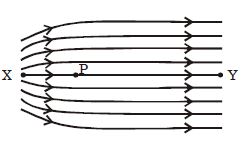
The diagram below shows electric field lines in a region of space. Which of the following diagrams best shows the variation with distance $d$ of the potential $V$ along the line $XY$ as we move from $X$ to $Y$ ?
An ionic atom equivalent to hydrogen atom has wavelength equal to 1/4 of the wavelengths of hydrogen lines. The ion will be
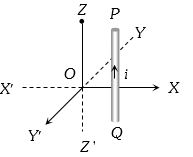
A vertical wire kept in $Z-X$ plane carries a current from $Q$ to $P$ (see figure). The magnetic field due to current will have the direction at the origin $O$ along
Identify the electromagnetic wave which is also known as heatwaves.
A wire of resitance $R$ and length $L$ is cut into $5$ equal part. if these parts are joined parts are joined paralley, than result resistance will be:
Given below are two statements:

Statement $I:$ Out of microwaves, infrared rays and ultraviolet rays, ultraviolet rays are the most effective for the emission of electrons from a metallic surface.

Statement $II:$ Above the threshold frequency, the maximum kinetic energy of photoelectrons is inversely proportional to the frequency of the incident light.

In the light of above statements, choose the correct answer from the options given below: