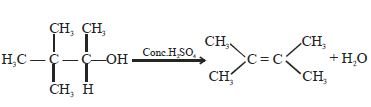
- ✓$\mathrm{MeOSO}_2 \mathrm{O}^{\ominus}$
- B$\mathrm{MeO}^{\ominus}$
- C$\mathrm{Me}^{\ominus}$
- D$\mathrm{MeOSO}_2^{\ominus}$
Generate a complete, print-ready paper with questions like this in minutes — across 16+ boards, with answer keys.
$\begin{array}{*{20}{c}}
{C{H_3}}\\
{|\,\,\,\,\,}\\
{{C_6}{H_5}C{H_2} - C - C{H_2} - C{H_3}}\\
{|\,\,\,\,\,}\\
{Br\,\,\,}
\end{array}$ $\xrightarrow[{{C_2}{H_5}OH}]{{{C_2}{H_5}ONa}}$
$I.$ They activate many enzymes
$II.$ They participate in the oxidation of glucose to produce $ATP$
$III.$ Along with sodium ions, they are responsible for the transmission of nerve signals
The following inferences are made
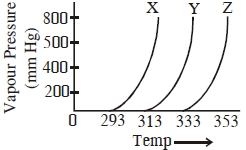
$(A)$ $\mathrm{X}$ has higher intermolecular interactions compared to $Y$.
$(B)$ $\mathrm{X}$ has lower intermolecular interactions compared to $Y$.
$(C)$ $\mathrm{Z}$ has lower intermolecular interactions compared to $Y.$
The correct inference(s) is/are
${C_2}{H_4}O\left( g \right) \to C{H_4}\left( g \right) + CO\left( g \right)$
if the initial pressure of $C_2H_4O(g)$ is $80\ mm$ and the total pressure at the end of $20\ minutes$ is $120\ mm$ ........... $mm$