Question
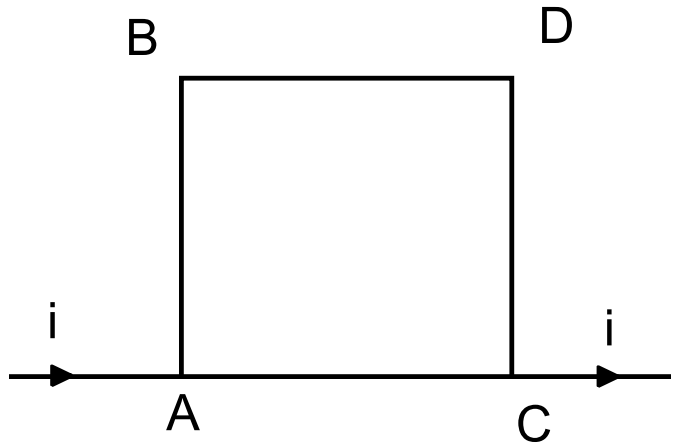
Consider the situation described in the previous problem. Suppose the current i enters the loop at the point A and leaves it at the point B. Find the magnetic field at the centre of the loop.
Answer


$\overrightarrow{\text{B}}$ due t BC
$\overrightarrow{\text{B}}$ due to AD at Pt ‘P’ are equal ore Opposite
Hence net $\overrightarrow{\text{B}}=0$
Similarly, due to AB & CD at P = 0 
$\therefore$ The net B  at the Centre of the square loop = zero

Need a full question paper?

Generate a complete, print-ready paper with questions like this in minutes — across 16+ boards, with answer keys.

Start Generating Free

Similar questions

Answer the following questions, which help you understand the difference between Thomson’s model and Rutherford’s model better.
Is the average angle of deflection of α-particles by a thin gold foil predicted by Thomson’s model much less, about the same, or much greater than that predicted by Rutherford’s model?
What is the importance of Gaussian surface?
In a rectangular wire, due to a source of emf, a constant current is flowing from left to right. When the switch of the source is off, then what will be the direction of induced current in the wire?
Kamla peddles a stationary bicycle. The pedals of the bicycle are attached to a 100 turn coil of area $0.10 m ^2$. The coil rotates at half a revolution per second and it is placed in a uniform magnetic field of $0.01 T$ perpendicular to the axis of rotation of the coil. What is the maximum voltage generated in the coil?
How does the fringe width of interference fringes change, when the whole apparatus of Young’s experiment is kept in a liquid of refractive index 1.3?
The threshold wavelength of a metal is $\lambda_0.$ Light of wavelength slightly less $\tan \lambda_0.$ is incident on an insulated plate made of this metal. It is found that photoelectrons are emitted for some time and after that the emission stops. Explain.
Light passes through a closed cylindrical tube containing a gas. If the gas is gradually pumped out, the speed of light inside the tube will:
  1. Increase.
  2. Decrease.
  3. Remain constant.
  4. First increase and then decrease.
Can the peak voltage across the inductor be greater than the peak voltage of the source in an LCR circuit?
With what purpose was famous Davisson-Germer experiment with electrons performed?
If a thin lens is dipped in water, does its focal length change?