Question 11 Mark
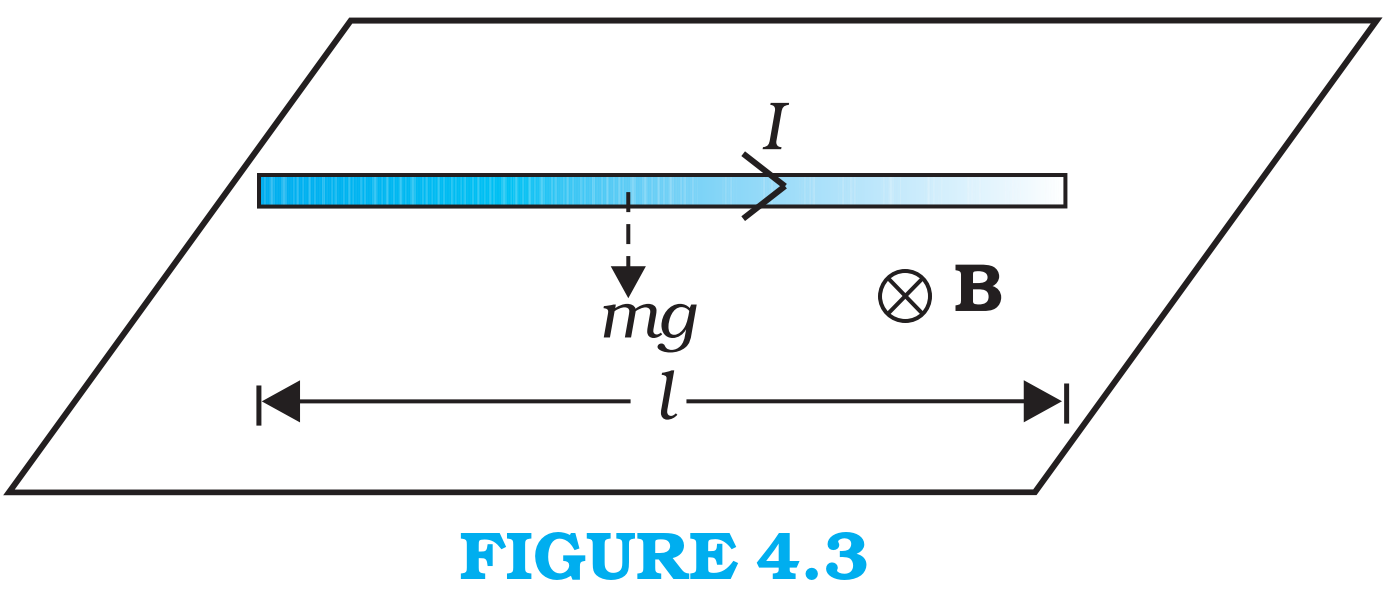
A straight horizontal conducting rod of length $0.45 m$ and mass $60 g$ is suspended by two vertical wires at its ends. A current of $5.0 A$ is set up in the rod through the wires.
- What magnetic field should be set up normal to the conductor in order that the tension in the wires is zero?
- What will be the total tension in the wires if the direction of current is reversed keeping the magnetic field same as before? $($Ignore the mass of the wires.$) g = 9.8\ m s^{–2}.$
Answer
View full question & answer→Length of the rod, $l = 0.45 m$ Mass suspended by the wires, $m = 60 g = 60 \times 10^{-3} \ kg$
Acceleration due to gravity, $g = 9.8\ m/s^2$ current in the rod flowing through the wire, $I = 5A$
$\therefore\text{B}=\frac{\text{mg}}{\text{Il}}$
$=\frac{60\times10^{-3}\times9.8}{5\times0.45}=0.26\ \text{T}$
$=1.176\ \text{N}$
Acceleration due to gravity, $g = 9.8\ m/s^2$ current in the rod flowing through the wire, $I = 5A$
- Magnetic field $(B)$ is equal and opposite to the weight of the wire i.e.,
$\therefore\text{B}=\frac{\text{mg}}{\text{Il}}$
$=\frac{60\times10^{-3}\times9.8}{5\times0.45}=0.26\ \text{T}$
- A horizontal magnetic field of $0.26 T$ normal to the length of the conductor should be set,
$=1.176\ \text{N}$
 $\overrightarrow{\text{B}}$ due t BC