Question
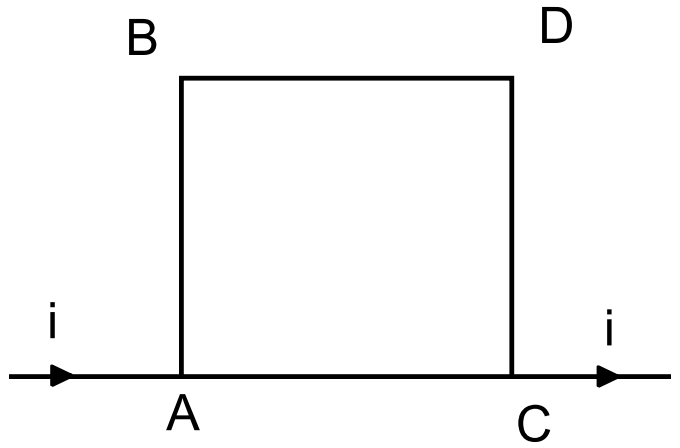
Consider the situation described in the previous problem. Suppose the current i enters the loop at the point A and leaves it at the point B. Find the magnetic field at the centre of the loop.
Answer


$\overrightarrow{\text{B}}$ due t BC

$\overrightarrow{\text{B}}$ due to AD at Pt ‘P’ are equal ore Opposite

Hence net $\overrightarrow{\text{B}}=0$

Similarly, due to AB & CD at P = 0 

$\therefore$ The net B  at the Centre of the square loop = zero

Need a full question paper?

Generate a complete, print-ready paper with questions like this in minutes — across 16+ boards, with answer keys.

Start Generating Free

Similar questions

For transistor action, which of the following statements are correct:
  1. Base, emitter and collector regions should have similar size and doping concentrations.
  2. The base region must be very thin and lightly doped.
  3. The emitter junction is forward biased and collector junction is reverse biased.
  4. Both the emitter junction as well as the collector junction are forward biased.
The polarising angle of a medium is 60°. What is the refractive index of the medium?
In what way is the behaviour of a diamagnetic material different from that of a  paramagnetic, when kept in an external magnetic field.
A capillary tube of radius 0.50mm is dipped vertically in a pot of water. Find the difference between the pressure of the water in the tube 5.0cm below the surface and the atmospheric pressure. Surface tension of water = 0.075N/m.
What percentage of a given mass of a radioactive substance will be left undecayed after four half periods?
Will a current loop placed in a magnetic field always experience a zero force?
What is the form of stored energy in any coil?
An AC source is connected to a capacitor. Will the rms current increase, decrease or remain constant if a dielectric slab is inserted into the capacitor?
Write following radiations in descending order of wavelengths:X-rays, Radio waves, Ultraviolet waves, Gamma rays.
On a winter day the temperature of the tap water is 20°C whereas the room temperature is 5°C. Water is stored in a tank of capacity 0.5m3 for household use. If it were possible to use the heat liberated by the water to lift a 10kg mass vertically, how high can it be lifted as the water comes to the room temperature? Take g = 10m s-2.