Question
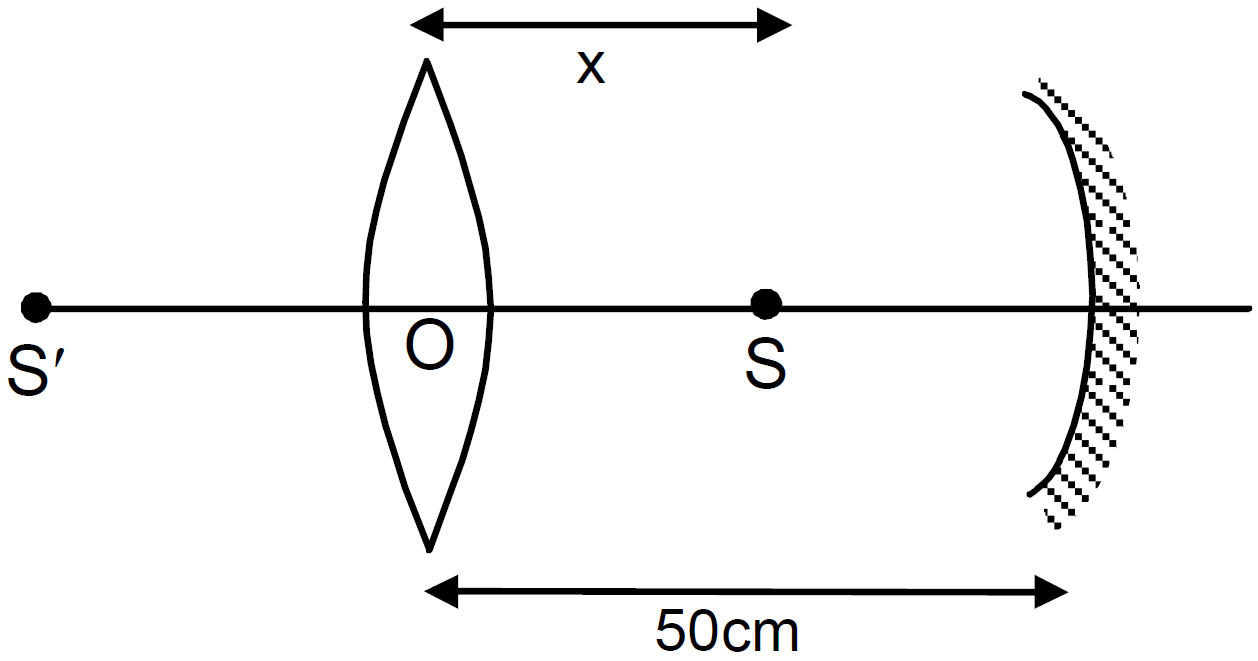
Consider the situation described in the previous problem. Where should a point source be placed on the principal axis so that the two images form at the same place?
Answer

Let the source be placed at a distance ‘x’ from the lens as shown, so that images formed by both coincide. For the lens, $\frac{1}{\text{v}_\ell}-\frac{1}{-\text{x}}=\frac{1}{15}\Rightarrow\text{v}_\ell=\frac{15\text{x}}{\text{x}-15} \ ...(1)$ For the mirror, $\text{u}=-(50-\text{x}), \ \text{f}=-10\text{cm}$ So, $\frac{1}{\text{v}_\text{m}}+\frac{1}{-(50-\text{x})}=-\frac{1}{10}$$\Rightarrow\frac{1}{\text{v}_\text{m}}=\frac{1}{-(50-\text{x})}-\frac{1}{10}$
$\text{v}_\text{m}=\frac{10(50-\text{x})}{\text{x}-40} \ ...(2)$
Since the lens and mirror are 50cm apart,$\text{v}_\ell-\text{v}_{\text{m}}=50\Rightarrow\frac{15\text{x}}{\text{x}-15}-\frac{10(50-\text{x})}{(\text{x}-40)}=50$
$\Rightarrow\text{x}=30\text{cm}.$
So, the source should be placed 30cm from the lens.

Need a full question paper?

Generate a complete, print-ready paper with questions like this in minutes — across 16+ boards, with answer keys.
Start Generating Free

Similar questions

Read the passage given below and answer the following questions from (i) to (v). The velocity of an object, in general, changes during its course of motion. Initially, at the time of Galileo, it was thought that, this change m could be described by the rate of change of velocity with distance. But, through his studies of motion of freely falling objects and motion of objects on an inclined plane, Galileo concluded that, the rate of change of velocity with time is a constant of motion for all objects in free fall. This led to the concept of acceleration as the rate of change of velocity with time. The motion in which the acceleration remains constant is known as to be uniformly accelerated motion. There are certain equations which are used to relate the displacement (x), time taken (t), initial velocity (u), final velocity (v) and acceleration (a) a for such a motion and are known as kinematics equations for uniformly accelerated motion.
  1. The displacement of a body in 8s starting from rest with an acceleration of $20\ cms^{-2}$ is:
  1. $64m$
  2. $640m$
  3. $64cm$
  4. $0.064m$
  1. A particle starts with a velocity of $2ms^{-1}$ and moves in a straight line with a retardation of $0.1ms^{-2}$. The first time at which the particle is $15\ m$ from the starting point is:
  1. $10s$
  2. $20s$
  3. $30s$
  4. $40s$
  1. If a body starts from rest and travels $120cm$ in 6th second, then what is its acceleration?
  1. $0.20 ms^{-2}$
  2. $0.027ms^{-2}$
  3. $0.218ms^{-2}$
  4. $003. ms^{-2}$
  1. An object starts from rest and moves with uniform acceleration a. The final velocity of the particle in terms of the distance x covered by it is given as:
  1. $\sqrt{2\text{ax}}$
  2. $2\text{ax}$
  3. $\sqrt{\frac{\text{ax}}{2}}$
  4. $\sqrt{\text{ax}}$
  1. A body travelling with uniform acceleration crosses two points A and B with velocities $20ms^{-1}$ and $30ms^{-1}$​​​​​​​, respectively. The speed of the body at mid-point of A and B is:
  1. $25\text{ms}^{-1}$
  2. $25.5\text{ms}^{-1}$
  3. $24\text{ms}^{-1}$
  4. $10\sqrt{6}\text{ms}^{-1}$
Read the passage given below and answer the following questions from (i) to (v). Vectors
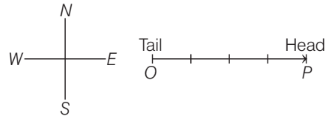
Vectors are the physical quantities which have both magnitudes and directions and obey the triangle/parallelogram laws of addition and subtraction. It is specified by giving its magnitude by a number and its direction. e.g. Displacement, acceleration, velocity, momentum, force, etc. A vector is represented by a bold face type and also by an arrow placed over a letter, i.e. F, a, b or $\overrightarrow{\text{F}},\overrightarrow{\text{a}},\overrightarrow{\text{b}}.$ The length of the line gives the magnitude and the arrowhead gives the direction. The point P is called head or terminal point and pointO is called tail or initial point of the vector OP.
  1. Amongst the following quantities, which is not a vector quantity?
  1. Force
  2. Acceleration
  3. Temperature
  4. Velocity
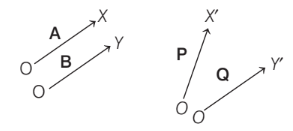
  1. Set of vectors A and B, P and Q are as shown below

Length of A and B is equal, similarly length of P and Q is equal. Then, the vectors which are equal, are:
  1. A and P
  2. P and Q
  3. A and B
  4. B and Q
  1. $\mid\lambda\text{A}\mid=\lambda\mid\text{A}\mid,$ if:
  1. $\lambda>0$
  2. $\lambda,<0$
  3. $\lambda,=0$
  4. $\lambda,\neq0$
  1. Among the following properties regarding null vector which is incorrect?
  1. A + 0 = A
  2. $\lambda0=\lambda$
  3. 0A = 0
  4. A - A = 0
  1. The x and y components of a position vector P have numerical values 5 and 6, respectively. Direction and magnitude of vector P are:
  1. $\tan^{-1}\big(\frac{6}{5}\big)\text{and}\sqrt{61}$
  2. $\tan^{-1}\big(\frac{5}{6}\big)\text{and}\sqrt{61}$
  3. 60° and 8
  4. 30° and 9
Read the passage given below and answer the following questions from 1 to 5. Earth’s Satellite: Earth satellites are objects which revolve around the earth. Their motion is very similar to the motion of planets around the Sun. In particular, their orbits around the earth are circular or elliptic. Moon is the only natural satellite of the earth with a near circular orbit with a time period of approximately $27.3$ days which is also roughly equal to the rotational period of the moon about its own axis. Also, the speed that a satellite needs to be travelling to break free of a planet or moon’s gravity well and leave it without further propulsion is known as escape velocity. For example, a spacecraft leaving the surface of earth needs to be going 7 miles per second or nearly 25000 miles per hour to leave without falling back to the surface or falling into orbit.
  1. Gas escapes from the surface of a planet because it acquires an escape velocity. The escape velocity will depend on which of the following factors?
  1. Mass of the planet
  2. Mass of the particle escaping
  3. Temperature of the planet
  4. None of the above
  1. The escape velocity of a satellite from the earth is ve If the radius of earth contracts to $(\frac{1}{4})$ th of its value, keeping the mass of the earth constant, escape velocity will be:
  1. doubled
  2. halved
  3. tripled
  4. unaltered
  1. The ratio of escape velocity at earth $(v_e)$ to the escape velocity at a planet $(v_p)$, whose radius and mean density are twice as that of earth is:
  1. $1:2\sqrt{2}$
  2. 1 : 4
  3. $1:\sqrt{2}$
  4. 1 : 2
  1. A satellite S is moving in an elliptical orbit around the earth. The mass of the satellite is very small as compared to the mass of the earth, then:
  1. the angular momentum of S about the centre of the earth changes in direction, but its magnitude remains constant
  2. the total mechanical energy of S varies periodically with time
  3. the linear momentum of S remains constant in magnitude
  4. the acceleration of S is always directed towards the centre of the earth
  1. The orbital velocity of an artificial satellite in a circular orbit just above the earth’s surface is vo The orbital velocity of a satellite orbiting at an altitude of half of the radius, is:
  1. $\frac{3}{2}\text{v}_\circ$
  2. $\frac{2}{3}\text{v}_\circ$
  3. $\sqrt{\frac{3}{2}\text{v}_\circ}$
  4. $\sqrt\frac{2}{3}\text{v}_\circ$
Find the change in the volume of 1.0 litre kerosene when it is subjected to an extra pressure of $2.0 \times 10^5 \mathrm{~N} / \mathrm{m}^2$ from the following data. Density of kerosene $=800 \mathrm{~kg} / \mathrm{m}^3$ and speed of sound in kerosene $=1330 \mathrm{~m} / \mathrm{s}$.
Consider a gravity-free hall in which an experimenter of mass $50kg$ is resting on a $5kg$ pillow, 8ft above the floor of the hall. He pushes the pillow down so that it starts falling at a speed of $8ft/s$. The pillow makes a perfectly elastic collision with the floor, rebounds and reaches the experimenter's head. Find the time elapsed in the process.
A person is standing on a weighing machine placed on the floor of an elevator. The elevator starts going up with some acceleration, moves with uniform velocity for a while and finally decelerates to stop. The maximum and the minimum weights recorded are $72kg$ and $60kg$. Assuming that the magnitudes of the acceleration and the deceleration are the same, find:
  1. The true weight of the person.
  2. The magnitude of the acceleration. Take $g = 9.9m/s^2$.
By mistake, an eye surgeon puts a concave lens in place of the lens in the eye after a cataract operation. Will the patient be able to see clearly any object placed at any distance?
Read the passage given below and answer the following questions from (i) to (v). Kelvin-Planck statement: No process is possible whose sole result is the absorption of heat from a reservoir and the complete conversion of the heat into work. Clausius statement: No process is possible whose sole result is the transfer of heat from a colder object to a hotter object. It can be proved that the two statements above are completely equivalent. A thermodynamic process is reversible if the process can be turned back such that both the system and the surroundings return to their original states, with no other change anywhere else in the universe. a reversible process is an idealized motion. A process is reversible only if it is quasi-static (system in equilibrium with the surroundings at every stage) and there are no dissipative effects. For example, a quasi-static isothermal expansion of an ideal gas in a cylinder fitted with a frictionless movable piston is a reversible process. The free expansion of a gas is irreversible. The combustion reaction of a mixture of petrol and air ignited by a spark cannot be reversed. Cooking gas leaking from a gas cylinder in the kitchen diffuses to the entire room. The diffusion process will not spontaneously reverse and bring the gas back to the cylinder. The stirring of a liquid in thermal contact with a reservoir will convert the work done into heat, increasing the internal energy of the reservoir. The process cannot be reversed exactly; otherwise it would amount to conversion of heat entirely into work, violating the Second Law of Thermodynamics. Irreversibility is a rule rather an exception in nature.
  1. The diffusion process is:
  1. Reversible process
  2. Irreversible process
  1. A quasi-static isothermal expansion of an ideal gas in a cylinder fitted with a frictionless movable piston is
  1. Reversible process
  2. Irreversible process
  1. State Kelvin Planck statement.
  2. State Clausius statement.
  3. Define reversible processes and irreversible processes of thermodynamics.
A person goes to bed at sharp 10:00 pm every day. Is it an example of periodic motion? If yes, what is the time period? If no, why?
$\int\frac{\text{dx}}{\sqrt{2\text{ax}-\text{x}^2}}=\text{a}^{\text{n}}\sin^{-1}\Big[\frac{\text{x}}{\text{a}}-1\Big].$ The value of n is: