Question
Read the passage given below and answer the following questions from (i) to (v). Vectors
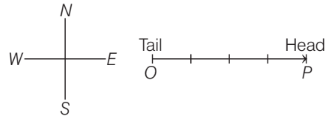
Vectors are the physical quantities which have both magnitudes and directions and obey the triangle/parallelogram laws of addition and subtraction. It is specified by giving its magnitude by a number and its direction. e.g. Displacement, acceleration, velocity, momentum, force, etc. A vector is represented by a bold face type and also by an arrow placed over a letter, i.e. F, a, b or $\overrightarrow{\text{F}},\overrightarrow{\text{a}},\overrightarrow{\text{b}}.$ The length of the line gives the magnitude and the arrowhead gives the direction. The point P is called head or terminal point and pointO is called tail or initial point of the vector OP.
  1. Amongst the following quantities, which is not a vector quantity?
  1. Force
  2. Acceleration
  3. Temperature
  4. Velocity
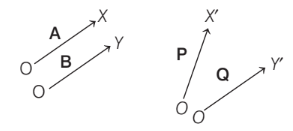
  1. Set of vectors A and B, P and Q are as shown below

Length of A and B is equal, similarly length of P and Q is equal. Then, the vectors which are equal, are:
  1. A and P
  2. P and Q
  3. A and B
  4. B and Q
  1. $\mid\lambda\text{A}\mid=\lambda\mid\text{A}\mid,$ if:
  1. $\lambda>0$
  2. $\lambda,<0$
  3. $\lambda,=0$
  4. $\lambda,\neq0$
  1. Among the following properties regarding null vector which is incorrect?
  1. A + 0 = A
  2. $\lambda0=\lambda$
  3. 0A = 0
  4. A - A = 0
  1. The x and y components of a position vector P have numerical values 5 and 6, respectively. Direction and magnitude of vector P are:
  1. $\tan^{-1}\big(\frac{6}{5}\big)\text{and}\sqrt{61}$
  2. $\tan^{-1}\big(\frac{5}{6}\big)\text{and}\sqrt{61}$
  3. 60° and 8
  4. 30° and 9

Answer

  1. (c) Temperature
Explanation:
Temperature is not a vector quantity because it has magnitude only.
However, force, acceleration and velocity have both a magnitude and a direction.
So, these are vectors in nature.
  1. (c) A and B
Explanation:
Two vectors are said to be equal, if and only if they have the same magnitude and direction.
Among the given vectors A and B are equal vectors as they have same magnitude (length) and direction.
However, P and Q are not equal even though they are of same magnitude because their directions are different.
  1. (c) $\lambda>0$
Explanation:
$\mid\lambda\text{A}\mid=\lambda\mid\text{A}\mid,$ if $\lambda>0$ as multiplication of vector A with a positive number $\lambda$ gives a
vector whose magnitude is changed by the factor $\lambda$ but the direction is same as that of A.
  1. (b) $\lambda0=\lambda$
Explanation:
Null vector 0 is a vector, whose magnitude iszero and its direction cannot be specified.
So, it means, $\mid0\mid=0.$
Thus, $\lambda0=0.$
Hence, property given in option (b) is incorrect.
  1. (c) 60° and 8
Explanation:
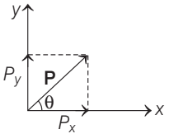
Let P be as shown in the figure, then according to the given information

Px = 5, Py = 6
$\therefore\mid\text{P}\mid=\sqrt{\text{P}_\text{x}^2+\text{P}_\text{y}^2}$
$=\sqrt{25+336}$
$\Rightarrow\mid\text{P}\mid=\sqrt{61}$ and $\tan\theta=\frac{\text{P}_\text{y}}{\text{P}_\text{x}}=\frac{6}{5}$
$\Rightarrow\theta=\tan^{-1}\big(\frac{6}{5}\big)$

Need a full question paper?

Generate a complete, print-ready paper with questions like this in minutes — across 16+ boards, with answer keys.

Start Generating Free

Similar questions

Why don't we have interference when two candles are placed close to each other and the intensity is seen at a distant screen? What happens if the candles are replaced by laser sources?
Read the passage given below and answer the following questions from $1$ to $5.$ The rules for determining the uncertainty or error in the measured quantity in arithmetic operations can be understood from the following examples. a.) If the length and breadth of a thin rectangular sheet are measured, using a metre scale as $16.2\ cm$ and, $10.1\ cm$ respectively, there are three significant figures in each measurement. It means that the length L may be written as L = 16.2 ± 0.1cm = 16.2cm ± 0.6%. Similarly, the breadth b may be written as $b = 10.1 ± 0.1\ cm = 10.1\ cm ± 1\%$ Then, the error of the product of two (or more) experimental values, using the combination of errors rule, will be $L*b = 163.62\ cm^2 + 1.6% = 163.62 + 2.6\ cm^2 $ This leads us to quote the final result as $L*b = 164 + 3\ cm^2.$ Here $3\ cm^2$ is the uncertainty or error in the estimation of area of rectangular sheet. b) If a set of experimental data is specified to $n$ significant figures a result obtained by combining the data will also be valid to n significant figures.However, if data are subtracted, the number of significant figures can be reduced.For example, $12.9g – 7.06g$, both specified to three significant figures, cannot properly be evaluated as 5.84g but only as $5.8g$, as uncertainties in subtraction or addition combine in a different fashion (smallest number of decimal places rather than the number of significant figures in any of the number added or subtracted). c.) The relative error of a value of number specified to significant figures depends not only on n but also on the number itself. For example, the accuracy in measurement of mass $1.02g$ is $± 0.01g$ whereas another measurement $9.89g$ is also accurate to $± 0.01g$. The relative error in $1.02g$ is: $= (± 0.01/1.02) \times 100\% = ± 1\%$ Similarly, the relative error in $9.89\ g$ is $= (± 0.01/9.89) \times 100\% = ± 0.1%$ Finally, remember that intermediate results in a multi-step computation should be calculated to one more significant figure in every measurement than the number of digits in the least precise measurement. $d.$) The nature of a physical quantity is described by its dimensions. All the physical quantities represented by derived units can be expressed in terms of some combination of seven fundamental or base quantities. We shall call these base quantities as the seven dimensions of the physical world, which are denoted with square brackets $[  ]$. Thus, length has the dimension $[L],$ mass $[M],$ time $[T],$ electric current $[A]$, thermodynamic temperature $[K]$, luminous intensity $[cd],$ and amount of substance $[mol]$. The dimensions of a physical quantity are the powers (or exponents) to which the base quantities are raised to represent that quantity. Note that using the square brackets $[ ]$ round a quantity means that we are dealing with ‘the dimensions of’ the quantity. In mechanics, all the physical quantities can be written in terms of the dimensions $[L], [M]$ and $[T]$. For example, the volume occupied by an object is expressed as the product of length, breadth and height, or three lengths. Hence the dimensions of volume are $[L] \times [L] \times [L] = [L^3].$
  1. Dimensions of area is:
  1. $[L^2]$
  2. $[L^3]$
  3. $[M^2]$
  4. None of these
  1. dimensions of volume are:
  1. $[L^2]$
  2. $[L]$
  3. $[L^3]$
  4. None of these
  1. What is uncertainty in physics$?$ Explain with one example:
  1. define dimensions of a physical quantity:
  1. Give list for $7$ base quantities with dimensions:
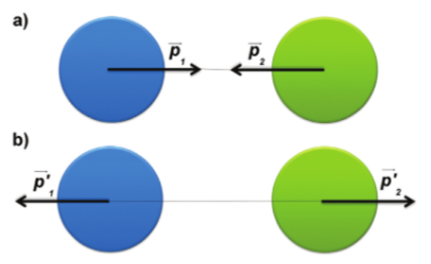
The kinetic energy of an object is the energy associated with the object which is under motion. It is defined as "the energy required by a body to accelerate from rest to stated velocity." It is a vector quantity and the momentum of an object is the virtue of its mass. It is defined as the product of mass and velocity. It is a vector quantity. The relation between them is given by $E =\frac{P^2}{2 m}$. In case of the elastic collision both of these quantities remain constant.
Image
1.Two masses of 1 gm and 4 gm are moving with equal linear momentum. The ratio of their kinetic energy is:
(a) $1: 2$ (b) $4: 1$ (c) $1: 1$ (d) $4: 2$
2. If the linear momentum is increased by $50 \%$, then K .E will be increased by:
(a) $50 \%$ (b) $200 \%$ (c) $125 \%$ (d) $100 \%$
3.A heavy object and a light object have the same momentum. Which has the greater speed?
(a) both heavy and light object
(b) heavy object
(c) Moderate object
(d) light object
OR
Kinetic energy with any reference must be $\qquad$
(a) Change (b) negative (c) zero (d) positive
4.When a body moves with a constant speed along a circle then
(a) no acceleration is produced
(b) no work is done on it
(c) no displacement on it
(d) no force acts on it
When the diode shows saturated current, dynamic place resistance is:
Why do marine animals live deep inside a lake when the surface of the lake freezes?
A small coin is placed on a record rotating at $33\frac{1}{3}$ rev/ minute. The coin does not slip on the record. Where does it get the required centripetal force from?
A bar magnet makes 40 oscillations per minute in an oscillation magnetometer. An identical magnet is demagnetized completely and is placed over the magnet in the magnetometer. Find the time taken for 40 oscillations by this combination. Neglect any induced magnetism.
A magnetic needle is free to rotate in a vertical plane which makes an angle of 60° with the magnetic meridian. If the needle stays in a direction making an angle of $\tan^{-1}\Big(\frac{2}{\sqrt{3}}\Big)$ with the horizontal, what would be the dip at that place?
Read the passage given below and answer the following questions from 1 to 5. Acceleration due to gravity The acceleration for any object moving under the sole influence of gravity is known as acceleration due to gravity. So, for an object of mass m, the acceleration experienced by it is usually denoted by the symbol g which is related to F by Newton’s second law by relation F = mg Thus, $\text{g}=\frac{\text{F}}{\text{m}}=\frac{{\text{Gm}_\text{e}}}{\text{R}^2_\text{e}}$ Acceleration g is readily measurable as Re is a known quantity. The measurement ofG by Cavendish’s experiment (or otherwise), combined with knowledge of g and Re enables one to estimate $M_e$ from the above equation. This is the reason why there is a popular statement regarding Cavendish “Cavendish weighed the earth”. The value of g decrease as we go upwards from the earth’s surface or downwards, but it is maximum at its surface.
  1. If g is the acceleration due to gravity at the surface of the earth, the force acting on the particle of mass m placed at the surface is:
  1. mg
  2. $\frac{\text{GmM}\theta}{\text{R}^2_\text{e}}$
  3. Data insufficient
  4. Both (a) and (b)
  1. The weight of a body at the centre of earth is:
  1. same as on the surface of earth
  2. same as on the poles
  3. same as on the equator
  4. None of the above
  1. If the mass of the sun is ten times smaller and gravitational constant G is ten times larger in magnitude, then for earth:
  1. walking on ground would become more easy
  2. acceleration due to gravity on the earth will not change
  3. raindrops will fall much slower
  4. airplanes will have to travel much faster
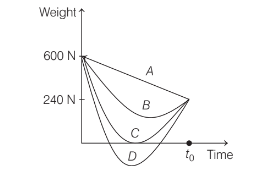
  1. Suppose, the acceleration due to gravity at the earth’s surface is $10 ms^{-2}$ and at the surface of mars, it is $4.0 ms ^{-2}$ 60kg passenger goes from the earth to the mars in a spaceship moving with a constant velocity. Neglect all other objects in the sky. Which curve best represents the weight (net gravitational force) of the passenger as a function of time?
  1. A
  2. B
  3. C
  4. D
  1. If the mass of the earth is doubled and its radius halved, then new acceleration due to the gravity $\acute{\text{g}}$ is:
  1. $\acute{\text{g}}=4\text{g}$
  2. $\acute{\text{g}}=8\text{g}$
  3. $​​\acute{g}=\text{g}$
  4. $\acute{\text{g}}=16\text{g}$
What can be said about the centre of mass of a uniform hemisphere without making any calculation? Will its distance from the centre be more than $\frac{\text{r}}{2}$ or less than $\frac{\text{r}}{2}?$