Question
Consider the situation described in the previous problem. Where should a point source be placed on the principal axis so that the two images form at the same place?
Answer

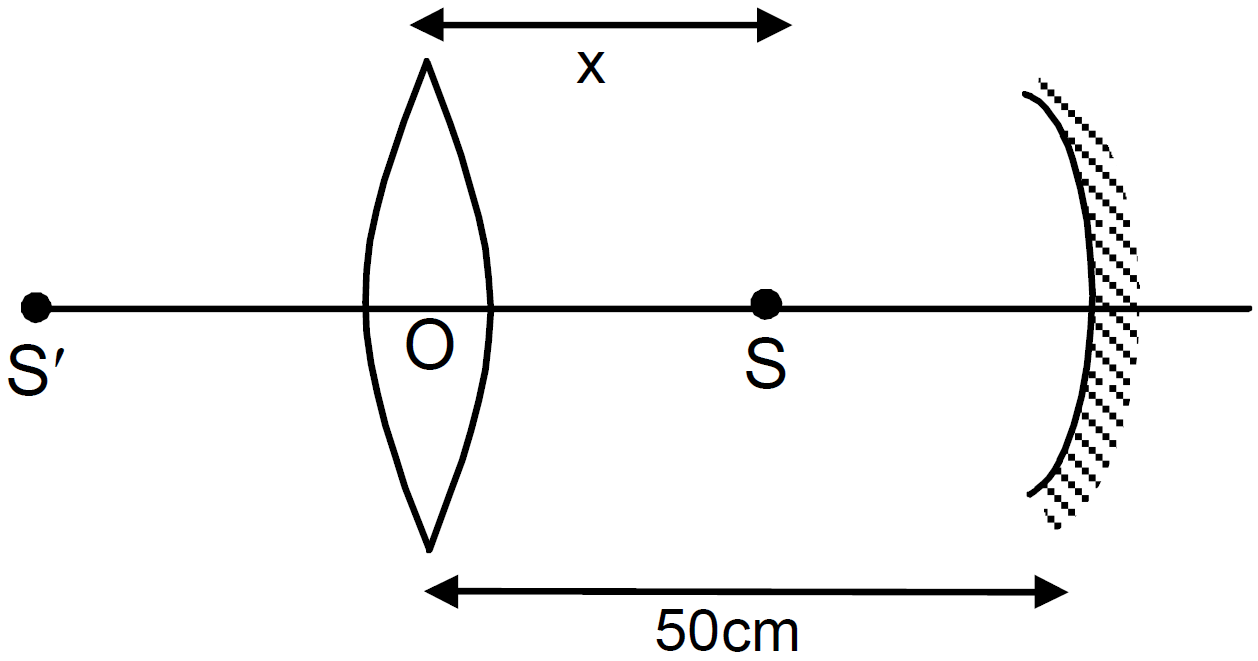
Let the source be placed at a distance ‘x’ from the lens as shown, so that images formed by both coincide.

For the lens, $\frac{1}{\text{v}_\ell}-\frac{1}{-\text{x}}=\frac{1}{15}\Rightarrow\text{v}_\ell=\frac{15\text{x}}{\text{x}-15} \ ...(1)$

For the mirror, $\text{u}=-(50-\text{x}), \ \text{f}=-10\text{cm}$

So, $\frac{1}{\text{v}_\text{m}}+\frac{1}{-(50-\text{x})}=-\frac{1}{10}$

$\Rightarrow\frac{1}{\text{v}_\text{m}}=\frac{1}{-(50-\text{x})}-\frac{1}{10}$

$\text{v}_\text{m}=\frac{10(50-\text{x})}{\text{x}-40} \ ...(2)$

Since the lens and mirror are 50cm apart,

$\text{v}_\ell-\text{v}_{\text{m}}=50\Rightarrow\frac{15\text{x}}{\text{x}-15}-\frac{10(50-\text{x})}{(\text{x}-40)}=50$

$\Rightarrow\text{x}=30\text{cm}.$

So, the source should be placed 30cm from the lens.

Need a full question paper?

Generate a complete, print-ready paper with questions like this in minutes — across 16+ boards, with answer keys.
Start Generating Free

Similar questions

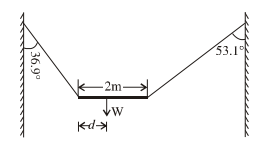
A non-uniform bar of weight W is suspended at rest by two strings of negligible weight as shown in Fig. The angles made by the strings with the vertical are 36.9º and 53.1º respectively. The bar is 2 m long. Calculate the distance d of the centre of gravity of the bar from its left end.
Image
A moving-coil galvanometer has a 50-turn coil of size 2cm × 2cm. It is suspended between the magnetic poles producing a magnetic field of 0.5T. Find the torque on the coil due to the magnetic field when a current of 20mA passes through it. 
(a) A child stands at the centre of a turntable with his two arms outstretched. The turntable is set rotating with an angular speed of 40 rev/min. How much is the angular speed of the child if he folds his hands back and thereby reduces his moment of inertia to 2/5 times the initial value? Assume that the turntable rotates wihout
friction.
(b) Show that the child’s new kinetic energy of rotation is more than the initial kinetic energy of rotation. How do you account for this increase in kinetic energy?
In one of the exercises to strengthen the wrist and fingers, a person squeezes and releases a soft rubber ball. Is the work done on the ball positive, negative or zero during compression? During expansion?
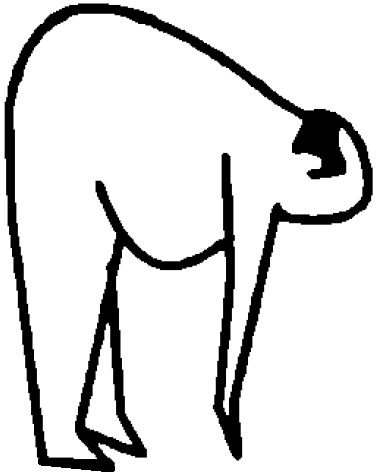
When a fat person tries to touch his toes, keeping the legs straight, he generally falls. Explain with reference to figure.

You are holding a cage containing a bird. Do you have to make less effort if the bird flies from its position in the cage and manages to stay in the middle without touching the walls of the cage? Does it make a difference whether the cage is completely closed or it has rods to let air pass?
Read the passage given below and answer the following questions from (i) to (v).

There are no physical examples of absolutely pure simple harmonic motion. In practice we come across systems that execute simple harmonic motion approximately under certain conditions.

Oscillations due to a spring:

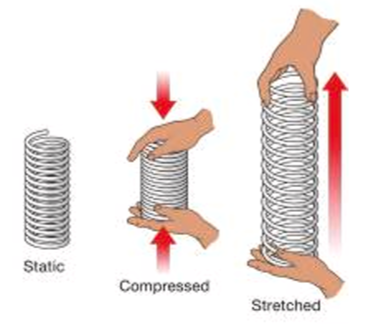
The simplest observable example of simple harmonic motion is the small oscillations of a block of mass m fixed to a spring, which in turn is fixed to a rigid wall. The block is placed on a frictionless horizontal surface. If the block is pulled on one side and is released, it then executes a to and fro motion about the mean position. Let x = 0, indicate the position of the centre of the block when the spring is in equilibrium. The positions marked as –A and +A indicate the maximum displacements to the left and the right of the mean position. We have already learnt that springs have special properties, which were first discovered by the English physicist Robert Hooke. He had shown that such a system when deformed is subject to a restoring force, the magnitude of which is proportional to the deformation or the displacement and acts in opposite direction. This is known as Hooke’s law. It holds good for displacements small in comparison to the length of the spring. At any time t, if the displacement of the block from its mean position is x, the restoring force F acting on the block is,

F(x) = –k x

The constant of proportionality, k, is called the spring constant, its value is governed by the elastic properties of the spring. A stiff spring has large k and a soft spring has small k. Equation is same as the force law for SHM and therefore the system executes a simple harmonic motion.

Damped oscillations

We know that the motion of a simple pendulum, swinging in air, dies out eventually. Why does it happen? This is because the air drag and the friction at the support oppose the motion of the pendulum and dissipate its energy gradually. The pendulum is said to execute damped oscillations. In damped oscillations, the energy of the system is dissipated continuously; but, for small damping, the oscillations remain approximately periodic. The dissipating forces are generally the frictional forces.

The damping force is generally proportional to velocity of the bob and acts opposite to the direction of velocity. If the damping force is denoted by Fd, we have

Fd = –bv

where the positive constant b depends on characteristics of the medium (viscosity, for example) and the size and shape of the block, is usually valid only for small velocity.
  1. Damping force is directly proportional to:
  1. Velocity
  2. Area
  3. Acceleration
  4. None of these
  1. Oscillations due to spring performs SHM for:
  1. Only small oscillations of spring
  2. Only for large oscillations of spring
  3. Both large as well as small oscillations of spring
  4. None of these
  1. Give expression for restoring force in spring while performing small SHM oscillations.
  2. Explain damped oscillations.
  3. Explain oscillations due to spring.
A person is standing on a weighing machine placed on the floor of an elevator. The elevator starts going up with some acceleration, moves with uniform velocity for a while and finally decelerates to stop. The maximum and the minimum weights recorded are 72kg and 60kg. Assuming that the magnitudes of the acceleration and the deceleration are the same, find:
  1. The true weight of the person.
  2. The magnitude of the acceleration. Take g = 9.9m/s2.
​​​​​​​
A simple pendulum fixed in a car has a time period of 4 seconds when the car is moving uniformly on a horizontal road. When the accelerator is pressed, the time period changes to 3.99 seconds. Making an approximate analysis, find the acceleration of the car.