Question
Consider the situation of the previous problem.
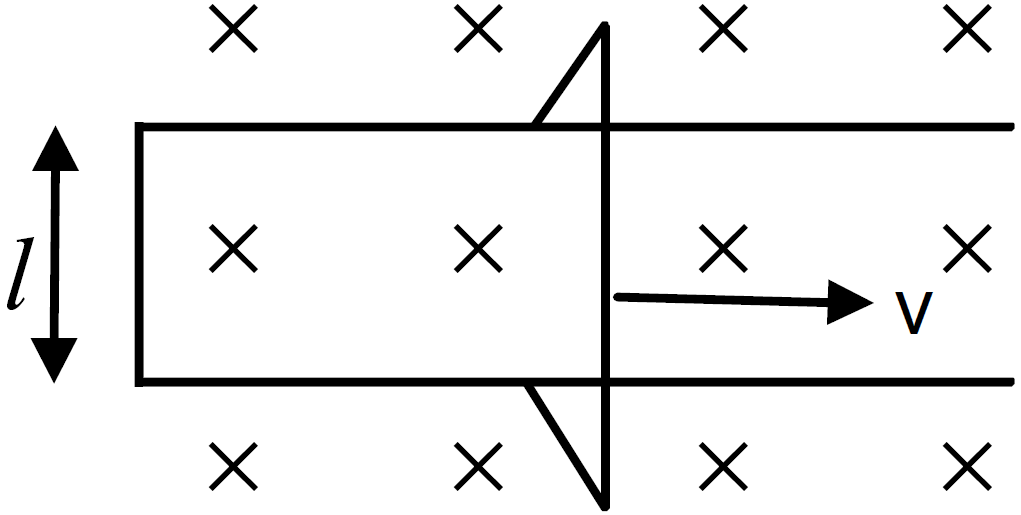
  1. Calculate the force needed to keep the sliding wire moving with a constant velocity v.
  2. If the force needed just after t = 0 is F0, find the time at which the force needed will be $\frac{\text{F}_0}{2}.$
Answer

$\text{e}=\text{Bvl}$

$\text{i}=\frac{\text{e}}{\text{R}}=\frac{\text{Bvl}}{2\text{r}(\text{l}+\text{vt})}$

  1. $\text{F}=\text{ilB}=\frac{\text{Bvl}}{2\text{r}(\text{l}+\text{vt})}\times\text{lB}=\frac{\text{B}^2\text{l}^2\text{v}}{2\text{r}(\text{l}+\text{vt})}$
  2. Just after $\text{t}=0$

$\text{f}_0=\text{ilB}=\text{lB}\Big(\frac{\text{lBv}}{2\text{rl}}\Big)=\frac{\text{l}\text{B}^2\text{v}}{2\text{r}}$

$\frac{\text{f}_0}{2}=\frac{\text{l}\text{B}^2\text{v}}{4\text{r}}=\frac{\text{l}^2\text{B}^2\text{v}}{2\text{r}(\text{l}+\text{vt})}$

$\Rightarrow2\text{l}=\text{l}+\text{vt}$

$\Rightarrow\text{T}=\frac{\text{l}}{\text{v}}$

Need a full question paper?

Generate a complete, print-ready paper with questions like this in minutes — across 16+ boards, with answer keys.

Start Generating Free

Similar questions

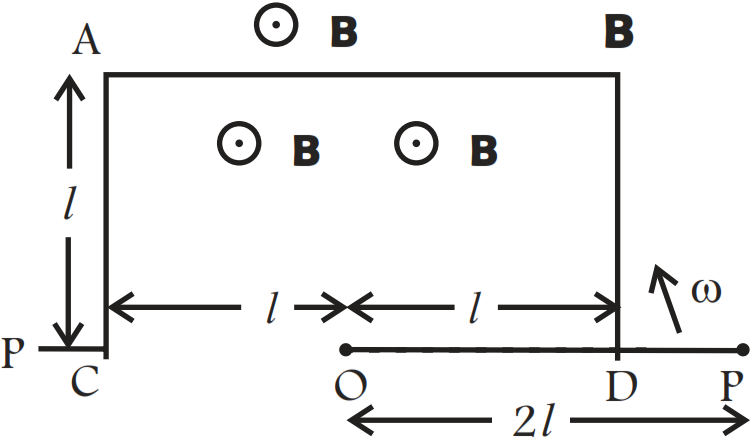
ODBAC is a fixed rectangular conductor of negilible resistance (CO is not connnected) and OP is a conductor which rotates clockwise with an angular velocity $\omega$ (Fig). The entire system is in a uniform magnetic field B whose direction is along the normal to the surface of the rectangular conductor ABDC. The conductor OP is in electric contact with ABDC. The rotating conductor has a resistance of $\lambda$ per unit length. Find the current in the rotating conductor, as it rotates by 180º.

Two monochromatic beams A and B of equal intensity I, hit a screen. The number of photons hitting the screen by beam A is twice that by beam B. Then what inference can you make about their frequencies?
Consider the situation of the previous problem:
  1. Find the tension in the string in equilibrium.
  2. Suppose the ball is slightly pushed aside and released. Find the time period of the small oscillations.
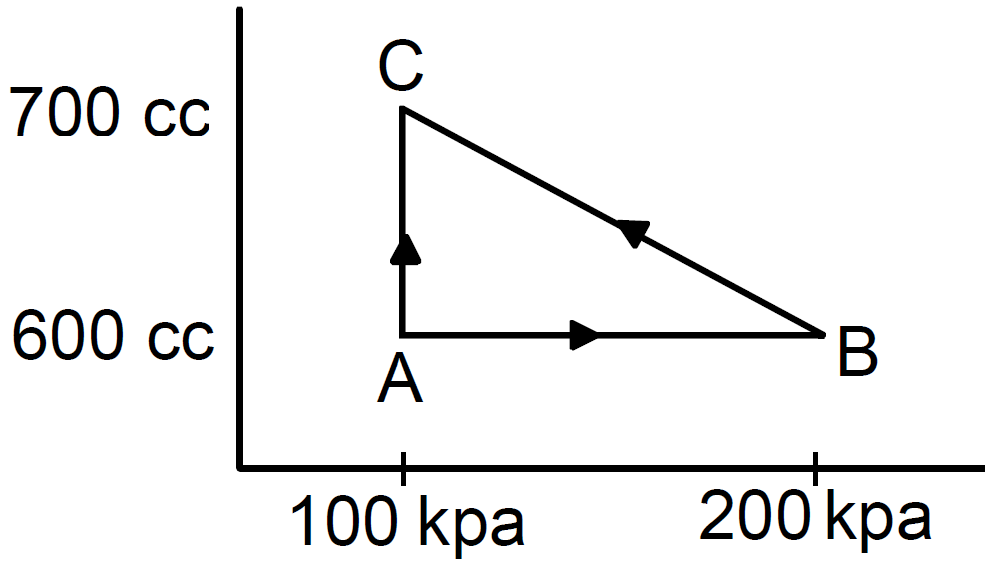
A gas is taken through a cyclic process ABCA as shown in figure. If 2.4 cal of heat is given in the process, what is the value of J?

A circuit containing a 80 mH inductor and a 60 μF capacitor in series is connected to a 230V, 50Hz supply. The resistance of the circuit is negligible.
  1. Obtain the current amplitude and rms values.
  2. Obtain the rms values of potential drops across each element.
  3. What is the average power transferred to the inductor?
  4. What is the average power transferred to the capacitor?
  5. What is the total average power absorbed by the circuit? ['Average' implies 'averaged over one cycle'.]
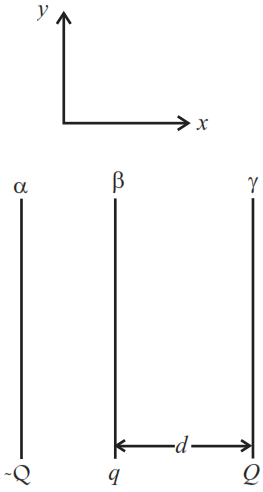
Two fixed, identical conducting plates $(\alpha\ \&\ \beta)$, each of surface area S are charged to -Q and q, respectively, where Q > q > 0. A third identical plate $(\gamma)$, free to move is located on the other side of the plate with charge q at a distance d (Fig.). The third plate is released and collides with the plate $\beta$. Assume the collision is elastic and the time of collision is sufficient to redistribute charge amongst $\beta\ \&\ \gamma$.

Find the velocity of the plate $\gamma$ after the collision and at a distance d from the plate $\beta$.
Two glass bulbs of equal volume are connected by a narrow tube and are filled with a gas at 0°C at a pressure of 76cm of mercury. One of the bulbs is then placed in melting ice and the other is placed in a water bath maintained at 62°C. What is the new value of the pressure inside the bulbs? The volume of the connecting tube is negligible.
A capacitor of capacitance $12.0\mu\text{F}$ is connected to a battery of emf 6.00V and internal resistance $1.00\Omega$ through resistanceless leads. $12.0\mu\text{s}$ after the connections are made, what will be (a) the current in the circuit (b) the power delivered by the battery (c) the power dissipated in heat and (d) the rate at which the energy stored in the capacitor is increasing.
Find the diameter of the image of the moon formed by a spherical concave mirror of focal length 7.6m. The diameter of the moon is 3450km and the distance between the earth and the moon is 3.8 × 10⁵km.
If neutrons exert only attractive force, why don't we have a nucleus containing neutrons alone?