Question types

Electromagnetic Induction question types

133 questions across 6 question groups — pick any mix to generate a Physics paper with step-by-step answer keys.

133
Questions
6
Question groups
5
Question types
Sample Questions

Electromagnetic Induction questions

One sample from each question group in this chapter. Select any group above to see the full set with answer keys.

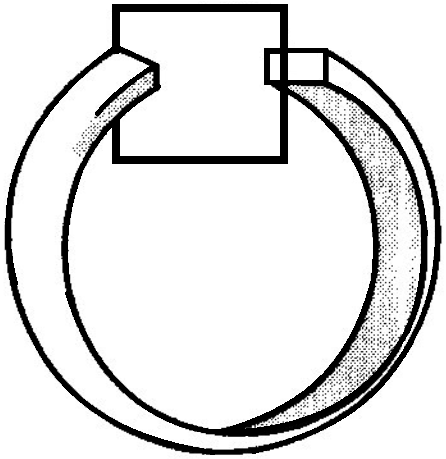
Figure shows a conducting square loop placed parallel to the pole faces of a ring magnet. The Pole-faces have an area of 1cm2 each and the field between the poles is 0.10T. The wires making the loop are all outside the magnetic field. If the magnet is removed in 1.0s, what is the average emf induced in the loop?
View full solution
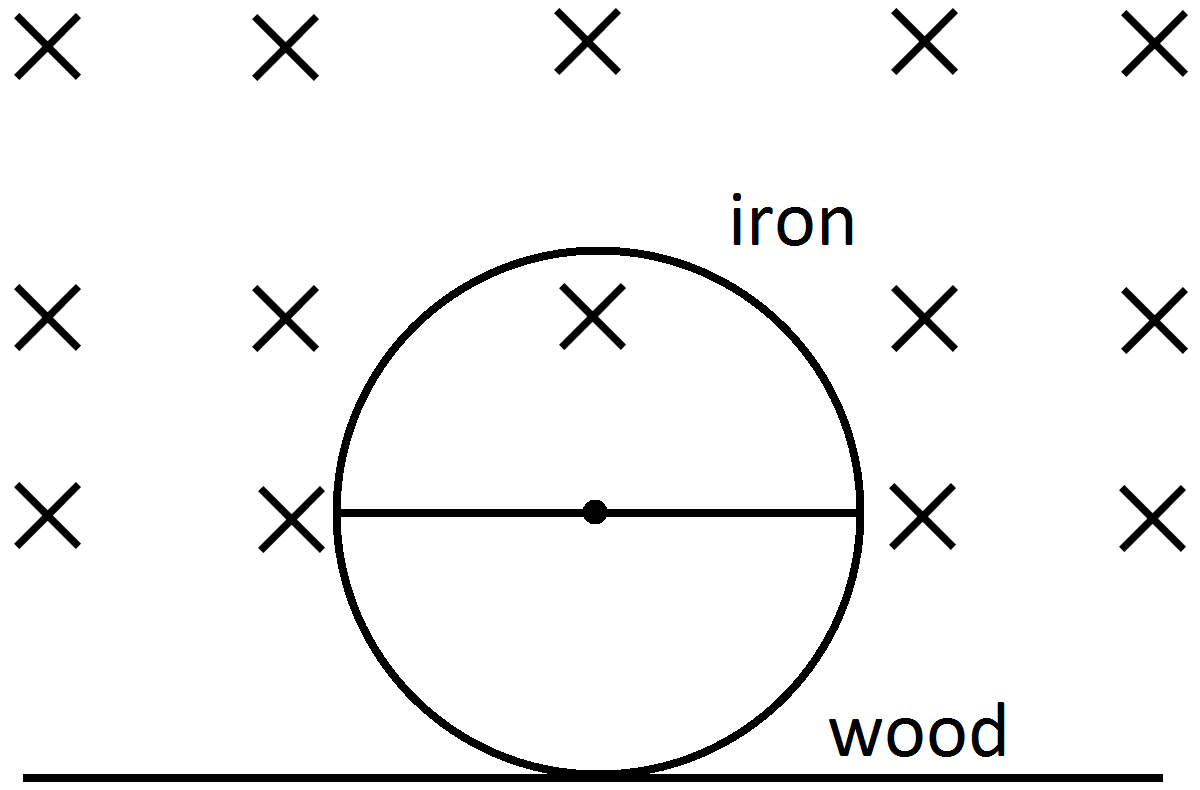
Figure shows a circular wheel of radius 10.0cm whose upper half, shown dark in the figure, is made of iron and the lower half of wood. The two junctions are joined by an iron rod. A uniform magnetic field B of magnitude 2.00 × 10⁻⁴ T exists in the space above the central line as suggested by the figure. The wheel is set into pure rolling on the horizontal surface. If it takes 2.00 seconds for the iron part to come down and the wooden part to go up, find the average emf induced during this period.

View full solution
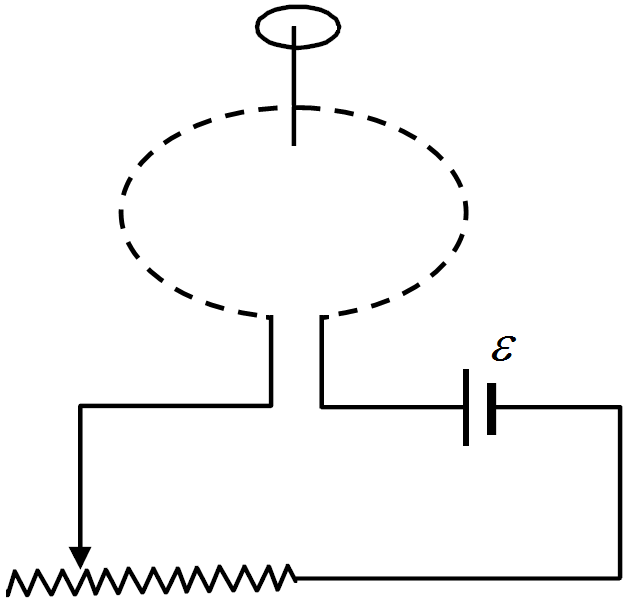
An inductor is connected to a battery through a switch. Explain why the emf induced in the inductor is much larger when the switch is opened as compared to the emf induced when the switch is closed.
View full solution
The two rails of a railway track, insulated from each other and from the ground, are connected to a millivoltmeter. What will be the reading of the millivoltmeter when a train travels on the track at a speed of 180km/h-1? The vertical component of earth's magnetic field is 0.2 × 10⁻⁴ T and the rails are separated by 1m.
View full solution
The current in a long solenoid of radius R and having n turns per unit length is given by $\text{i}=\text{i}_0\sin\omega\text{t}.$ A coil having N turns is wound around it near the centre. Find
  1. The induced emf in the coil.
  2. The mutual inductance between the solenoid and the coil.
View full solution
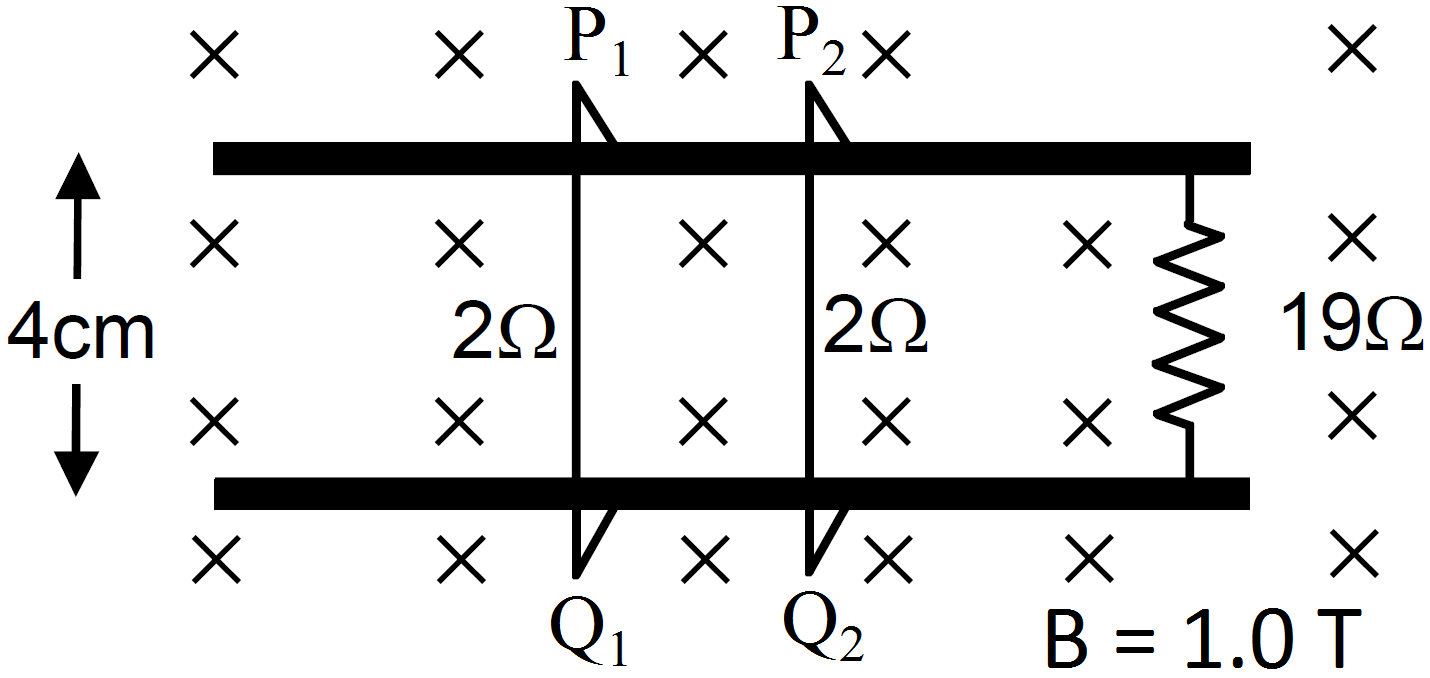
Consider the situation shown in figure. The wires P1Q1 and P2Q2 are made to slide on the rails with the same speed 5cm/s. Find the electric current in the $19\Omega$ resistor if:

  1. Both the wires move towards right.
  2. If P1Q1 moves towards left but P2Q2 moves towards right.

View full solution
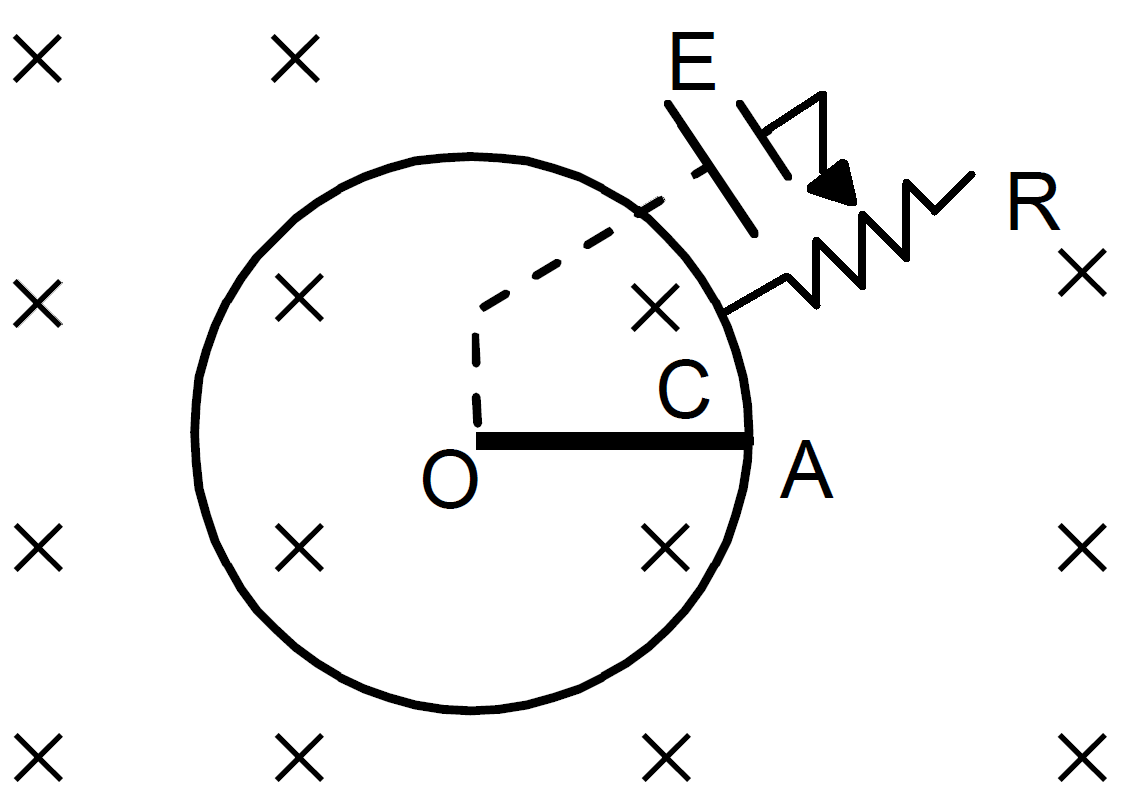
Consider a variation of the previous problem (figure). Suppose the circular loop lies in a vertical plane. The rod has a mass m. The rod and the loop have negligible resistances but the wire connecting O and C has a resistance R. The rod is made to rotate with a uniform angular velocity $\omega$ in the clockwise direction by applying a force at the midpoint of OA in a direction perpendicular to it. Find the magnitude of this force when the rod makes an angle $\theta$ with the vertical.
View full solution
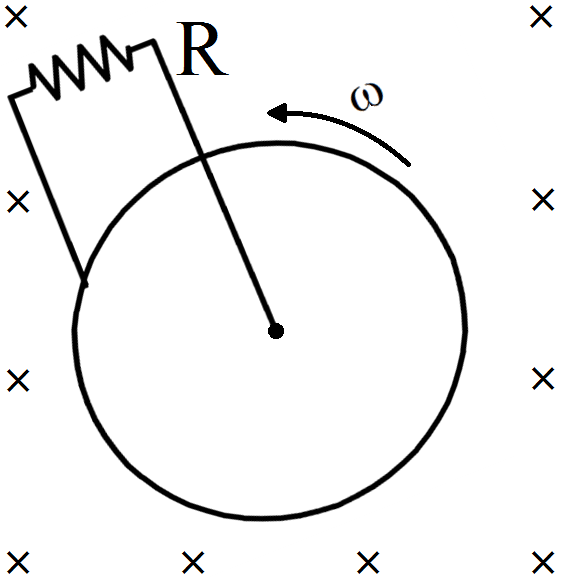
Figure shows a conducting disc rotating about its axis in a perpendicular magnetic field B. A resistor of resistance R is connected between the centre and the rim. Calculate the current in the resistor. Does it enter the disc or leave it at the centre? The radius of the disc is 5.0cm, angular speed $\omega=10 \ \text{rad/s}, \ \text{B}=0.40\text{T}$ and $\text{R}=10\Omega.$

View full solution
Q 103 Marks Question3 Marks
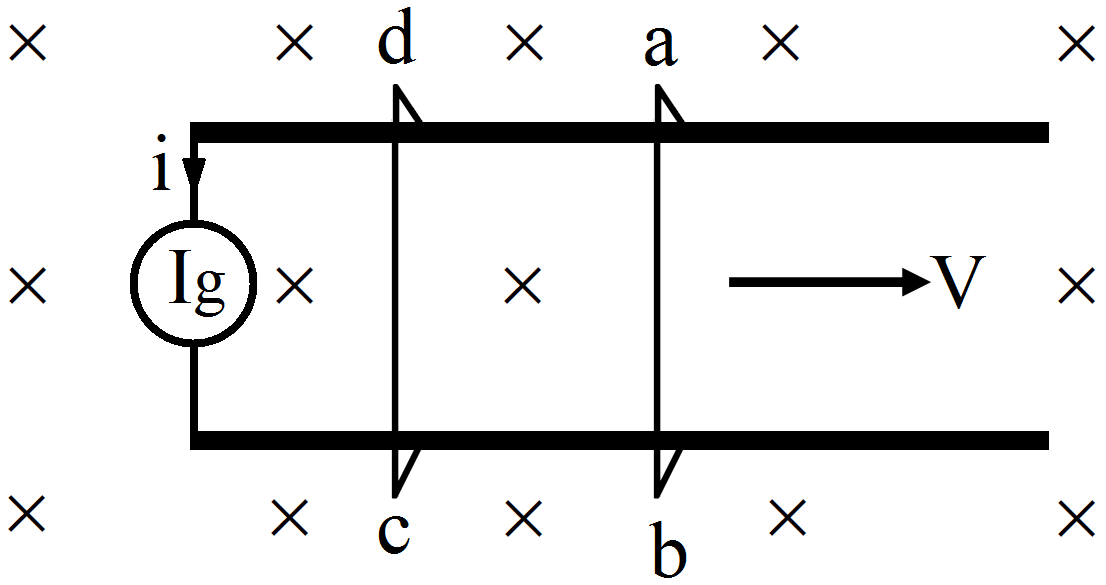
The current generator Ig shown in figure, sends a constant current i through the circuit. The wire cd is fixed and ab is made to slide on the smooth, thick rails with a constant velocity v towards right. Each of these wires has resistance r. Find the current through the wire cd.

View full solution
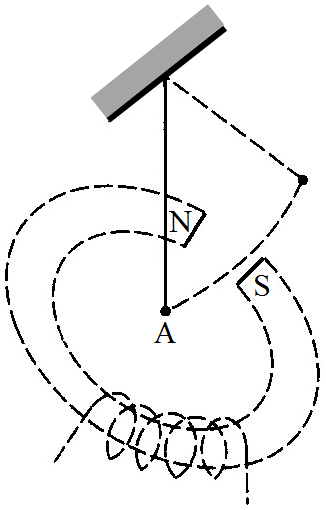
A metallic bob A oscillates through the space between the poles of an electromagnet. The oscillations are more quickly damped when the circuit is on, as compared to the case when the circuit is off. Explain.

View full solution
Two circular loops are placed with their centres separated by a fixed distance. How would you orient the loops to have:
  1. The largest mutual inductance.
  2. The smallest mutual inductance?
View full solution
A metallic metre stick moves with a velocity of 2m/s-1 in a direction perpendicular to its length and perpendicular to a uniform magnetic field of magnitude 0.2 T. Find the emf induced between the ends of the stick.
View full solution
Q 17M.C.Q (1 Marks)1 Mark
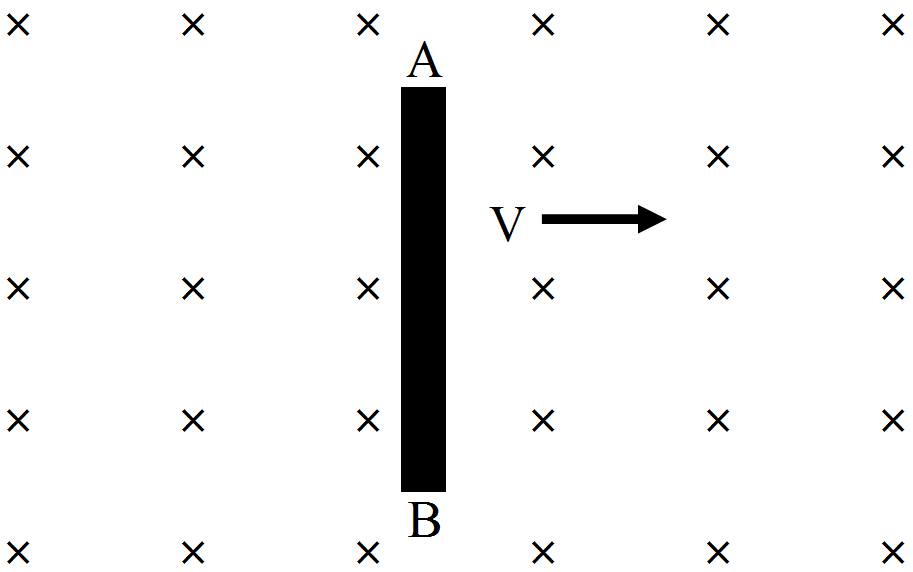
A rod AB moves with a uniform velocity v in a uniform magnetic field as shown in figure.
  1. The rod becomes electrically charged.
  2. The end A becomes positively charged.
  3. The end B becomes positively charged.
  4. The rod becomes hot because of Joule heating.

View full solution
Q 18M.C.Q (1 Marks)1 Mark
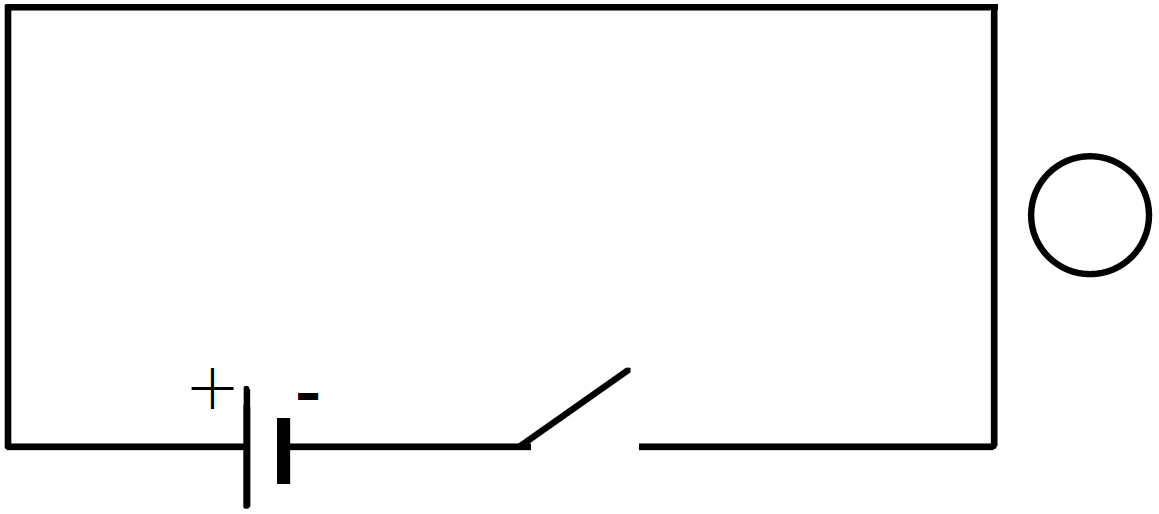
Consider the situation shown in figure. If the switch is closed and after some time it is opened again, the closed loop will show:
  1. An anticlockwise current-pulse.
  2. A clockwise current-pulse.
  3. An anticlockwise current-pulse and then a clockwise current-pulse.
  4. A clockwise current-pulse and then an anticlockwise current-pulse.

View full solution
Q 19M.C.Q (1 Marks)1 Mark
Consider the following statements:
  1. An emf can be induced by moving a conductor in a magnetic field.
  2. An emf can be induced by changing the magnetic field.
  1. Both A and B are true.
  2. A is true but B is false.
  3. B is true but A is false.
  4. Both A and B are false.
View full solution
Q 20M.C.Q (1 Marks)1 Mark
A conducting loop is placed in a uniform magnetic field with its plane perpendicular to the field. An emf is induced in the loop if:
  1. It is translated.
  2. It is rotated about its axis.
  3. It is rotated about a diameter.
  4. It is deformed.
View full solution
Q 21M.C.Q (1 Marks)1 Mark
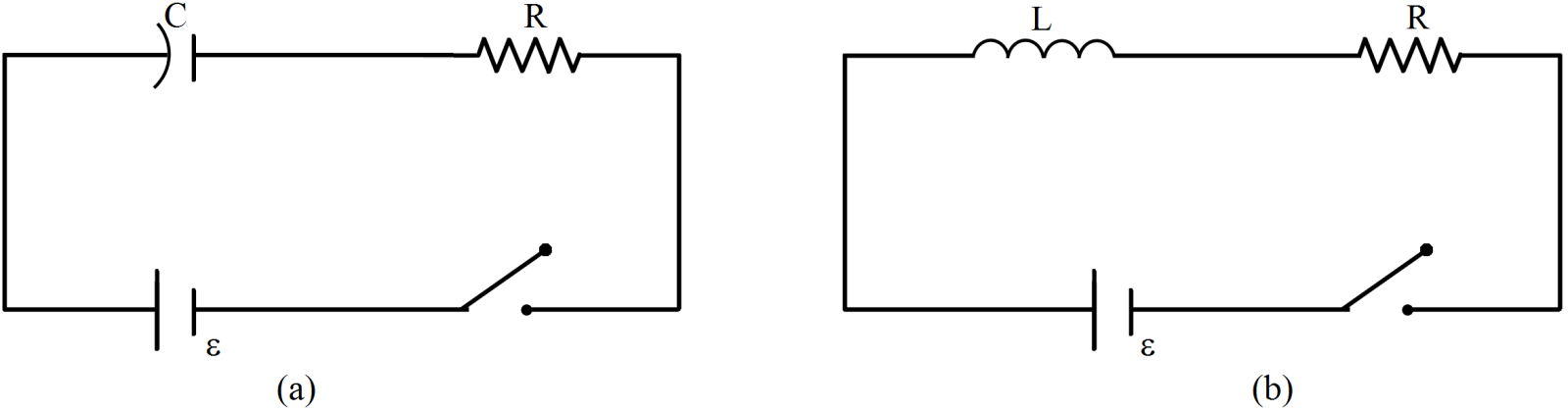
The switches in figure are closed at t = 0 and reopened after a long time at t = t0:

  1. The charge on C just after t = 0 is $\in\text{C}.$
  2. The charge on C long after t = 0 is $\in\text{C}.$
  3. The current in L just before t = tis $\frac{\in}{\text{R}}.$
  4. The current in L long after t = t0 is $\frac{\in}{\text{R}}.$
View full solution
The current in a discharging LR circuit without the battery drops from 2.0A to 1.0A in 0.10s.
  1. Find the time constant of the circuit.
  2. If the inductance of the circuit is 4.0H, what is its resistance?
View full solution
Figure shows a situation similar to the previous problem. All parameters are the same except that a battery of emf $\in$ and a variable resistance R are connected between O and C. The connecting wires have zero resistance. No external force is applied on the rod (except gravity, forces by the magnetic field and by the pivot). In what way should the resistance R be changed so that the rod may rotate with uniform angular velocity in the clockwise direction? Express your answer in terms of the given quantities and the angle $\theta$ made by the rod OA with the horizontal.

View full solution
Consider the situation shown in the figure of the previous problem. Suppose the wire connecting O and C has zero resistance but the circular loop has a resistance R uniformly distributed along its length. The rod OA is made to rotate with a uniform angular speed $\omega$ shown in the figure. Find the current in the rod when $\angle\text{AOC}=90^{\circ}$
View full solution
A bicycle is resting on its stand in the east-west direction and the rear wheel is rotated at an angular speed of 100 revolutions per minute. If the length of each spoke is 30.0cm and the horizontal component of the earth's magnetic field is 2.0 × 10⁻⁵ T, find the emf induced between the axis and the outer end of a spoke. Neglect centripetal force acting on the free electrons of the spoke.
View full solution

Generate a Electromagnetic Induction paper free

Pick question groups from the list above, set marks and difficulty, and export a branded PDF with step-by-step answer keys. First 3 chapters free — no signup.

Download App