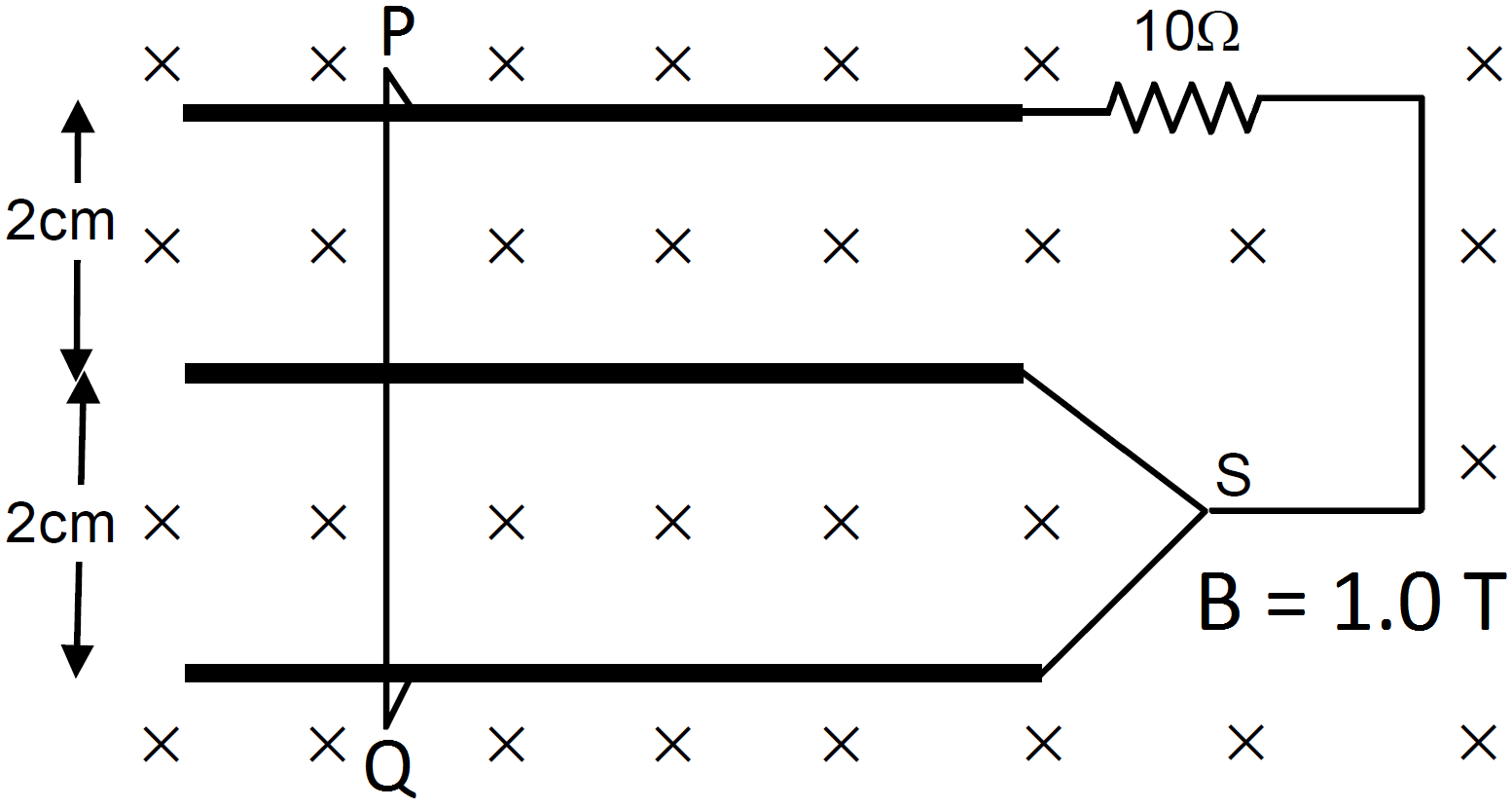
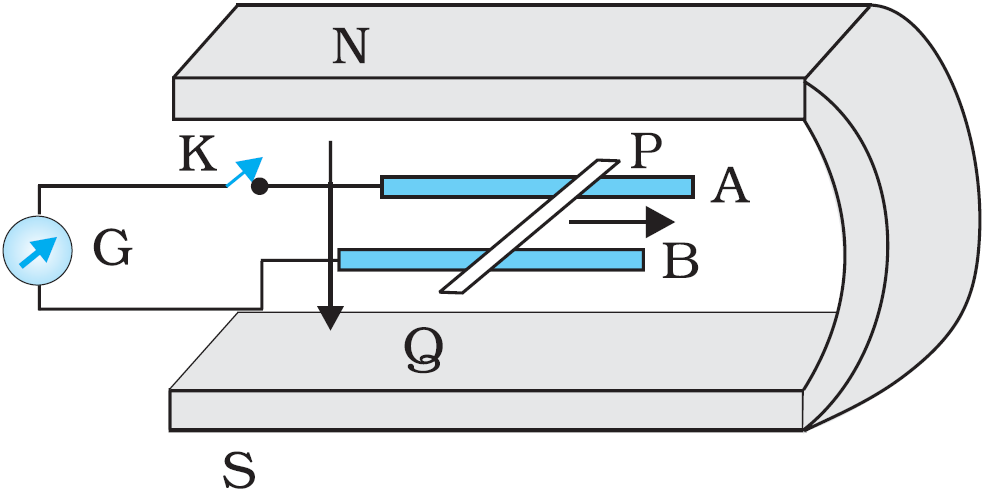
- Calculate the force needed to keep the sliding wire moving with a constant velocity v.
- If the force needed just after t = 0 is F0, find the time at which the force needed will be $\frac{\text{F}_0}{2}.$
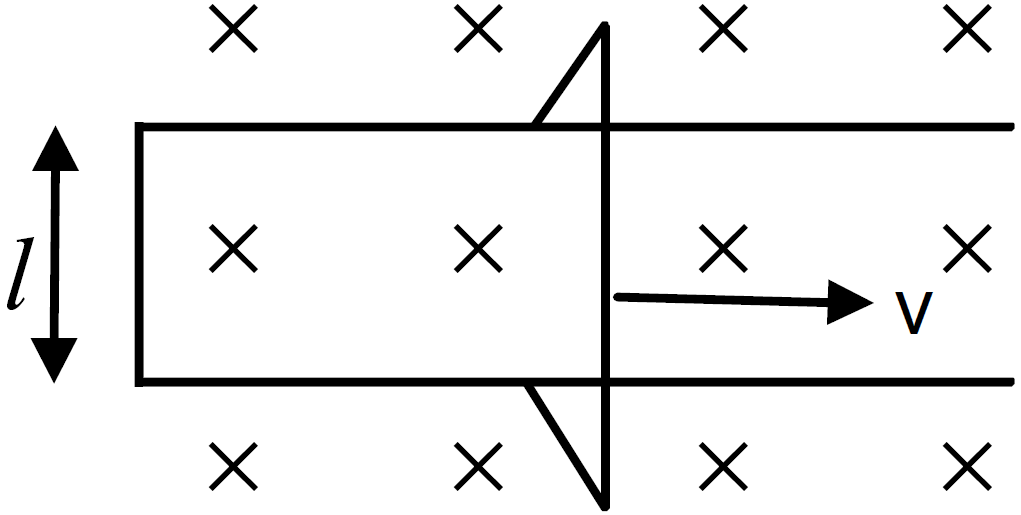
$\text{e}=\text{Bvl}$ $\text{i}=\frac{\text{e}}{\text{R}}=\frac{\text{Bvl}}{2\text{r}(\text{l}+\text{vt})}$ $\text{f}_0=\text{ilB}=\text{lB}\Big(\frac{\text{lBv}}{2\text{rl}}\Big)=\frac{\text{l}\text{B}^2\text{v}}{2\text{r}}$
$\frac{\text{f}_0}{2}=\frac{\text{l}\text{B}^2\text{v}}{4\text{r}}=\frac{\text{l}^2\text{B}^2\text{v}}{2\text{r}(\text{l}+\text{vt})}$
$\Rightarrow2\text{l}=\text{l}+\text{vt}$
$\Rightarrow\text{T}=\frac{\text{l}}{\text{v}}$
Generate a complete, print-ready paper with questions like this in minutes — across 16+ boards, with answer keys.


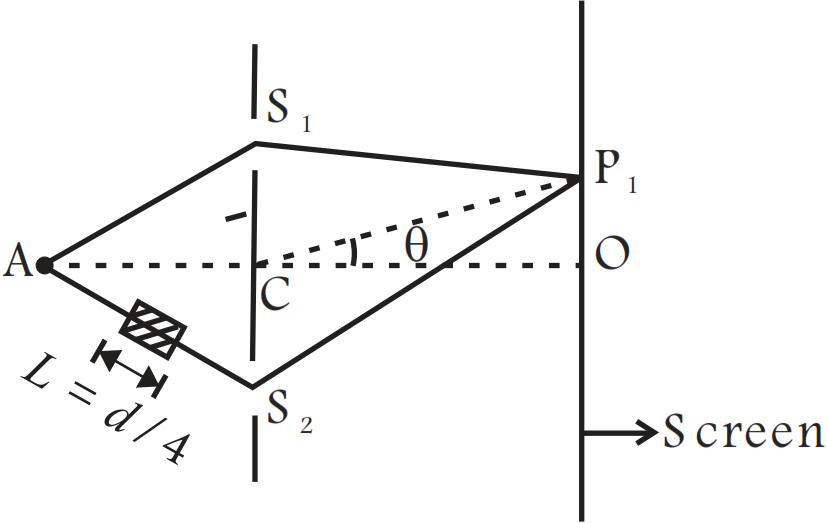
AC = CO = D, S1C = S2C = d < < D
A small transparent slab containing material of μ = 1.5 is placed along AS2 (Fig). What will be the distance from O of the principal maxima and of the first minima on either side of the principal maxima obtained in the absence of the glass slab.
$\text{mg}$
$\frac{\text{mg}}{\cos\theta}$
$\text{mg}\cos\theta$
$\text{mg}\tan\theta$