Question
What is a moving coil galvanometer? Write its working by drawing its diagram and its principle. Prove that current in it is proportional to the produced deflection.###What is a galvanometer? Explain construction, working and principle of a moving coil galvanometer.
Answer

SELF

Need a full question paper?

Generate a complete, print-ready paper with questions like this in minutes — across 16+ boards, with answer keys.

Start Generating Free

Similar questions

A load resistor of $2\text{k}\Omega$ is connected in the collector branch of an amplifier circuit using a transistor in common-emitter mode. The current gain $\beta=50.$ The input resistance of the transistor is $0.50\text{k}\Omega.$ If the input current is changed by $50\mu\text{A}.$
  1. By what amount does the output voltage change?
  2. By what amount does the input voltage change?
  3. What is the power gain?
The plates of a capacitor of capacitance $10\mu\text{F},$ charged to $60\mu\text{C},$ are joined together by a wire of resistance $10\Omega$ at t = 0. Find the charge on the capacitor in the circuit at (a) t = 0 (b) $\text{t}=30\mu\text{s}$ (c) $\text{t}=120\mu\text{s}$ and (d) t = 1.0ms.
A capacitor of capacitance $10\mu\text{F}$ is connected to a battery of emf 2V. It is found that it takes 50ms for the charge of the capacitor to become $12.6\mu\text{C}.$ Find the resistance of the circuit.
Add vectors $\overrightarrow{\text{A}},\overrightarrow{\text{B}}$ and $\overrightarrow{\text{C}}$ each having magnitude of 100 unit and inclined to the X-axis at angles 45°, 135° and 315° respectively.
A travelling wave is produced on a long horizontal string by vibrating an end up and down sinusoidally. The amplitude of vibration is 1.0cm and the displacement becomes zero 200 times per second. The linear mass density of the string is 0.10kg/m and it is kept under a tension of 90N.
  1. Find the speed and the wavelength of the wave.
  2. Assume that the wave moves in the positive x-direction and at t = 0, the end x = 0 is at its positive extreme position. Write the wave equation.
  3. Find the velocity and acceleration of the particle at x - 50cm at time t = 10ms.
A bicycle is resting on its stand in the east-west direction and the rear wheel is rotated at an angular speed of 100 revolutions per minute. If the length of each spoke is 30.0cm and the horizontal component of the earth's magnetic field is 2.0 × 10⁻⁵ T, find the emf induced between the axis and the outer end of a spoke. Neglect centripetal force acting on the free electrons of the spoke.
The capacitance between the adjacent plates shown in figure is 50nF. A charge of $1.0\mu\text{C}$ is placed on the middle plate:

  1. What will be the charge on the outer surface of the upper plate?
  2. Find the potential difference developed between the upper and the middle plates.
First a set of n equal resistors of R each are connected in series to a battery of emf E and internal resistance R. A current I is observed to flow. Then the n resistors are connected in parallel to the same battery. It is observed that the current is increased 10 times. What is 'n'?
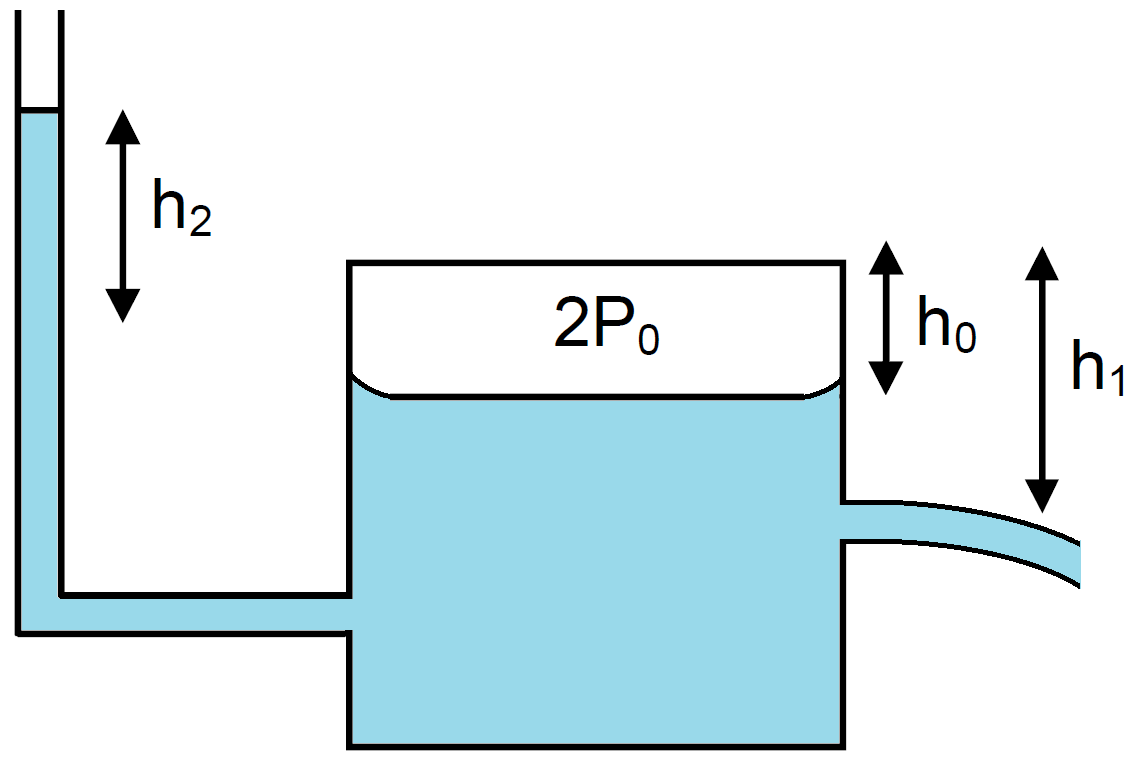
Figure. shows a large closed cylindrical tank containing water. Initially the air trapped above the water surface has a height h0 and pressure 2p0 where p0 is the atmospheric pressure. There is a hole in the wall of the tank at a depth h1 below the top from which water comes out. A long vertical tube is connected as shown.
  1. Find the height h2 of the water in the long tube above the top initially.
  2. Find the speed with which water comes out of the hole.
  3. Find the height of the water in the long tube above the top when the water stops coming out of the hole.

Consider N = n1n2 identical cells, each of emf $\in$ and internal resistance r. Suppose n1 cells are joined in series to form a line and n2 such lines are connected in parallel. The combination drives a current in an external resistance R. (a) Find the current in the external resistance. (b) Assuming that n1 and n2 can be continuously varied, find the relation between n1, n2, R and r for which the current in R is maximum.