Question
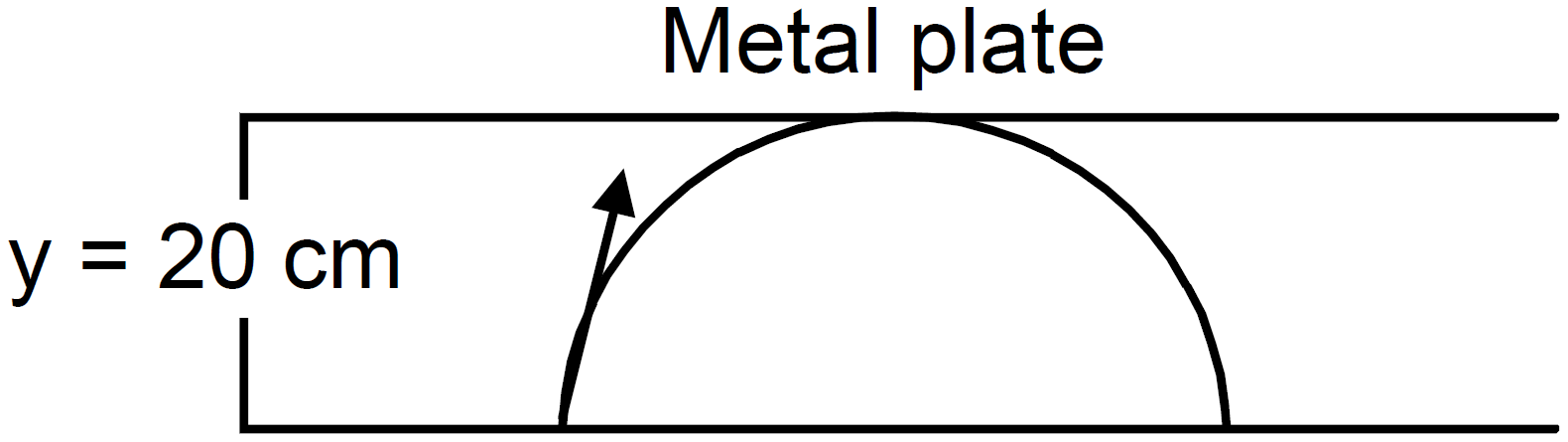
Consider the situation of the previous problem. Consider the fastest electron emitted parallel to the large metal plate. Find the displacement of this electron parallel to its initial velocity before it strikes the large metal plate.

Answer

Here electric field of metal plate $=\text{E}=\frac{\text{p}}{\text{E}_0}$

$=\frac{1\times10^{-19}}{8.85\times10^{-12}}=113\text{v/m}$

accl. de $=\phi=\frac{\text{qE}}{\text{m}}$

$=\frac{1.6\times10^{-19}\times113}{9.1\times10^{-31}}=19.87\times10^{12}$

$\text{t}=\frac{\sqrt{2\text{y}}}{\text{a}}=\frac{\sqrt{2\times20\times10^{-2}}}{19.87\times10^{-31}}=1.41\times10^{-7}\text{sec}$

K.E. $=\frac{\text{hc}}{\lambda}-\text{w}=1.2\text{ev}$

= 1.2 × 1.6 × 10 - 19J [because in previous problem i.e. in problem 31 : KE = 1.2ev]

$\therefore\text{v}=\frac{\sqrt{2\text{KE}}}{\text{m}}$

$=\frac{\sqrt{2\times1.2\times1.6\times10^{-19}}}{4.1\times10^{-31}}=0.665\times10^{-6}$

$\therefore$ Horizontal displacement = Vt × t

= 0.655 × 10-6 × 1.4 × 10-7 = 0.092m = 9.2cm.
Need a full question paper?

Generate a complete, print-ready paper with questions like this in minutes — across 16+ boards, with answer keys.

Start Generating Free

Similar questions

A simple pendulum is constructed by hanging a heavy ball by a 5.0m long string. It undergoes small oscillations.
  1. How many oscillations does it make per second?
  2. What will be the frequency if the system is taken on the moon where acceleration due to gravitation of the moon is 1.67m/s2.
In a Young's double slit interference experiment the fringe pattern is observed on a screen placed at a distance D from the slits. The slits are separated by a distance d and are illuminated by monochromatic light of wavelength $\lambda$. Find the distance from the central point where the intensity falls to,
  1. Half the maximum.
  2. One fourth of the maximum.
An astronomical telescope is to be designed to have a magnifying power of 50 in normal adjustment. If the length of the tube is 102cm, find the powers of the objective and the eyepiece.
The electric field associated with a light wave is given by $\text{E}=\text{E}_0\sin[(1.57\times10^7\text{m}^{-1})(\text{x}-{\text{ct}})].$ Find the stopping potential when this light is used in an experiment on photoelectric effect with the emitter having work function 1.9eV.
Consider a metallic pipe with an inner radius of 1cm. If a cylindrical bar magnet of radius 0.8cm is dropped through the pipe, it takes more time to come down than it takes for a similar unmagnetised cylindrical iron bar dropped through the metallic pipe. Explain.
When a proton is released from rest in a room, it starts with an initial acceleration a0 towards west. When it is projected towards north with a speed v0, it moves with an initial acceleration 3a0 towards west. Find the electric field and the maximum possible magnetic field in the room.
A bullet of mass 20g moving horizontally at a speed of 300m/s is fired into a wooden block of mass 500g suspended by a long string. The bullet crosses the block and emerges on the other side. If the centre of mass of the block rises through a height of 20.0cm, find the speed of the bullet as it emerges from the block.
What are circular and elliptically polarized light?
The equation of a wave travelling on a string stretched along the X-axis is given by-

$\text{y}=\text{A}\text{e}^{-\Big(\frac{\text{x}}{\text{a}}+\frac{\text{t}}{\text{T}}\Big)^2}.$

  1. Write the dimensions of A, a and T.
  2. Find the wave speed.
  3. In which direction is the wave. travelling?
  4. Where is the maximum of the pulse located at t = T? at t = 2T?
If the outer coil of the previous problem is rotated through 90° about a diameter, what would be the magnitude of the magnetic field B at the centre?