Question
When a proton is released from rest in a room, it starts with an initial acceleration a0 towards west. When it is projected towards north with a speed v0, it moves with an initial acceleration 3a0 towards west. Find the electric field and the maximum possible magnetic field in the room.

Answer

$\text{q}_\text{p}=\text{e},\ \text{mp}=\text{m},\ \text{F}=\text{q}_\text{p}\times\text{E}$
$\text{ma}_0=\text{eE}$
$\text{E}=\frac{\text{ma}_0}{\text{e}}$ towards west

The acceleration changes from a0 to 3a0
Hence net acceleration produced by magnetic field $\overrightarrow{\text{B}}$ is 2a0.
Force due to magnetic field
$\overrightarrow{\text{F}}_\text{B}=\text{m}\times2\text{a}_0=\text{e}\times\text{V}_0\times\text{B}$
$\Rightarrow\text{B}=\frac{2\text{ma}_0}{\text{eV}_0}$ downwards

Need a full question paper?

Generate a complete, print-ready paper with questions like this in minutes — across 16+ boards, with answer keys.

Start Generating Free

Similar questions

For the $\beta^{+}$ (positron) emission from a nucleus, there is another competing process known as electron capture (electron from an inner orbit, say, the K–shell, is captured by the nucleus and a neutrino is emitted).
$\text{e}^{+}+^{\text{A}}_{\text{Z}}\text{X}\rightarrow\ ^{\text{A}}_{\text{Z}-1}\text{Y}+\text{v}$
Show that if $\beta^{+}$ emission is energetically allowed, electron capture is necessarily allowed but not vice–versa.
Briefly explain the principle of a capacitor. Derive an expression for the capacitance of a parallel plate capacitor, whose plates are separated by a dielectric medium.
On the basis of band theory, differentiate between conductors, insulators and conductors.
A 4.5 cm needle is placed 12 cm away from a convex mirror of focal length 15 cm. Give the location of the image and the magnification. Describe what happens as the needle is moved farther from the mirror.
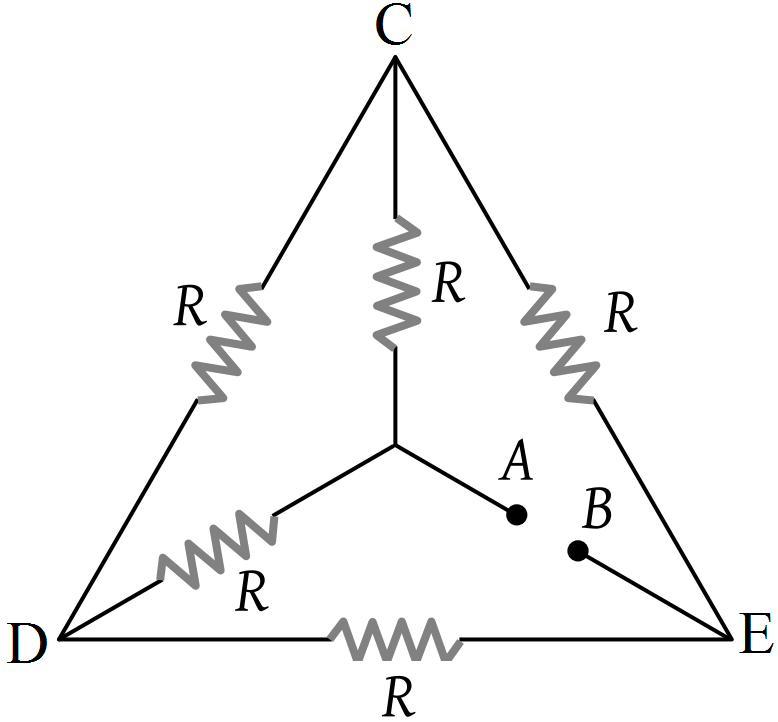
  1. Calculate the equivalent resistance of the given electrical network between points A and B.

  1. Also calculate the current through CD and ACB if a 10V dc source is connected between points A and B and the value of $\text{R}=2\Omega.$
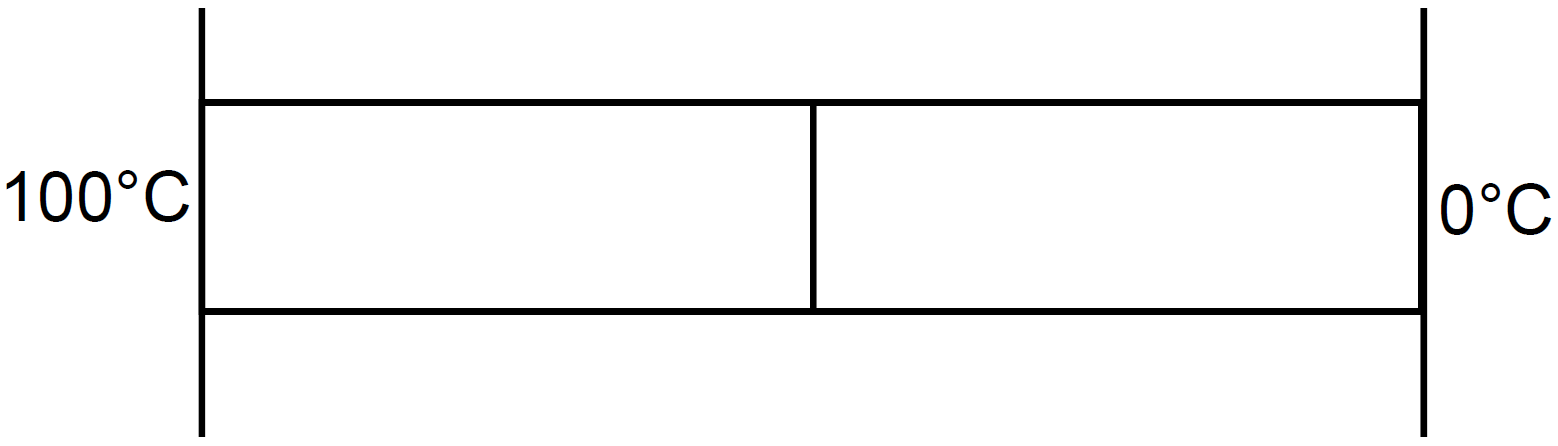
The two rods shown in figure, have identical geometrical dimensions. They are in contact with two heat baths at temperatures 100°C and 0°C. The temperature of the junction is 70°C. Find the temperature of the junction if the rods are interchanged.

  1. Compare the individual dipole moment and the specimen dipole moment for H2O molecule and O2 molecule when placed in:
  1. Absence of external electric field.
  2. Presence of external eclectic field. Justify your answer.
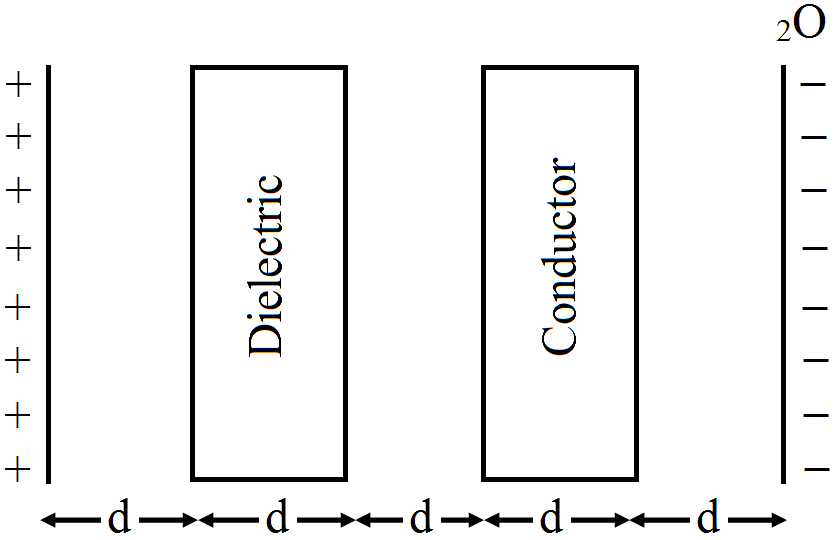
  1. Given two parallel conducting plates of area A and charge densities $+\sigma$ and $-\sigma.$ A dielectric slab of constant K and a conducting slab of thickness d each are inserted in between them as shown.

  1. Find the potential difference between the plates.
  2. Plot E versus x graph, taking x = 0 at positive plate and x = 5d at negative plate.
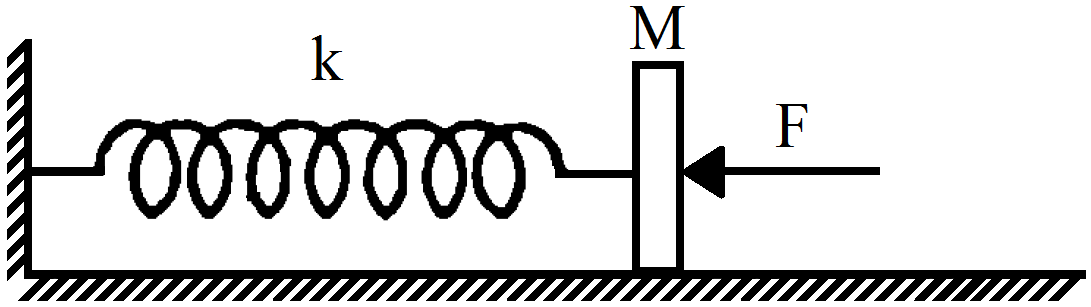
In figure k = 100N/m, M = 1kg and F = 10N,
  1. Find the compression of the spring in the equilibrium position.
  2. A sharp blow by some external agent imparts a speed of 2m/s to the block towards left. Find the sum of the potential energy of the spring and the kinetic energy of the block at this instant.
  3. Find the time period of the resulting simple harmonic motion.
  4. Find the amplitude.
  5. Write the potential energy of the spring when the block is at the left extreme.
  6. Write the potential energy of the spring when the block is at the right extreme.
The answers of (b), (e) and (f) are different. Explain why this does not violate the principle of conservation of energy.

Consider a straight piece of length x of a wire carrying a current i. Let P be a point on the perpendicular bisector of the piece, situated at a distance d from its middle point. Show that for d >> x, the magnetic field at P varies as $\frac{1}{\text{d}^2}$ whereas ford d << x, it varies as $\frac{1}{\text{d}}.$
A paperweight in the form of a hemisphere of radius 3.0cm is used to hold down a printed page. An observer looks at the page vertically through the paperweight. At what height above the page will the printed letters near the centre appear to the observer?