Question
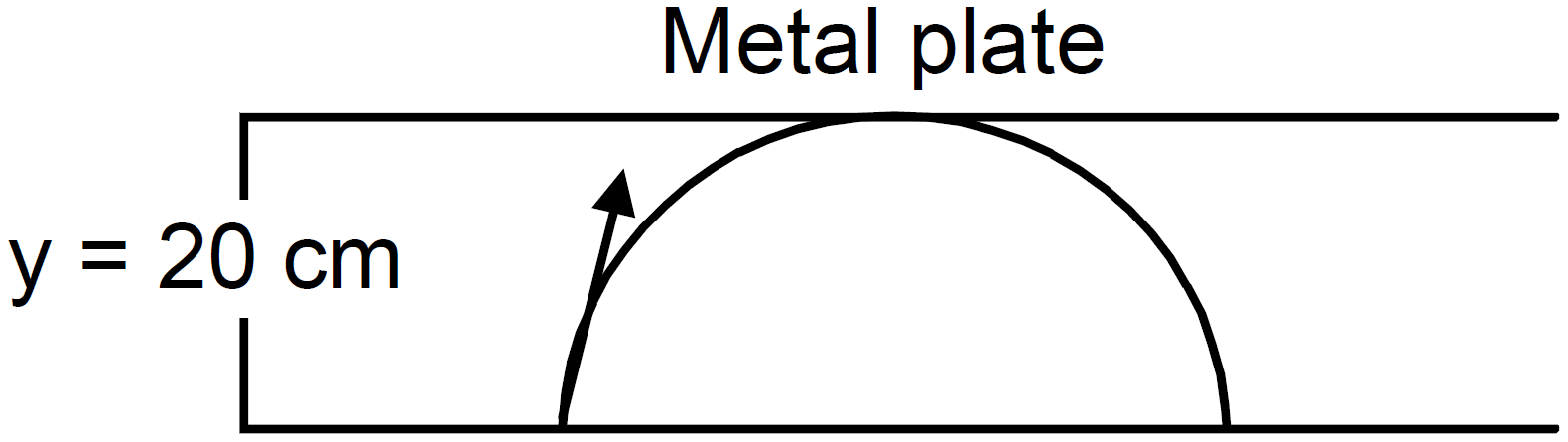
Consider the situation of the previous problem. Consider the fastest electron emitted parallel to the large metal plate. Find the displacement of this electron parallel to its initial velocity before it strikes the large metal plate.
Answer

Here electric field of metal plate $=\text{E}=\frac{\text{p}}{\text{E}_0}$
$=\frac{1\times10^{-19}}{8.85\times10^{-12}}=113\text{v/m}$
accl. de $=\phi=\frac{\text{qE}}{\text{m}}$
$=\frac{1.6\times10^{-19}\times113}{9.1\times10^{-31}}=19.87\times10^{12}$
$\text{t}=\frac{\sqrt{2\text{y}}}{\text{a}}=\frac{\sqrt{2\times20\times10^{-2}}}{19.87\times10^{-31}}=1.41\times10^{-7}\text{sec}$
K.E. $=\frac{\text{hc}}{\lambda}-\text{w}=1.2\text{ev}$
$= 1.2 × 1.6 × 10 - 19J [$because in previous problem i.e. in problem $31 : KE = 1.2ev]$
$\therefore\text{v}=\frac{\sqrt{2\text{KE}}}{\text{m}}$
$=\frac{\sqrt{2\times1.2\times1.6\times10^{-19}}}{4.1\times10^{-31}}=0.665\times10^{-6}$
$\therefore$ Horizontal displacement $= Vt × t$
$= 0.655 \times 10^{-6} \times 1.4 \times 10^{-7} = 0.092m = 9.2cm$.

Need a full question paper?

Generate a complete, print-ready paper with questions like this in minutes — across 16+ boards, with answer keys.
Start Generating Free

Similar questions

Establish the formula for the capacitance of a parallel plate capacitor in the presence of dielectric material completely and partially.
  1. Derive the expression for the torque acting on the rectangular current carrying coil of a galvanometer. Why is the magnetic field made radial?
  2. An $\alpha-$particle is accelerated through a potential difference of 10kV and moves along x-axis. It enters in a region of uniform magnetic field $B = 2 \times 10^{–3}T$ acting along y-axis. Find the radius of its path. (Take mass of $\alpha-$particle $= 6.4 \times 10^{–27}kg$).
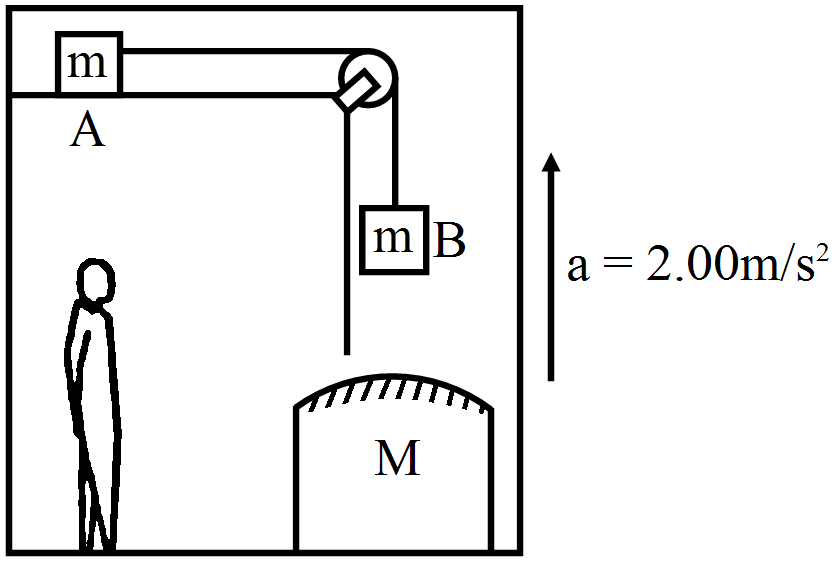
Consider the situation shown in figure. The elevator is going up with an acceleration of $2.00m/s^2$ and the focal length of the mirror is 12.0cm. All the surfaces are smooth and the pulley is light. The mass-pulley system is released from rest (with respect to the elevator) at t = 0 when the distance of B from the mirror is 42.0cm. Find the distance between the image of the block B and the mirror at $t = 0.200s$. Take $g = 10m/s^2$.
Consider a circular current-carrying loop of radius R in the x-y plane with centre at origin. Consider the line intergral $\Im(\text{L})=\begin{vmatrix}\int\limits_{-\text{L}}^{\text{L}}\text{B.dl} \end{vmatrix}$ taken along z-axis.
  1. Show that $\Im(\text{L})$ monotonically increases with L.
  2. Use an appropriate Amperian loop to show that $\Im(\infty)=\mu_0\text{I}$, where I is the current in the wire.
  3. Verify directly the above result.
  4. Suppose we replace the circular coil by a square coil of sides R carrying the same current I. What can you say about $\Im(\text{L})$ and $\Im(\infty)$?
Four equal charges $2.0 \times 10^{-6}C$ each are fixed at the four corners of a square of side 5cm. Find the Coulomb force experienced by one of the charges due to the rest three.
A parallel-plate capacitor having plate area $20cm^2$ and separation between the plates 1.00mm is connected to a battery of 12.0V. The plates are pulled apart to increase the separation to 2.0mm.
  1. Calculate the charge flown through the circuit during the process.
  2. How much energy is absorbed by the battery during the process?
  3. Calculate the stored energy in the electric field before and after the process.
  4. Using the expression for the force between the plates, find the work done by the person pulling the plates apart.
  5. Show and justify that no heat is produced during this transfer of charge as the separation is increased.
When a Coolidge tube is operated for some time it becomes hot. Where does the heat come from?
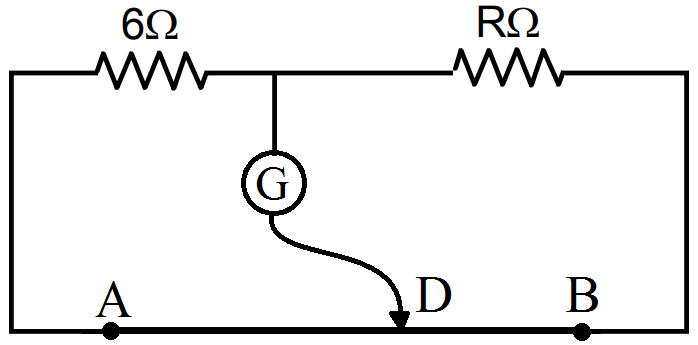
The potentiometer wire AB shown in figure. is 50cm long. When AD = 30cm, no deflection occurs in the galvanometer. Find R.
A thin prism of angle $6.0^\circ,\omega=0.07$ and $\mu_\text{y}=1.50$ is combined with another thin prism having $\omega=0.08$ and $\mu_\text{y}=1.60.$ The combination produces no deviation in the mean ray.
  1. Find the angle of the second prism.
  2. Find the net angular dispersion produced by the combination when a beam of white light passes through it.
  3. If the prisms are similarly directed, what will be the deviation in the mean ray
  4. Find the angular dispersion in the situation described in (c).
A converging lens of focal length 15cm and a converging mirror of focal length 10cm are placed 50cm apart with common principal axis. A point source is placed in between the lens and the mirror at a distance of 40cm from the lens. Find the locations of the two images formed.