Question
  1. Derive the expression for the torque acting on the rectangular current carrying coil of a galvanometer. Why is the magnetic field made radial?
  2. An $\alpha-$particle is accelerated through a potential difference of 10kV and moves along x-axis. It enters in a region of uniform magnetic field $B = 2 \times 10^{–3}T$ acting along y-axis. Find the radius of its path. (Take mass of $\alpha-$particle $= 6.4 \times 10^{–27}kg$).
Answer

  1.  

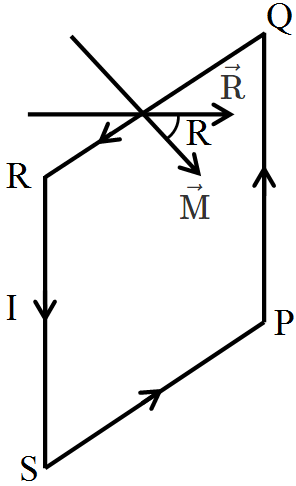
$\text{PQ}=\text{RS}=1$
$\text{PS}=\text{QR}=\text{b}$
Area $\text{A}=\text{lb}$
$\vec{\text{M}}\times\vec{\text{IA}}$
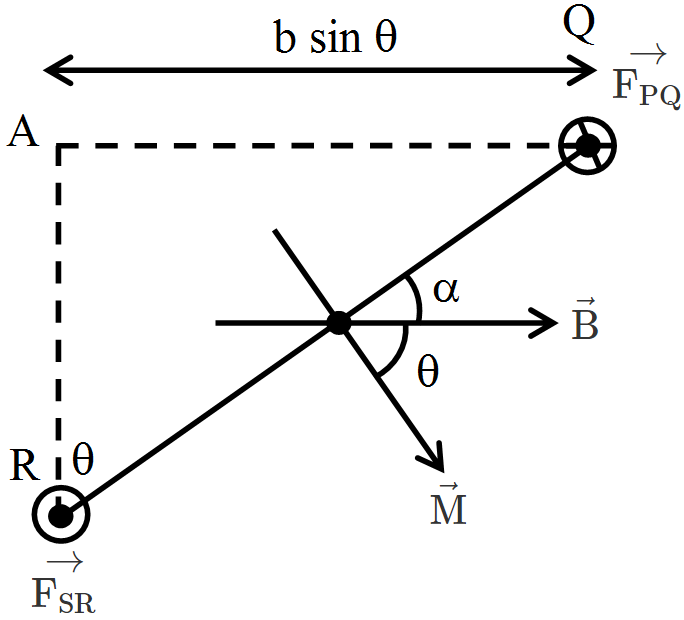
$\overrightarrow{\text{F}_{\text{PQ}}}=\text{IlB}\otimes$
$\overrightarrow{\text{F}_{\text{RS}}}=\text{IlB}\ominus$
$\overrightarrow{\text{F}_{\text{QR}}}=\text{IbB}\sin(90^\circ-\theta)=\text{IbB}\cos\theta\text{ up}$
$\overrightarrow{\text{F}_{\text{SP}}}=\text{IbB}\sin(90^\circ-\theta)=\text{IbB}\cos\theta\text{ down}$
Only $\overrightarrow{\text{F}_{\text{PB}}}\ \& \ \overrightarrow{\text{F}_{\text{RS}}}$ form a couple to apply torque on loop,

$\tau=\text{MB}\sin\theta$
Magnetic field is taken radial in Galvanometer coil in order to create $\theta=90^\circ$ at every orientation of coil in the magnetic field so that current varies linearly with deflection.
  1. $\text{qV}=\frac{1}{2}\text{mv}^2$
$\Rightarrow\text{v}=\sqrt{\frac{2\text{qV}}{\text{m}}}$
$\because\vec{\text{v}}=\text{vi}\perp\vec{\text{B}}(=\text{Bj})$
$\therefore$ Particle deflects along circular path of radius $\text{r}=\frac{\text{mv}}{\text{qB}}=\frac{\text{m}}{\text{qB}}\sqrt{\frac{2\text{qv}}{\text{m}}}=\frac{1}{\text{B}}\sqrt{\frac{2\text{mv}}{\text{q}}}$
$\text{r}=\frac{1}{2\times10^{-3}}\sqrt{\frac{2\times6.4\times10^{-27}\times10^4}{2\times1.6\times10^{-19}}}$
$=\frac{1}{2\times10^{-3}}\times2\times10^{-2}$
$=10^1\text{m}=10\text{m}.$

Need a full question paper?

Generate a complete, print-ready paper with questions like this in minutes — across 16+ boards, with answer keys.

Start Generating Free

Similar questions

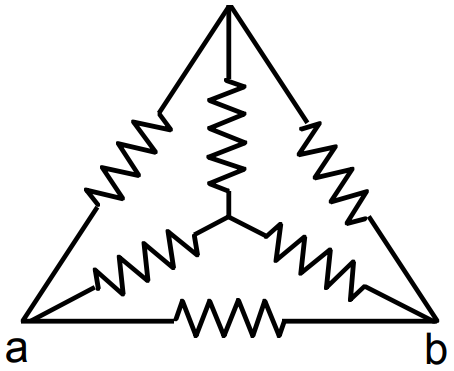
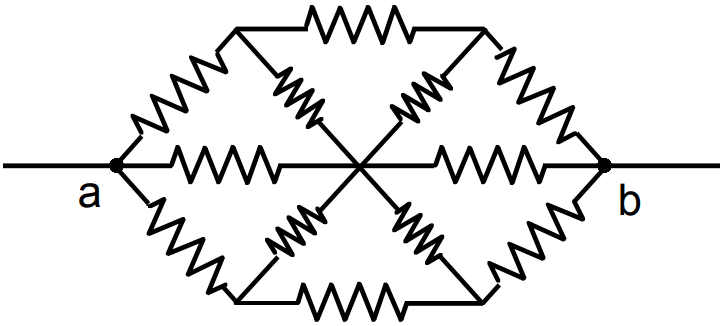
Find the equivalent resistance of the circuits shown in the figure. between the points a and b. Each resistor has resistance r.

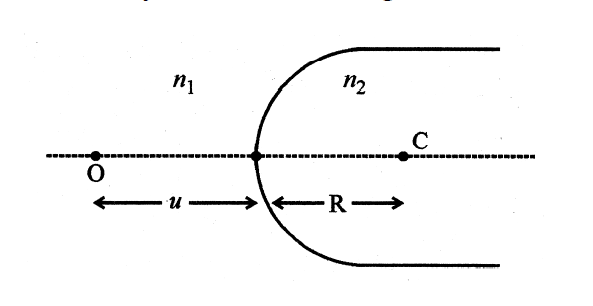
A point object 'O' is kept in a medium of refractive index $n_1$ in front of a convex spherical surface of radius of curvature R which separates the second medium of refractive index $n_2$ from the first one, as shown in the figure. Draw the ray diagram showing the image formation and deduce the relationship between the object distance and the image distance in terms of $n_1, n_2$ and R.
  1.  
  1. hen the image formed above acts as a virtual object for concave spherical, surface separating the medium $n_2$ from $n_1 (n_2> n_1),$ draw this ray diagram and write the similar (similar to (a) relation. Hence obtain the expression for the lens maker's formula.
The coil of an electric bulb takes 40 watts to start glowing. If more than 40W is supplied, 60% of the extra power is converted into light and the remaining into heat. The bulb consumes 100W at 220V. Find the percentage drop in the light intensity at a point if the supply voltage changes from 220V to 200V.
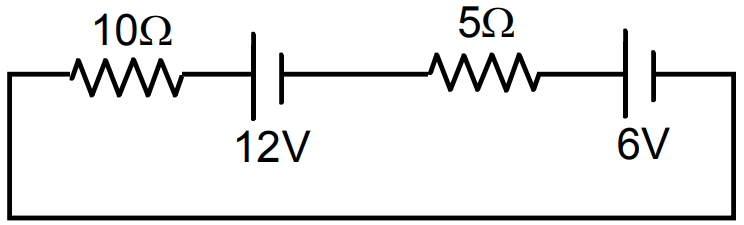
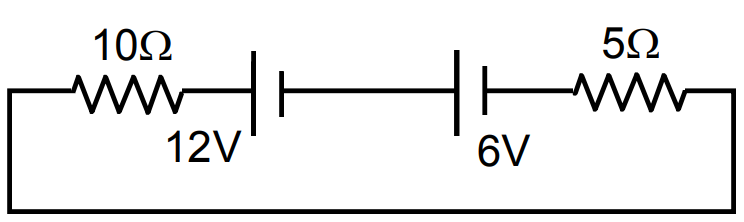
Consider the circuit shown in the figure. Find (a) the current in the circuit (b) the potential drop across the $5\Omega$ resistor (c) the potential drop across the $10\Omega$ resistor. (d) Answer the parts (a), (b) and (c) with reference to the figure.

  1. With the help of a diagram, explain the principle and working of a moving coil galvanometer.
  2. What is the importance of a radial magnetic field and how is it produced?
  3. Why is it that while using a moving coil galvanometer as a voltmeter a high resistance in series is required whereas in an ammeter a shunt is used?
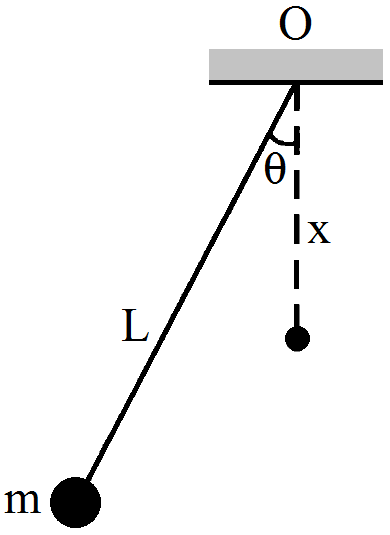
A simple pendulum of length L having a bob of mass m is deflected from its rest position by an angle $\theta$ and released (figure). The string hits a peg which is fixed at a distance x below the point of suspension and the bob starts going in a circle centred at the peg.
  1. Assuming that initially the bob has a height less than the peg, show that the maximum height reached by the bob equals its initial height.
  2. If the pendulum is released with $\theta=90^\circ$ and $\text{x}=\frac{\text{L}}{2}$ find the maximum height reached by the bob above its lowest position before the string becomes slack.
  3. Find the minimum value of $\frac{\text{x}}{\text{L}}$ for which the bob goes in a complete circle about the peg when the pendulum is released from $\theta=90^\circ.$
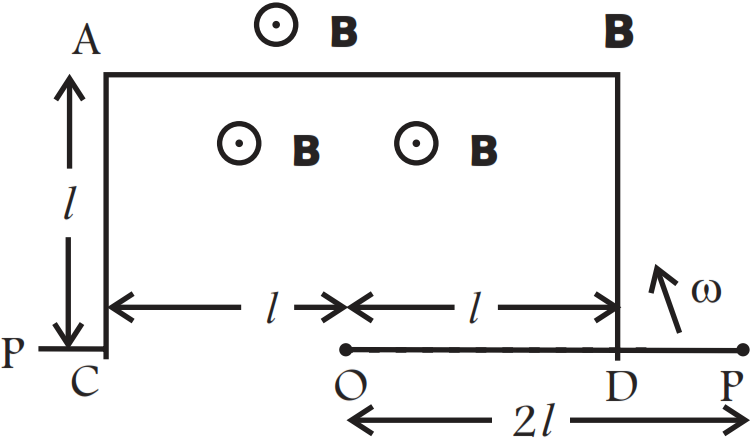
ODBAC is a fixed rectangular conductor of negilible resistance (CO is not connnected) and OP is a conductor which rotates clockwise with an angular velocity $\omega$ (Fig). The entire system is in a uniform magnetic field B whose direction is along the normal to the surface of the rectangular conductor ABDC. The conductor OP is in electric contact with ABDC. The rotating conductor has a resistance of $\lambda$ per unit length. Find the current in the rotating conductor, as it rotates by 180º.
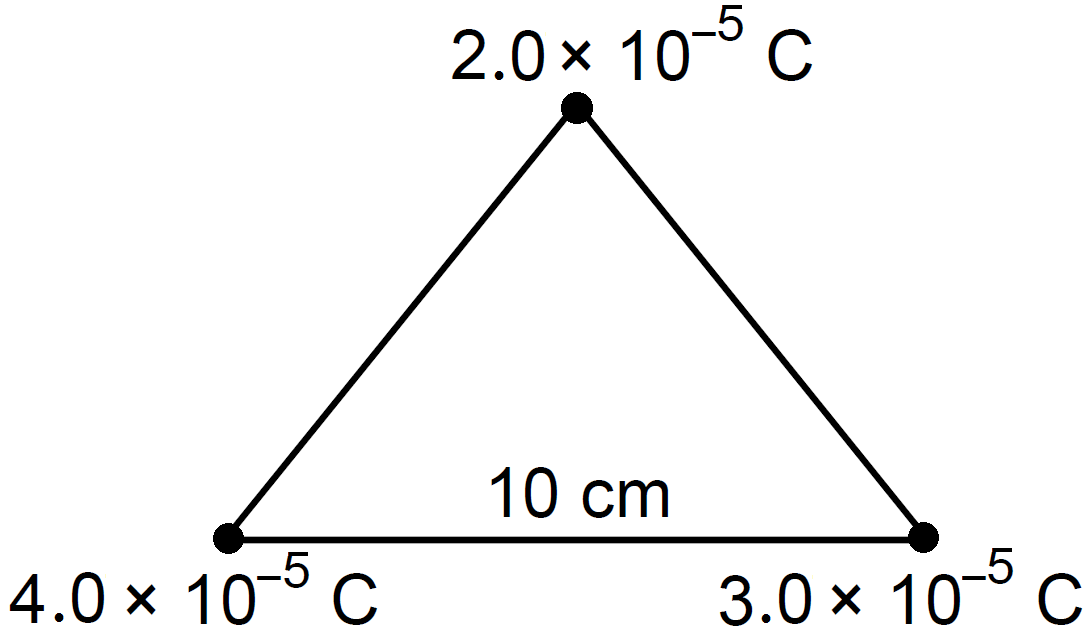
How much work has to be done in assembling three charged particles at the vertices of an equilateral triangle as shown in figure?
  1. Deduce an expression for the frequency of revolution of a charged particle in a magnetic field and show that it is independent of velocity or energy of the particle.
  2. Draw a schematic sketch of a cyclotron. Explain, giving the essential details of its construction, how it is used to accelerate the charged particles.
In an agricultural experiment, a solution containing 1 mole of a radioactive material $\Big(\text{t}_{\frac{1}{2}}=14.3\text{ days}\Big)$ was injected into the roots of a plant. The plant was allowed 70 hours to settle down and then activity was measured in its fruit. If the activity measured was $1\mu\text{Ci},$ what per cent of activity is transmitted from the root to the fruit in steady state?