Question
Consider the situation of the previous problem:
  1. Find the tension in the string in equilibrium.
  2. Suppose the ball is slightly pushed aside and released. Find the time period of the small oscillations.
Answer


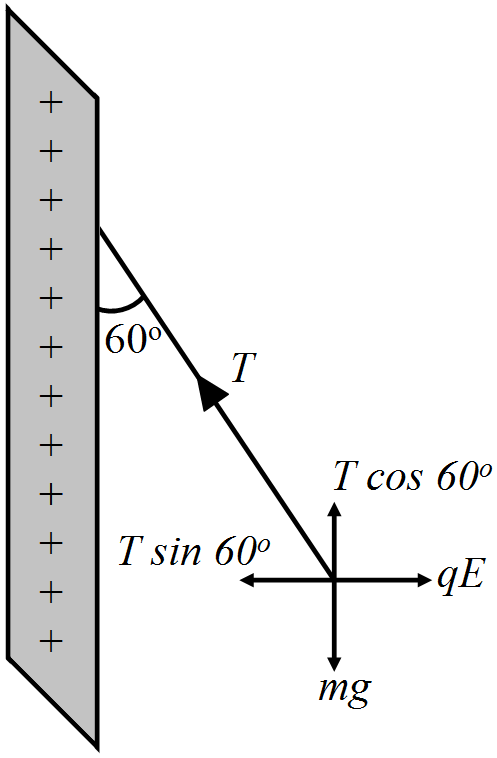
In equilibrium state, the thread makes an angle of $60^\circ$ with the vertical.
The tension in the thread is resolved into horizontal and vertical components.
Then, tension in the string in equilibrium,
$\text{T}\cos60^\circ=\text{mg}$
$\text{T}\times\frac{1}{2}=\big(10\times10^{-3}\big)\times10$
$\text{T}=\big(10\times10^{-3}\big)\times10\times2=0.20\text{N}$
$(b)$ As it is displaced from equilibrium, net force on the ball,
$\text{F}=\sqrt{(\text{mg})^2+\Big(\frac{\text{q}\sigma}{2\epsilon_0}\Big)^2}$
As $F = ma$
$\Rightarrow\text{a}=\sqrt{(\text{g})^2+\Big(\frac{\text{q}\sigma}{m2\epsilon_0}\Big)^2}$
The surface charge density of the plate $($as calculated in the previous question$),$
$\sigma=7.5\times10^{-7}\text{C/m}^2$
Charge on the ball, $q = 4 \times 10^{-6}C$
Mass of the ball $, m = $The time period of oscillation of the given simple pendulum,
$\text{T}=2\pi\sqrt{\frac{\text{l}}{\text{g}}}$
$=2\pi\sqrt{\frac{10\times10^{-2}}{9.8}}$
$=0.45\text{ sec}$

Need a full question paper?

Generate a complete, print-ready paper with questions like this in minutes — across 16+ boards, with answer keys.

Start Generating Free

Similar questions

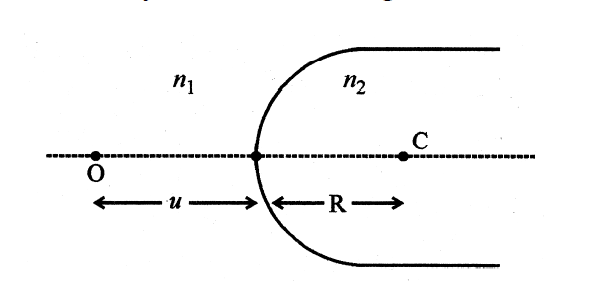
A point object $'O\ '$ is kept in a medium of refractive index $n_1$ in front of a convex spherical surface of radius of curvature $R$ which separates the second medium of refractive index $n_2$ from the first one, as shown in the figure. Draw the ray diagram showing the image formation and deduce the relationship between the object distance and the image distance in terms of $n_1, n_2$ and $R.$​​​​​​​
  1.  
  1. hen the image formed above acts as a virtual object for concave spherical, surface separating the medium $n_2$ from $n_1 (n_2> n_1),$ draw this ray diagram and write the similar $($similar to $(a)$ relation. Hence obtain the expression for the lens maker's formula.
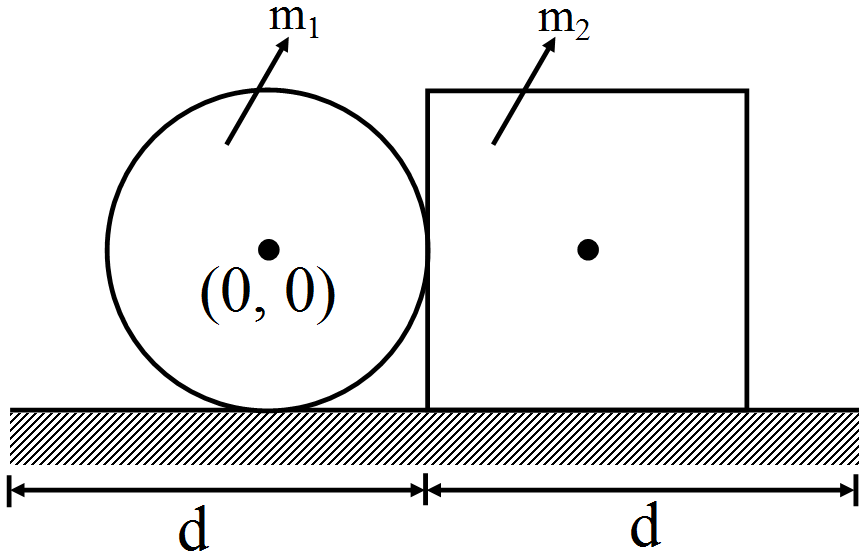
A square plate of edge d and a circular disc of diameter d are placed touching each other at the midpoint of an edge of the plate as shown in figure. Locate the centre of mass of the combination, assuming same mass per unit area for the two plates.
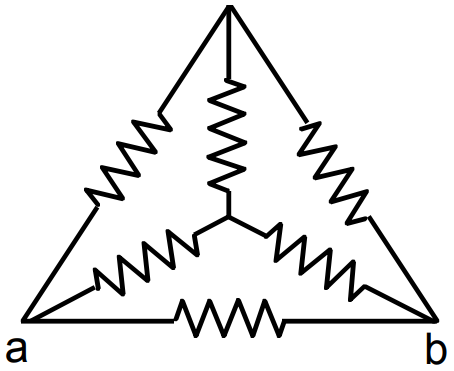
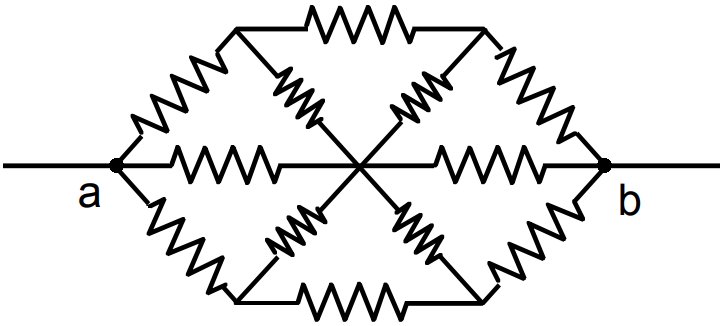
Find the equivalent resistance of the circuits shown in the figure. between the points a and b. Each resistor has resistance r.

Describe the main difference between Fraunhofer and Fresnel's diffraction. 
Three capacitors having capacitances $20\mu\text{F},\ 30\mu\text{F}$ and $40\mu\text{F}$ are connected in series with a 12V battery. Find the charge on each of the capacitors. How much work has been done by the battery in charging the capacitors?
Air is pumped into an automobile tyre's tube up to a pressure of 200kPa in the morning when the air temperature is 20°C. During the day the temperature rises to 40°C and the tube expands by 2%. Calculate the pressure of the air in the tube at this temperature.
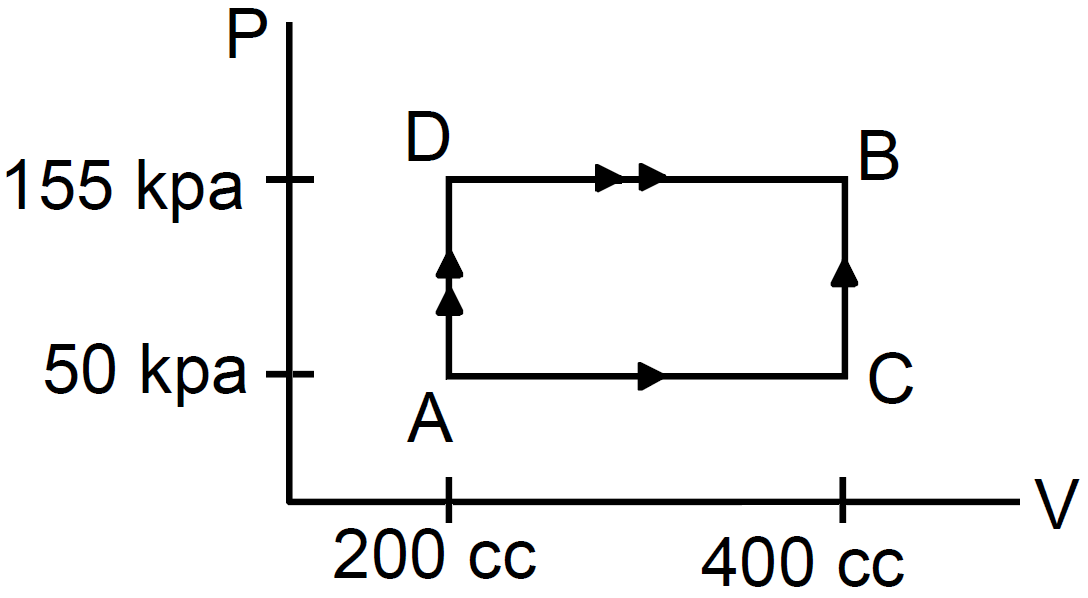
$50\ cal$ of heat should be supplied to take a system from the state $A$ to the state $B$ through the path $\text{ACB}$ as shown in figure. Find the quantity of heat to be supplied to take it from $A$ to $B$ via $\text{ADB.}$
A calorimeter contains $50g$ of water at $50^\circ C$. The temperature falls to $45^\circ C$ in $10$ minutes. When the calorimeter contains $100g$ of water·at $50^\circ 0$, it takes $18$ minutes for the temperature to become $45^\circ C$. Find the water equivalent of the calorimeter.
Consider the de$-$Broglie wavelength of an electron and a proton. Which wavelength is smaller if the two particles have.
  1. The same speed.
  2. The same momentum.
  3. The same energy?.
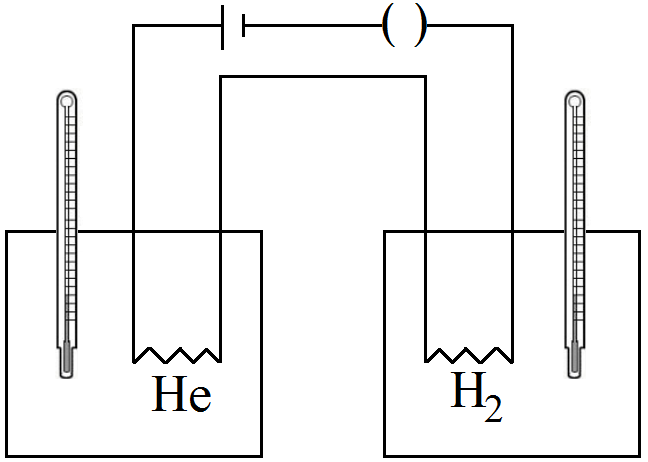
The figure shows two vessels with adiabatic walls, one containing $0.1g$ of helium $\big(\gamma=1.67,\text{M}=4\text{g-mol}^{-1}\big)$ and the other containing some amount of hydrogen $\big(\gamma=1.4,\text{M}=2\text{g-mol}^{-1}\big).$ Initially, the temperatures of the two gases are equal. The gases are electrically heated for some time during which equal amounts of heat are given to the two gases. It is found that the temperatures rise through the same amount in the two vessels. Calculate the mass of hydrogen.