Question
Consider the situation of the previous problem. Take "the table plus the ball" as the system. Friction between the table and the ball is then an internal force. As the ball slows down, the momentum of the system decreases. Which external force is responsible for this change in the momentum?
Answer

In this case as friction is internal force, The force applied by table offered to the ball is reason of decrease in momentum of the ball. (As Newton's third law as ball moves forward the table exerts some force on the ball that is in opposite direction)

Need a full question paper?

Generate a complete, print-ready paper with questions like this in minutes — across 16+ boards, with answer keys.

Start Generating Free

Similar questions

Calculate the dimensions of:
  1. $\int\vec{\text{E}}.\vec{\text{dl}}.$
  2. $\text{vBl}$
  3. $\frac{\text{d}\psi_{\text{B}}}{\text{dt}}$
The symbols have their usual meanings.
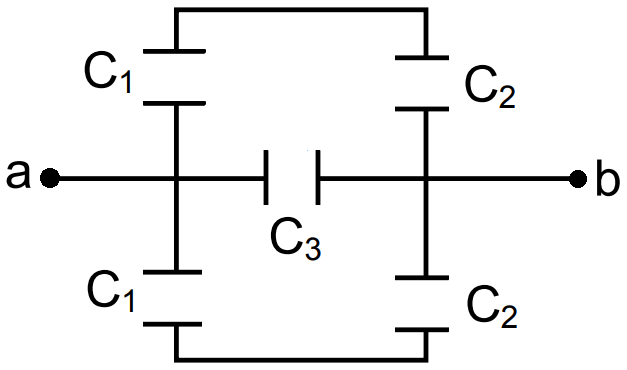
Find the equivalent capacitance of the syatem shown in figure between the points a and b.
A Young's double slit apparatus has slits separated by 0.28mm and a screen 48cm away from the slits. The whole apparatus is immersed in water and the slits are illuminated by the red light ($\lambda=700\text{nm}$ in vacuum). Find the fringe-width of the pattern formed on the screen.
A circular coil of radius 2.0cm has 500 turns and carries a current of 1.0A. Its axis makes an angle of 30° with the uniform magnetic field of magnitude 0.40 T that exists in the space. Find the torque acting on the coil.
The pendulum of a clock is replaced by a spring-mass system with the spring having spring constant 0.1N/m. What mass should be attached to the spring?
A square coil of 200 turns of size $\frac{50}{\pi}$ is rotated in a magnetic field of 2.0 weber/ at the speed of 1200 rotations/minute. Calculate the magnitude of maximum induced electromotive force in the coil.
Write the principle of capacitor.
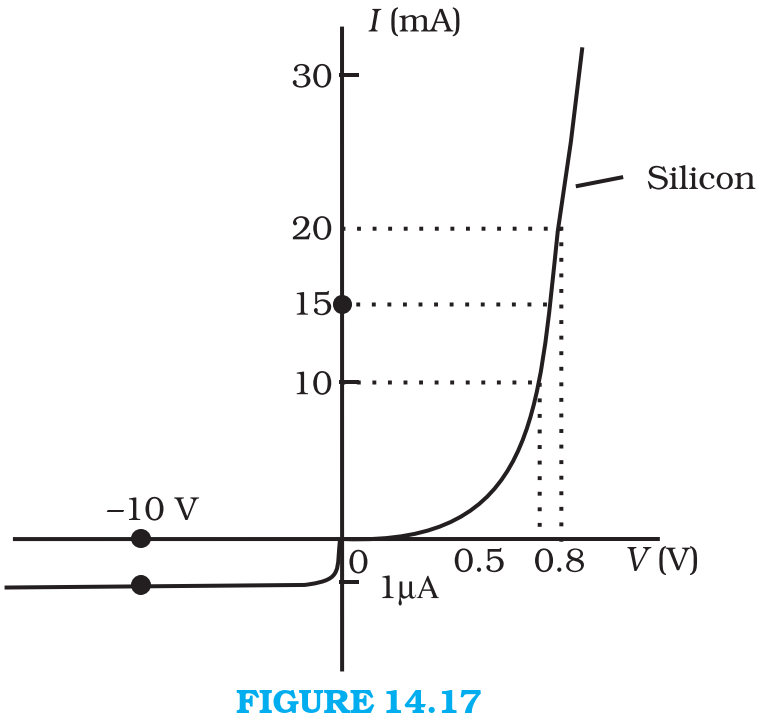
The $V-I$ characteristic of a silicon diode is shown in the Fig. 14.17. Calculate the resistance of the diode at (a) $I_D=15 mA$ and (b) $V_D=-10 V$.
Image
A long narrow horizontal slit is placed 1mm above a horizontal plane mirror. The interference between the light coming directly from the slit and that after reflection is seen on a screen 1.0m away from the slit. Find the fringe-width if the light used has a wavelength of 700nm.
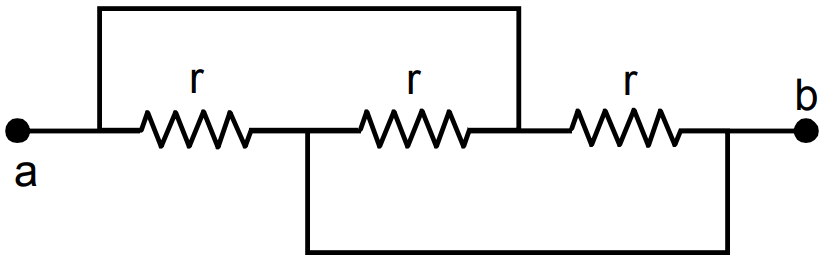
Find the equivalent resistance of the network shown in figure. between the points a and b.