MCQ
Consider two containers A and B containing identical gases at the same pressure, volume and temperature. The gas in container A is compressed to half of its original volume isothermally while the gas in container B is compressed to half of its original value adiabatically. The ratio of final pressure of gas in B to that of gas in A is
  • A
    $2^{\gamma-1}$
  • B
    $\Big(\frac{1}{2}\Big)^{\gamma-1}$
  • C
    $\Big(\frac{1}{1-\gamma}\Big)^2$
  • D
    $\Big(\frac{1}{\gamma-1}\Big)^2$

Answer

  1. $2^{\gamma-1}$

Explanation:

According to the P-V diagram shown for the container A (which is going through isothermal process) and for container B (which is going through adiabatic process).
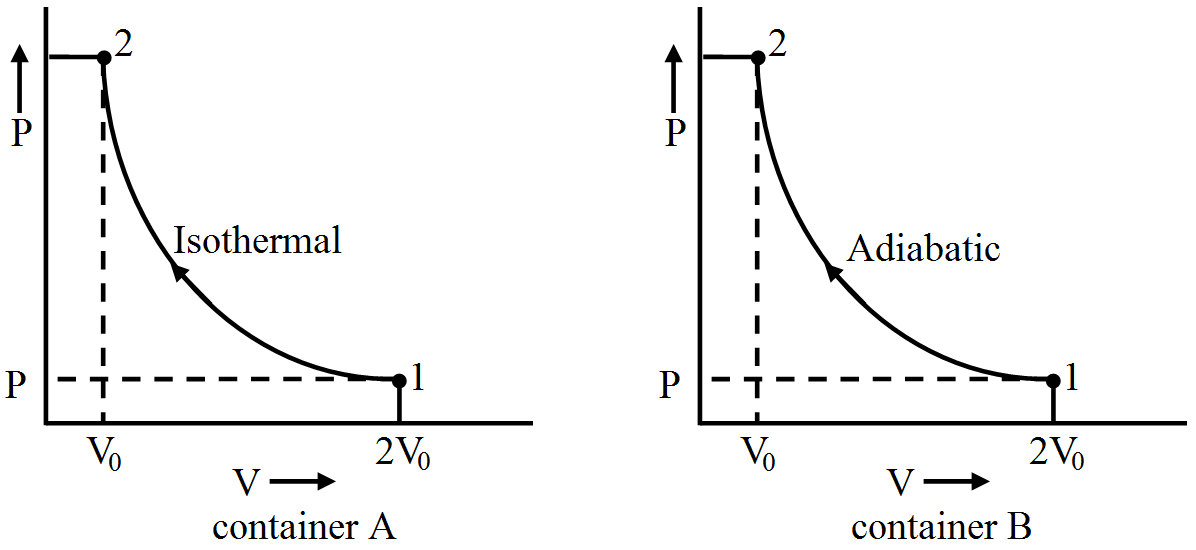
Both the process involves compression of the gas.

(I) Isothermal compression (gas A) (during 1 → 2)

$\text{P}_{1}\text{V}_{1}=\text{P}_{2}\text{V}_{2}$

$\Rightarrow\text{P}_{0}(2\text{V}_{0})^\gamma=\text{P}_{2}(\text{V}_{0})^\gamma$

$\Rightarrow\text{P}_{0}(2\text{V}_{0})=\text{P}_{2}(\text{V}_{0})$

(ii) Adiabatic compression, (gas B) (during 1 → 2)

$\text{P}_{1}\text{V}_{1} ^\gamma=\text{P}_{2}\text{V}_{2}^\gamma$

$\text{P}_{0}(2\text{V}_{0})^\gamma=\text{P}_{2}(\text{V}_{0})^\gamma$

$\text{P}_{2}=\Big(\frac{2\text{V}_{0}}{\text{V}_{0}}\Big)^\gamma\text{P}_{0}=(2)^\gamma\text{P}_{0}$

Hence $\frac{(\text{P}_{2})_\text{B}}{(\text{P}_{2})_\text{A}}=$ Ratio of final pressure $=\frac{(2)^\gamma\text{P}_{0}}{2\text{P}_{0}}=2^{\gamma-1}$

where, $\gamma$ is ratio of specific heat capacities for the gas.
Need a full question paper?

Generate a complete, print-ready paper with questions like this in minutes — across 16+ boards, with answer keys.

Start Generating Free

Similar questions

Two trains travelling on the same track are approaching each other with equal speeds of $40\, m/s$. The drivers of the trains begin to decelerate simultaneously when they are just $2.0\, km$ apart. Assuming the decelerations to be uniform and equal, the value of the deceleration to barely avoid collision should be.........$m/{s^2}$
A particle of mass $m$ executes simple harmonic motion with amplitude $a$ and frequency $v$. The average kinetic energy during its motion from the position of equilibrium to the end is
If the velocity of sound in air is $350 m/s$. Then the fundamental frequency of an open organ pipe of length $50\,cm,$ will be ............... $\mathrm{Hz}$
The graph between velocity and position for a damped oscillation will be
A free body of mass $8\, kg$ is travelling at $2\, meter$ per second in a straight line. At a certain instant, the body splits into two equal parts due to internal explosion which releases $16 \,joules$ of energy. Neither part leaves the original line of motion finally
A string of mass 2.5kg is under a tension of 200N. The length of the stretched string is 20.0m. If the transverse jerk is struck at one end of the string, the disturbance will reach the other end in:
  1. One second
  2. 0.5 second
  3. 2 seconds
  4. Data given is insufficient.
Two identical vessels $A \& B$ contain equal amount of ideal monoatomic gas. The piston of $A$ is fixed but that of $B$ is free. Same amount of heat is absorbed by$A \& B$. If $B'$s internal energy increases by $100 \,\,J$ the change in internal energy of $A$ is ...... .$J$
Equal masses of two liquids are filled in two similar calorimeters. The rate of cooling will
Assuming the earth to be a sphere of uniform mass density, the weight of a body at a depth $d=\frac{R}{2}$ from the surface of earth, if its werght on the surface of earth is $200\,N$, will be $...........\,N$ ( $Given R =$ Radrus of earth)
A body rolls down an inclined plane without slipping. The kinetic energy of rotation is $50 \,\%$ of its translational kinetic energy. The body is :