MCQ
Consider two identical galvanometers and two identical resistors with resistance $R$. If the internal resistance of the galvanometers $R_{ C } < R / 2$

($A$) The maximum voltage range is obtained when all the components are connected in series

($B$) The maximum voltage range is obtained when the two resistors and one galvanometer are connected in series, and the second galvanometer is connected in parallel to the first galvanometer

($C$) The maximum current range is obtained when all the components are connected in parallel

($D$) The maximum current range is obtained when the two galvanometers are connected in series and the combination is connected in parallel with both the resistors

  • A
    $B,D$
  • B
    $B,A$
  • C
    $B,C$
  • D
    $A,C$

Answer

Need a full question paper?

Generate a complete, print-ready paper with questions like this in minutes — across 16+ boards, with answer keys.

Start Generating Free

Similar questions

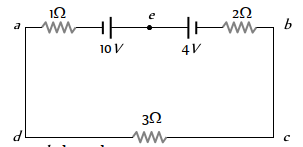
The magnitude and direction of the current in the circuit shown will be

Image

The length of the tube of a microscope is $10 \mathrm{~cm}$. The focal lengths of the objective and eye lenses are $0.5 \mathrm{~cm}$ and $1.0 \mathrm{~cm}$. The magnifying power of the microscope is about
When a $1.0 \mathrm{~kg}$ mass hangs attached to a spring of length $50 \mathrm{~cm}$, the spring stretches by $2 \mathrm{~cm}$. The mass is pulled down until the length of the spring becomes $60 \mathrm{~cm}$. What is the amount of elastic energy stored in the spring in this condition, if $g=10 \mathrm{~m} / \mathrm{s}$
A $100$ watt bulb working on $200$ volt and a $200$ watt bulb working on $100$ volt have
A bar magnet is oscillating in the Earth's magnetic field with a period $T$. What happens to its period and motion if its mass is quadrupled
Energy bands in solids are a consequence of
A boat takes two hours to travel $8 km$ and back in still water. If the velocity of water is $4 km / h$, the time taken for going upstream $8 km$ and coming back is
An electron jumps from the $4$ orbit to the $2$ orbit of hydrogen atom. Given the Rydberg's constant $R=10^5 \ cm ^{-1}$. The frequency in $Hz$ of the emitted radiation will be
The binding energy of the innermost electron in tungsten is $40 \mathrm{keV}$. To produce characteristic $X-$rays using a tungsten target in an $X-$rays tube the potential difference $V$ between the cathode and the anticathode should be
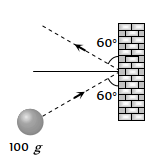
A mass of $100 \mathrm{~g}$ strikes the wall with speed $5 \mathrm{~m} / \mathrm{s}$ at an angle as shown in figure and it rebounds with the same speed. If the contact time is $2 \times 10^{-3} \mathrm{sec}$, what is the force applied on the mass by the wall
Image