Question
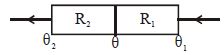
Consider two insulating sheets with thermal resistances $R_1$ and $R_2$ as shown. The temperatures $\theta $ is
Answer

Heat flow in $(1)=$ Heat flow in $(2)$

$\frac{\Delta \mathrm{T}_{1}}{\mathrm{R}_{1}}=\frac{\Delta \mathrm{T}_{2}}{\mathrm{R}_{2}}$

$\frac{\theta_{1}-\theta}{R_{1}}=\frac{\theta-\theta_{2}}{R_{2}} \Rightarrow \theta=\frac{\theta_{1} R_{2}+\theta_{2} R_{1}}{R_{1}+R_{2}}$

Need a full question paper?

Generate a complete, print-ready paper with questions like this in minutes — across 16+ boards, with answer keys.
Start Generating Free

Similar questions

A beam of fast moving alpha particles were directed towards a thin film of gold. The parts $A',\;B'$ and $C'$of the transmitted and reflected beams corresponding to the incident parts $A, B$ and $C$ of the beam, are shown in the adjoining diagram. The number of alpha particles in
The distance between object and its $3$ times magnified virtual image as produced by a convex lens is $20 \mathrm{~cm}$. The focal length of the lens used is $\mathrm{cm}$
Number of visible lines in Balmer's series
In the $s-t$ equation $\left(s=10+20 t-5 t^2\right)$, match the following columns.
Colum $I$ Colum $II$
$(A)$ Distance travelled in $3\,s$ $(p)$ $-20$ units
$(B)$ Displacement in $1\,s$ $(q)$ $15$ units
$(C)$ Initial acceleration $(r)$ $25$ units
$(D)$ Velocity at $4\,s$ $(s)$ $-10$ units
In a Young's double slit experiment the angular width of a fringe formed on a distant screen is $1^{\circ}$. The wavelength fo the light used is $6280 \;\mathring A$. $...........\,mm$ is the distance between the two coherent sources.
There are two spherical balls $A$ and $B$ of the same material with same surface, but the diameter of $A$ is half that of $B$. If $A$ and $B$ are heated to the same temperature and then allowed to cool, then
The degrees of freedom of a stationary rigid body about its axis will be
$TV$ waves have a wavelength range of $1-10 \,meter$. Their frequency range in $MHz$ is
The ratio of kinetic energies of two spheres rolling with equal centre of mass velocities is $2 : 1$. If their radii are in the ratio $2 : 1$; then the ratio of their masses will be
The nuclei ${ }_{6} C^{13}$ and ${ }_{7} N^{14}$ can be described as