MCQ
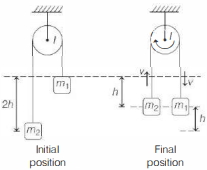
Consider two masses with $m_1 > m_2$ connected by a light inextensible string that passes over a pulley of radius $R$ and moment of inertia $I$ about its axis of rotation. The string does not slip on the pulley and  the pulley turns without friction. The two masses are released from rest separated by a vertical distance $2 h$. When the two masses pass each other, the speed of the masses is proportional to
  • $\sqrt{\frac{m_1-m_2}{m_1+m_2+\frac{I}{R^2}}}$
  • B
    $\sqrt{\frac{\left(m_1+m_2\right)\left(m_1-m_2\right)}{m_1+m_2+\frac{1}{R^2}}}$
  • C
    $\sqrt{\frac{m_1+m_2+\frac{I}{R^2}}{m_1-m_2}}$
  • D
    $\sqrt{\frac{1}{R^2}}$

Answer

Correct option: A.
$\sqrt{\frac{m_1-m_2}{m_1+m_2+\frac{I}{R^2}}}$
a
(a) Loss of potential energy of $m_1$ appears as kinetic energies of $m_1, m_2$ and pulley and also as potential energies of $m_1$ and $m_2$. So, by energy conservation, we get

$m_1 g h=\frac{1}{2} m_1 v^2+\frac{1}{2} m_2 v^2+\frac{1}{2} I \omega^2+m_2 g h$

Here, $m_1$ falls by distance $h, m_2$ rises by distance $h , v=$ speed of $m_1=$ speed of $m_2$ as they passes each other and $\omega=$ angular speed of pulley $=\frac{v}{R}$.

$\text { So, }\left(m_1-m_2\right) g h=\frac{v^2}{2}\left(m_1+m_2+\frac{I}{R^2}\right)$

$\therefore \quad v=\frac{2 g h\left(m_1-m_2\right)}{\left(m_1+m_2+\frac{I}{R^2}\right)}$

$\text { or } \quad v \propto \sqrt{\left(\frac{m_1-m_2}{m_1+m_2}+\frac{I}{R^2}\right)}$

Need a full question paper?

Generate a complete, print-ready paper with questions like this in minutes — across 16+ boards, with answer keys.

Start Generating Free

Similar questions

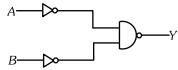
For the following logic circuit, the truth table is:
The diameter of a brass rod is 4 mm and Young's modulus of brass is $9 \times {10^{10}}\,N/{m^2}$. The force required to stretch by $0.1\%$ of its length is
In a uniform electric field, the potential is $10$ $V $ at the origin of coordinates, and $8$ $V$ at each of the points $(1, 0, 0), (0, 1, 0) $ and $(0, 0, 1)$. The potential at the point $(1, 1, 1)$ will be....$V$
The maximum current that flows through a fuse wire before it blows out varies with its radius as
A heat engine is involved with exchange of heat of $1915\, J,$ $-40\, J ,+125\, J$ and $-Q\,J$, during one cycle achieving an efficiency of $50.0 \%$. The value of $Q$ is.......$J$
$A$ particle is rotated in a vertical circle by connecting it to $a$ light rod of length $l$ and keeping the other end of the rod fixed. The minimum speed of the particle when the light rod is horizontal for which the particle will complete the circle is
The ratio of densities of nitrogen and oxygen is $14:16.$ The temperature at which the speed of sound in nitrogen will be same at that in oxygen at $55^oC$ is  ..... $^oC$
If a magnet of pole strength $m$  is divided into four parts such that the length and width of each part is half that of initial one, then the pole strength of each part will be
A body cools in a surrounding which is at a constant temperature of ${\theta _0}$. Assume that it obeys Newton's law of cooling. Its temperature $\theta $ is plotted against time $t$ . Tangents are drawn to the curve at the points $P(\theta = {\theta _1})$ and $Q(\theta = {\theta _2})$. These tangents meet the time axis at angles of ${\varphi _2}$and ${\varphi _1}$, as shown
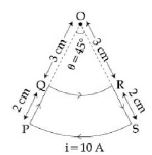
A current loop, having two circular arcs joined by two radial lines is shown in the figure. It carries a current of $10\, A$. The magnetic field at point $O$ will be close to