The diameter of a brass rod is 4 mm and Young's modulus of brass is $9 \times {10^{10}}\,N/{m^2}$. The force required to stretch by $0.1\%$ of its length is
Medium


Download our appand get started for free
Experience the future of education. Simply download our apps or reach out to us for more information. Let's shape the future of learning together!No signup needed.*
Similar Questions
- 1View SolutionThe dimensions of four wires of the same material are given below. In which wire the increase in length will be maximum when the same tension is applied
- 2The Young's modulus of a wire of length $L$ and radius $r$ is $Y$ $N/m^2$. If the length and radius are reduced to $L/2$ and $r/2,$ then its Young's modulus will beView Solution
- 3A metal wire of length $'L'$ is suspended vertically from a rigid support. When a body of mass $M$ is attached to the lower end of wire, the elongation in wire is $'l'$, consider the following statementsView Solution
$(I)$ the loss of gravitational potential energy of mass $M$ is $Mgl$
$(II)$ the elastic potential energy stored in the wire is $Mgl$
$(III)$ the elastic potential energy stored in wire is $\frac{1}{2}\, Mg l$
$(IV)$ heat produced is $\frac{1}{2}\, Mg l$
Correct statement are :-
- 4View SolutionIn solids, inter-atomic forces are
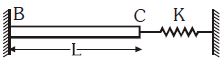
- 5A rod $BC$ of negligible mass fixed at end $B$ and connected to a spring at its natural length having spring constant $K = 10^4\ N/m$ at end $C$, as shown in figure. For the rod $BC$ length $L = 4\ m$, area of cross-section $A = 4 × 10^{-4}\ m^2$, Young's modulus $Y = 10^{11} \ N/m^2$ and coefficient of linear expansion $\alpha = 2.2 × 10^{-4} K^{-1}.$ If the rod $BC$ is cooled from temperature $100^oC$ to $0^oC,$ then find the decrease in length of rod in centimeter.(closest to the integer)View Solution
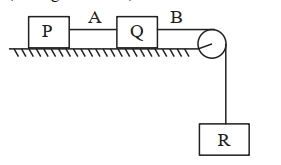
- 6Each of three blocks $P$, $Q$ and $R$ shown in figure has a mass of $3 \mathrm{~kg}$. Each of the wire $A$ and $B$ has cross-sectional area $0.005 \mathrm{~cm}^2$ and Young's modulus $2 \times 10^{11} \mathrm{~N} \mathrm{~m}^{-2}$. Neglecting friction, the longitudinal strain on wire $B$ is____________ $\times 10^{-4}$. $\left(\right.$ Take $\mathrm{g}=10 \mathrm{~m} / \mathrm{s}^2$ )View Solution
- 7Increase in length of a wire is $1\, mm$ when suspended by a weight. If the same weight is suspended on a wire of double its length and double its radius, the increase in length will be ........ $mm$View Solution
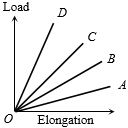
- 8View SolutionThe load versus elongation graph for four wires of the same material is shown in the figure. The thickest wire is represented by the line
- 9View SolutionWhich of the following affects the elasticity of a substance
- 10When a rubber ball is taken to the bottom of a sea of depth $1400 \,m$, its volume decreases by $2 \%$. The Bulk modulus of rubber ball is .................. $\times 10^8 N / m ^2$ [density of water is $1 \,g cc$ and $g=10 \,m / s ^2$ ]View Solution