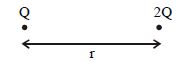
Mass of charge $Q$ is $m$ and mass of charge $2Q$ is $4\,m$ . If both are released from rest, then what will be $K.E.$ of $Q$ at infinite separation
Medium


Download our appand get started for free
Experience the future of education. Simply download our apps or reach out to us for more information. Let's shape the future of learning together!No signup needed.*
Similar Questions
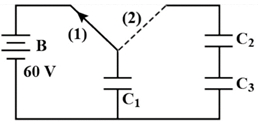
- 1A capacitor $C_1$ is charged up to a voltage $V\, = 60\,V$ by connecting it to battery $B$ through switch $( 1)$, Now $C_1$ is disconnected from battery and connected to a circuit consisting of two uncharged capacitors $C_2\, = 3.0\,\mu F$ and $C_3\,= 6.0\,\mu F$ through a switch $(2)$ as shown in the figure. The sum of final charges on $C_2$ and $C_3$ is......$\mu C$View Solution
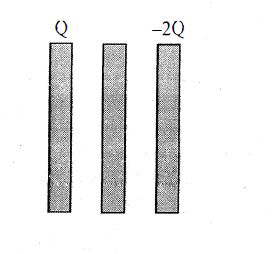
- 2The identical metal plates with large surface areas are kept parallel to each other as shown in figure. The left most plate is given a charge $Q$ , the rightmost a charge $-2Q$ and the middle one remains neutral. Find the charge appearing on the outer surface of the rightmost plateView Solution
- 3An electron with kinetic energy $K _{1}$ enters between parallel plates of a capacitor at an angle $'\alpha'$ with the plates. It leaves the plates at angle $' \beta '$ with kinetic energy $K _{2}$. Then the ratio of kinetic energies $K _{1}: K _{2}$ will be ....... .View Solution
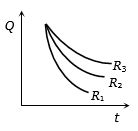
- 4Three identical capacitors are given a charge $Q$ each and they are then allowed to discharge through resistance $R_1, R_2\,$ and $\,R_3$. Their charges, as a function of time shown in the graph below. The smallest of the three resistance isView Solution
- 5A hollow metallic sphere of radius $R$ is given a charge $Q$. Then the potential at the centre isView Solution
- 6$64$ small drops of mercury, each of radius $ r$ and charge $q$ coalesce to form a big drop. The ratio of the surface density of charge of each small drop with that of the big drop isView Solution
- 7Two small equal point charges of magnitude $q$ are suspended from a common point on the ceiling by insulating mass less strings of equal lengths. They come to equilibrium with each string making angle $\theta $ from the vertical. If the mass of each charge is $m,$ then the electrostatic potential at the centre of line joining them will be $\left( {\frac{1}{{4\pi { \in _0}}} = k} \right).$View Solution
- 8Equipotential surfaces associated with an electric field which is increasing in magnitude along the $x$-direction areView Solution
- 9A capacitor stores $60\ \mu C$ charge when connected across a battery. When the gap between the plates is filled with a dielectric , a charge of $120\ \mu C$ flows through the battery. The dielectric constant of the material inserted is :View Solution
- 10A parallel plate capacitor is charged and then disconnected from the source steady $E.M.F.$ The plates are then drawn apart farther. Again it is connected to the same source. Then :View Solution