MCQ
Consider two spherical planets of same average density. Second planet is $8$ times as massive as first planet. The ratio of the acceleration due to gravity of the second planet to that of the first planet is
- A$1$
- ✓$2$
- C$4$
- D$8$
Given, mass of second planet $=8 \times$ mass of first planet
$\Rightarrow M_2=8 M_1 \quad \dots(i)$
$\Rightarrow \pi R_2^3 \times \rho=8 \times \frac{4}{3} \pi R_1^3 \times \rho$
$\therefore$ Density of both planets is same.
$\Rightarrow R_2^3=8 R_1^3$
or $R_2=2 R_1 \quad \dots(ii)$
So, ratio of acceleration due to gravity of the second planet to that of the first planet is
$\frac{g_2}{g_1}=\frac{\left(\frac{G M_2}{R_2^2}\right)}{\left(\frac{G M_1}{R_1^2}\right)}=\left(\frac{M_2}{M_1}\right) \times\left(\frac{R_1}{R_2}\right)^2$
$=\frac{8 M_1}{M_1} \times\left(\frac{R_1}{2 R_1}\right)^2=\frac{2}{1}$
So, $g_2=2 g_1$.
Generate a complete, print-ready paper with questions like this in minutes — across 16+ boards, with answer keys.

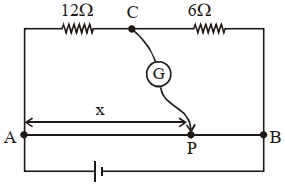
The value of $x,$ to the nearest integer, is ..... $cm$