MCQ
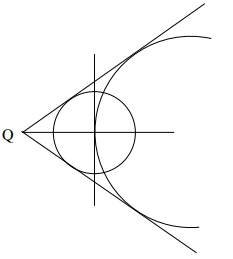
Consider two straight lines, each of which is tangent to both the circle $x ^2+ y ^2=\frac{1}{2}$ and the parabola $y^2=4 x$. Let these lines intersect at the point $Q$. Consider the ellipse whose center is at the origin $O (0,0)$ and whose semi-major axis is $OQ$. If the length of the minor axis of this ellipse is $\sqrt{2}$, then which of the following statement($s$) is (are) $TRUE$?

$(A)$ For the ellipse, the eccentricity is $\frac{1}{\sqrt{2}}$ and the length of the latus rectum is $1$

$(B)$ For the ellipse, the eccentricity is $\frac{1}{2}$ and the length of the latus rectum is $\frac{1}{2}$

$(C)$ The area of the region bounded by the ellipse between the lines $x=\frac{1}{\sqrt{2}}$ and $x=1$ is $\frac{1}{4 \sqrt{2}}(\pi-2)$

$(D)$ The area of the region bounded by the ellipse between the lines $x=\frac{1}{\sqrt{2}}$ and $x=1$ is $\frac{1}{16}(\pi-2)$

  • A
    $A,B$
  • B
    $A,D$
  • $A,C$
  • D
    $A,B,C$

Answer

Correct option: C.
$A,C$
c
Eq. of tangent to $y^2=4 x$ is

$y = mx +\frac{1}{ m }$

Eq. of tangent to $x^2+y^2=\left(\frac{1}{\sqrt{2}}\right)^2$ is

$y=m x \pm \frac{\sqrt{1+m^2}}{\sqrt{2}}$

Comparing (1) and (2), we get $m ^2=1 \Rightarrow m = \pm 1$

$\therefore Q \equiv(-1,0)$

$\therefore$ Eq. of ellipse is $\frac{x^2}{1^2}+\frac{y^2}{\left(\frac{1}{2}\right)}=1$

Eccentricity $=\sqrt{1-\frac{1}{2}}=\frac{1}{\sqrt{2}}$

Length of latus rectum $=2 \cdot \frac{1}{2}=1$

$\text { Area }  =2 \int_{\frac{1}{\sqrt{2}}}^1 \sqrt{\frac{1-x^2}{2}} d x$

$=\sqrt{2}\left[\frac{x}{2} \sqrt{1-x^2}+\frac{1}{2} \sin ^{-1}(x)\right]_{\frac{1}{\sqrt{2}}}^1=\frac{(\pi-2)}{4 \sqrt{2}}$

Need a full question paper?

Generate a complete, print-ready paper with questions like this in minutes — across 16+ boards, with answer keys.

Start Generating Free

Similar questions

If $\alpha \ne \beta $ but ${\alpha ^2} = 5\alpha - 3$ and ${\beta ^2} = 5\beta - 3$, then the equation whose roots are $\alpha /\beta $ and $\beta /\alpha $ is
The angle between tangents to the parabola ${y^2} = 4ax$ at the points where it intersects with the line $x - y - a = 0$, is
Let the tangent and normal at the point $(3 \sqrt{3}, 1)$ on the ellipse $\frac{x^2}{36}+\frac{y^2}{4}=1$ meet the $y$-axis at the points $A$ and $B$ respectively. Let the circle $C$ be drawn taking $A B$ as a diameter and the line $x =2 \sqrt{5}$ intersect $C$ at the points $P$ and $Q$. If the tangents at the points $P$ and $Q$ on the circle intersect at the point $(\alpha, \beta)$, then $\alpha^2-\beta^2$ is equal to
A point moves in such a way that its distance from origin is always $4$. Then the locus of the point is
Three distinct numbers are selected from first $100$ natural numbers. The probability that all the three numbers are divisible by $2$ and $3$ is
If any four numbers are selected and they are multiplied, then the probability that the last digit will be $1, 3, 5$ or $7$ is
Let f : R → R be defined by f(x) = 2x + |x|. Then f(2x) + f(-x) - f(x) =
One diagonal of a square is along the line $8x - 15y = 0$ and one of its vertex is $(1, 2)$ Then the equation of the sides of the square passing through this vertex, are
From the origin chords are drawn to the circle $(x -1)^2 + y^2 = 1$. The equation of the locus of the middle points of these chords is
The eccentricity of the ellipse $\frac{{{{(x - 1)}^2}}}{9} + \frac{{{{(y + 1)}^2}}}{{25}} = 1$ is