Question
Consider two waves passing through the same string. Principle of superposition for displacement says that the net displacement of a particle on the string is sum of the displacements produced by the two waves individually. Suppose we state similar principles for the net velocity of the particle and the net kinetic energy of the particle. Such a principle will be valid for:
  1. Both the velocity and the kinetic energy.
  2. The velocity but not for the kinetic energy.
  3. The kinetic energy but not for the velocity.
  4. Neither the velocity nor the kinetic energy.
Answer

  1. The velocity but not for the kinetic energy.

Explanation:

The principle of superposition Is valid only for vector quantities. Velocity is a vector quantity, but kinetic energy is a scalar quantity.

Need a full question paper?

Generate a complete, print-ready paper with questions like this in minutes — across 16+ boards, with answer keys.

Start Generating Free

Similar questions

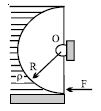
A light semi cylindrical gate of radius $R$ is piovted at its mid point $O$, of the diameter as shown in the figure holding liquid of density $\rho $. The force $F$ required to prevent the rotation of the gate is equal to 
Radius of gyration of a body depends on
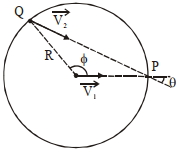
Two particles, one at the centre of a circle of radius $R$, and another at a point $Q$ on the circle, start moving towards a point $P$ on the circle at the same time (see figure below). Both are at rest initially and move with uniform velocities $\vec{V}_1$ and $\overrightarrow{V_2}$ respectively. They also reach the point $P$ at the same time, If the angle between the velocities is $\theta$ and the angle subtended by $P$ and $Q$ at the centre is $\phi$ (as shown in the figure), then
The degrees of freedom of a triatomic gas is
For a satellite to orbit around the earth, which of the following must be true ?
If velocity $v$, acceleration $A$ and force $F$ are chosen as fundamental quantities, then the dimensional formula of angular momentum in terms of $v,\,A$ and $F$ would be
The speed of a projectile at its maximum height is $\frac {\sqrt 3}{2}$ times its initial speed. If the range of the projectile is $P$ times the maximum height attained by it, $P$ is equal to
Due to capillary action, a liquid will rise in a tube, if the angle of contact is
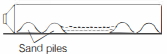
A closed pipe of length $300 \,cm$ contains some sand. A speaker is connected at one of its ends. The frequency of the speaker at which the sand will arrange itself in $20$ equidistant piles is close to .......... $kHz$ (velocity of sound is $300 \,m / s )$
The increase in length on stretching a wire is $0.05\%$. If its Poisson's ratio is $0.4$, then its diameter