MCQ
Consists of two statements, namely, Assertion $(A)$ and Reason $(R).$ For selecting the correct answer, use the following code:
Assertion (A)
Reason (R)
$\sqrt{3}$ is an irrational number.
The sum of rational number and an irrational number is an irrational number.
The correct answer is: $(a), (b), (c), (d).$
  • A
    Both Assertion $(A)$ and Reason $(R)$ are true and Reason $(R)$ is a correct explanation of Assertion $(A).$
  • Both Assertion $(A)$ and Reason $(R)$ are true but Reason is not a correct explanation of Assertion $(A).$
  • C
    Assertion $(A)$ is true and Reason $(R)$ is false.
  • D
    Assertion $(A)$ is false and Reason $(R)$ is true.
Answer

Correct option: B.
Both Assertion $(A)$ and Reason $(R)$ are true but Reason is not a correct explanation of Assertion $(A).$
If possible, let $\sqrt{3}$ be a rational number and its simplest form is $\frac{\text{a}}{\text{b}}.$
Then, $\sqrt{3}=\frac{\text{a}}{\text{b}}\Rightarrow\frac{\text{a}^2}{\text{b}^2}=3\Rightarrow\frac{\text{a}^2}{\text{b}}=3\text{b}$
Clearly, $3b$ is an integer and $\frac{\text{a}^2}{\text{b}}$ is not an integer since $(a, b) = 1$
Thus, we arrive at a contradiction
So, our supposition is wrong
Hence, $\sqrt{3}$ is an irrational number
So, the Assertion $(A)$ is true.
If possible, let the sum of a rational number a and an irrational number $\sqrt{\text{b}}$ be a rational number
Then, $\text{a}+\sqrt{\text{b}}=\text{c}\Rightarrow\sqrt{\text{b}}=\text{c}-\text{a}$
But, the difference of two irrational is a rational
So, $(c - a)$ is rational and thus, $\sqrt{\text{b}}$ is rational
Thus, we arrive at a contradiction
So, our supposition is wrong
Hence, the sum of a rational and an irrational is irrational
So, the reason $(R)$ is true.
Hence, the Assertion $(A)$ and Reason $(R)$ are true but Reason is not a correct explanation of Assertion $(A).$

Need a full question paper?

Generate a complete, print-ready paper with questions like this in minutes — across 16+ boards, with answer keys.

Start Generating Free

Similar questions

Directions: In the following questions, the Assertions $(A)$ and Reason(s) $(R)$ have been put forward. Read both the statements carefully and choose the correct alternative from the following:
Assertion: The graph of qudratic polynomial is parabola.
Reason:If $x+y=3, x^2+y^2=5$ then $x y$ is 2 .
Directions: In the following questions, the Assertions $(A)$ and Reason(s) $(R)$ have been put forward. Read both the statements carefully and choose the correct alternative from the following:
Assertion: The polynomial $3\text{x}^4-4\text{x}^{\frac{-3}{2}}+\text{x}^2$ is not a polynomial.
Reason: Because the power in the term $4\text{x}^{\frac{3}{2}}$ which is not a whole number.
Directions: In the following questions, the Assertions $(A)$ and Reason(s) $(R)$ have been put forward. Read both the statements carefully and choose the correct alternative from the following:
Assertion: A collection of points that has only length and no breadth is known as a line.
Reason: Line can be extended from both side.
Directions: In the following questions, the Assertions $(A)$ and Reason(s) $(R)$ have been put forward. Read both the statements carefully and choose the correct alternative from the following:
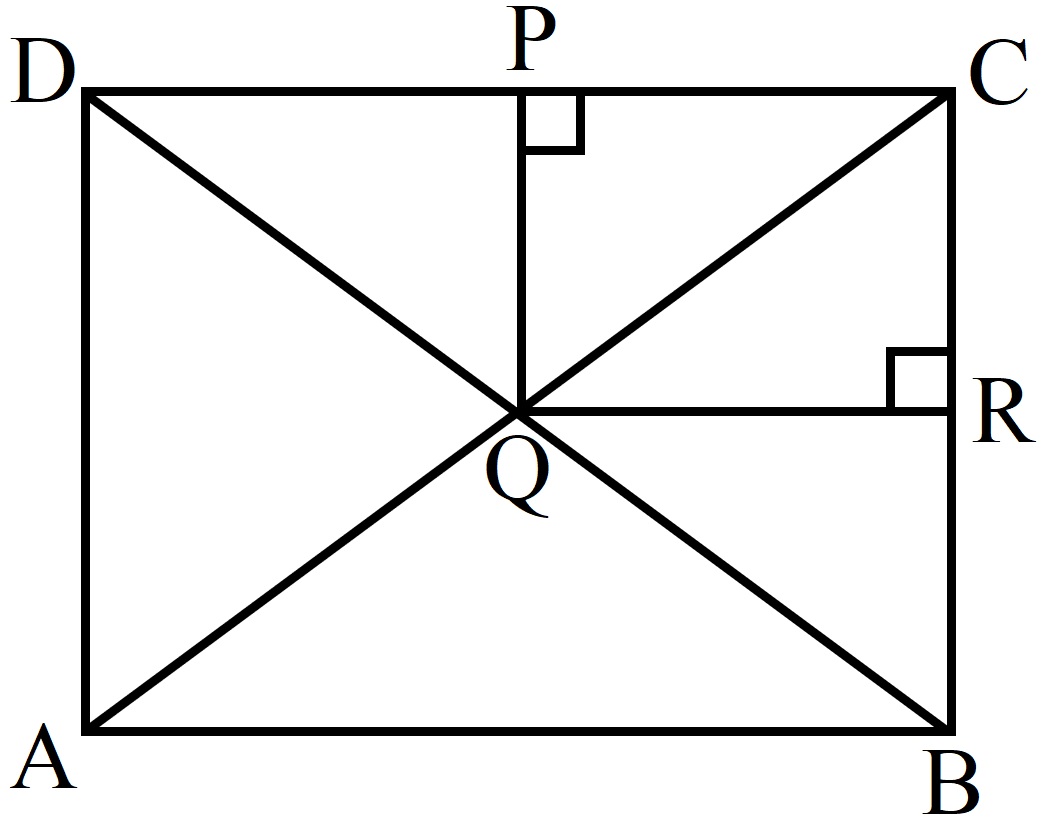
Assertion: $ABCD$ and $PQRC$ are rectangles and $Q$ is a midpoint of $AC $. Then $DP = PC.$

Reason: The line segment joining the midpoint of any two sides of a triangle is parallel to the third side and equal to half of it.
Directions: In the following questions, the Assertions $(A)$ and Reason(s) $(R)$ have been put forward. Read both the statements carefully and choose the correct alternative from the following:
Assertion: The mode and mean is given by $7$ and $8,$ respectively. Then the median is $\frac{22}{5}$
Reason: Mode $= 3$ Median $–\ 5$ Mean.
Directions: In the following questions, the Assertions $(A)$ and Reason(s) $(R)$ have been put forward. Read both the statements carefully and choose the correct alternative from the following:
Assertion: The graph of the linear equation $2x + 3y = 6$ cuts the $y$ - axis at the point $(0, 2)$.
Reason: The equation $2x + 5y = 7$ has a unique solution, if $x, y$ are natural number.
Directions: In the following questions, the Assertions $(A)$ and Reason(s) $(R)$ have been put forward. Read both the statements carefully and choose the correct alternative from the following:
Assertion: Every square is a rectangle.
Reason: Because it is a quadrilateral with all four angles right angles.
Assertion (A): The point (0, 3) lies on the graph of the linear equation 3x + 4y = 12.
Reason (R): (0, 3) satisfies the equation 3x + 4y = 12.
Directions: In the following questions, the Assertions $(A)$ and Reason(s) $(R)$ have been put forward. Read both the statements carefully and choose the correct alternative from the following:
Assertion: The sides of a triangle are in the ratio of $25 : 14 : 12$ and its perimeter is $510m.$ Then the greatest side is $250\ cm.$
Reason: Perimeter of a triangle $= a + b + c,$ where $a, b, c$ are sides of a triangle.
Directions: In the following questions, the Assertions $(A)$ and Reason(s) $(R)$ have been put forward. Read both the statements carefully and choose the correct alternative from the following:
Assertion: Median is the middle observation of an ordered set.
Reason: $1, 2, 4, 5, 5, 6, 8$ here middle observation is $5,$ so the median is $5$