Sample QuestionsNumber systems questions
One sample from each question group in this chapter. Select any group above to see the full set with answer keys.
On simplification, the expression $\frac{5^{\text{n}+2}-6\times5^{\text{n}+1}}{13\times5^{\text{n}}-2\times5^{\text{n}+1}}$ equals:
- A
$\frac{5}{3}$
- ✓
$-\frac{5}{3}$
- C
$\frac{3}{5}$
- D
$-\frac{3}{5}$
Answer: B.
View full solution →Which of the following is rational$?$
- A
$\sqrt{3}$
- B
$\pi$
- C
$\frac{4}{0}$
- ✓
$\frac{0}{4}$
Answer: D.
View full solution →Write the correct answer in the following: $\sqrt[4]{\sqrt[3]{2^2}}$ equals.
- A
$2^{-\frac{1}{6}}$
- B
$2^{-6}$
- ✓
$2^{\frac{1}{6}}$
- D
$2^{6}$
Answer: C.
View full solution →If $\text{a}=7-4\sqrt{3},$ then the value of $\sqrt{\text{a}}+\frac{1}{\sqrt{\text{a}}}$ is:
Answer: D.
View full solution →If $\text{x}=(7+4\sqrt{3})$ than $\Big(\text{x}+\frac{1}{\text{x}}\Big)=?$
- A
$49$
- ✓
$14$
- C
$48$
- D
$8\sqrt{3}$
Answer: B.
View full solution →Directions: In the following questions, the Assertions $(A)$ and Reason(s) $(R)$ have been put forward. Read both the statements carefully and choose the correct alternative from the following:
Assertion: $ \text{x}^4=\frac{\text{X}^5}{\text{x}^1}.$
Reason: $ \frac{\text{a}^{\text{b}}}{\text{a}^{\text{c}}}=\text{a}^{\text{b - c}}.$
- ✓
Both Assertion and Reason are correct and Reason is the correct explanation for Assertion.
- B
Both Assertion and Reason are correct and Reason is not the correct explanation for Assertion.
- C
Assertion is true but the reason is false.
- D
Both assertion and reason are false.
Answer: A.
View full solution →Directions: In the following questions, the Assertions $(A)$ and Reason(s) $(R)$ have been put forward. Read both the statements carefully and choose the correct alternative from the following:
Assertion: $\sqrt2,\sqrt3,$ are examples of irrational numbers.
Reason: An irrational number can be expressed in the form $\frac{\text{p}}{\text{q}}.$
- A
Assertion and Reason both are correct statements and Reason is the correct explanation of Assertion.
- B
Assertion and Reason both are correct statements but Reason is not the correct explanation of Assertion.
- ✓
Assertion is correct statement but Reason is wrong statement.
- D
Assertion is wrong statement but Reason is correct statement.
Answer: C.
View full solution →Directions: In the following questions, the Assertions $(A)$ and Reason(s) $(R)$ have been put forward. Read both the statements carefully and choose the correct alternative from the following:
Assertion: $2, 3, 5, 7$ are the prime numbers.
Reason: A number, other than $1,$ which is not a prime number is called a composite number.
- A
Both Assertion and Reason are correct and Reason is the correct explanation for Assertion.
- ✓
Both Assertion and Reason are correct and Reason is not the correct explanation for Assertion.
- C
Assertion is true but the reason is false.
- D
Both assertion and reason are false.
Answer: B.
View full solution →Directions: In the following questions, the Assertions $(A)$ and Reason(s) $(R)$ have been put forward. Read both the statements carefully and choose the correct alternative from the following:
Assertion: The product of two consecutive positive integers is divisible by $2$
Reason: The decimal expansion of $\frac{15}{169999}=0.0065789$
- A
Both Assertion and Reason are correct and Reason is the correct explanation for Assertion.
- B
Both Assertion and Reason are correct and Reason is not the correct explanation for Assertion.
- ✓
Assertion is true but the reason is false.
- D
Both assertion and reason are false.
Answer: C.
View full solution →Directions: In the following questions, the Assertions $(A)$ and Reason(s) $(R)$ have been put forward. Read both the statements carefully and choose the correct alternative from the following:
Assertion: $32^{\frac{2}{5}}=4$
Reason: $(32)^{\frac{2}{5}}=(2^5)^{\frac{2}{5}}=22=4$
- ✓
Both Assertion and Reason are correct and Reason is the correct explanation for Assertion.
- B
Both Assertion and Reason are correct and Reason is not the correct explanation for Assertion.
- C
Assertion is true but the reason is false.
- D
Both assertion and reason are false.
Answer: A.
View full solution →Every real number will be an irrational number.
Every point on the number line is of the form$\sqrt m$, where $m$ is a natural number.
View full solution →Every irrational number is a real number.
Every rational number is a whole number.
Every integer will be a whole number.
The decimal representation of a rational number is either _______ or ________.
The decimal form of an irrational number is neither ______ nor ______.
Every point on the number line corresponds to a ______ number which many be either ______ or ______.
Every real number is either ________ number or ________ number.
Simplify: $7 ^ { \frac { 1 } { 2 } } \cdot 8 ^ { \frac { 1 } { 2 } }$
View full solution →Simplify: $\frac{11^{1 / 2}}{11^{1 / 4}}$
View full solution →Simplify: $\left(\frac{1}{3^{3}}\right)^{7}$
View full solution →Simplify : $2^{\frac{2}{3}} \cdot 2^{\frac{1}{5}}$
View full solution →Find: $125^{-1 / 3}$
View full solution →Rationalize the denominator of $\frac{1}{{\sqrt 7 - \sqrt 6 }}$
View full solution →Represent $\sqrt{9.3}$ on the number line.
View full solution →Simplify the expression: $(\sqrt{5}-\sqrt{2})(\sqrt{5}+\sqrt{2})$
View full solution →Simplify the expression:
${\left( {\sqrt 5 + \sqrt 2 } \right)^2}$
View full solution →Simplify the expression:
$\left( {3 + \sqrt 3 } \right)\left( {3 - \sqrt 3 } \right)$
View full solution →Look at several examples of rational numbers in the form $\frac{p}{q}(q \neq 0)$, where $p$ and $q$ are integers with no common factors other than $1$ and having terminating decimal representations (expansions). Can you guess what property $q$ must satisfy?
View full solution →What can the maximum number of digits be in the recurring block of digits in the decimal expansion of $\frac{1}{{17}}$? Perform the division to check your answer.
View full solution →You know that $\frac{1}{7}=0 . \overline{142857}$. Can you predict what the decimal expansions of $\frac { 2 } { 7 } , \frac { 3 } { 7 } , \frac { 4 } { 7 } , \frac { 5 } { 7 } , \frac { 6 } { 7 }$ are, without actually doing the long division? If so, how?
View full solution →Write in decimal form and say what kind of decimal expansion: $\frac{{36}}{{100}}$
View full solution →Find five rational numbers between $\frac{3}{5}{\text{ and }}\frac{4}{5}$
View full solution →Locate $\sqrt{3}$ on the number line.
View full solution →Vasu represents $√4.5$ on the number line $PW.$ The length of $TS = 1$ unit. His representation is shown below.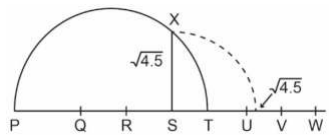
$6.$ Which letter represent 0 of the number line$?$
$A. P$
$B. R$
$C. X$
$D. S$
$7.$ Between which two points does $5.2$ lie on this number line$?$
$A. U$ and $V$
$B. T$ and $U$
$C. S$ and $T$
$D. V$ and $W$
$8.$ Screen size is deined by the distance between two diagonally opposite corners of a screen. $A$
manufacturer can make rectangular display screens as per clients’ demands.
A client purchased a display screen of size $\sqrt{70}$ units from the manufacturer last year. For an upgrade, he wants the same type of screen with a larger display.
What are the possible dimensions of the screen purchased by the client last year?
$9. $The new screen size must be more than double, but it should be less than three times that of the existing one.
Which of the following screen sizes meets the client’s requirement?
$A.$ $\sqrt{145}$ units
$B.$ $\sqrt{175}$ units
$C.$ $2 \sqrt{70}$ units
$D$. $\sqrt{580}$ units
$10.$ The new display screen is to be installed in a space measuring $3 m × 3 m.$ To make the desired screen for the client, what other information is required by the manufacturer? View full solution →Deep draws the spiral of irrational numbers below on a paper.
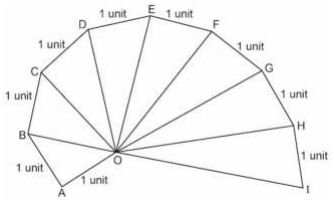
4. What is the length of $OE$ in the spiral$?$
5. Simplify:
A.$ -1$
B. $\sqrt{3}-\sqrt{5}$
C. $-4+\sqrt{15}$
D. $4-2 \sqrt{ } 15$ View full solution →$3.$ Irrational numbers can provide more precision on measuring scale.
What can be the possible arguments in favour and against this statement$?$
View full solution →Which of the following statements is true$?$
- A
Every irrational number can be represented as a fraction.
- ✓
Every irrational number can be represented with the help of decimals.
- C
Every rational number can be represented as a terminating decimal.
- D
Every rational number can be represented as an integer.
Answer: B.
View full solution → A number line consists of an ininite number of points. Points on it are associated with a rational
number.
Khushi says – ‘A point on the number line can represent different forms of a rational number.’
Akash says – ‘I think each point represents a unique rational number.’
Who is correct? Give an example to support your argument.