Question
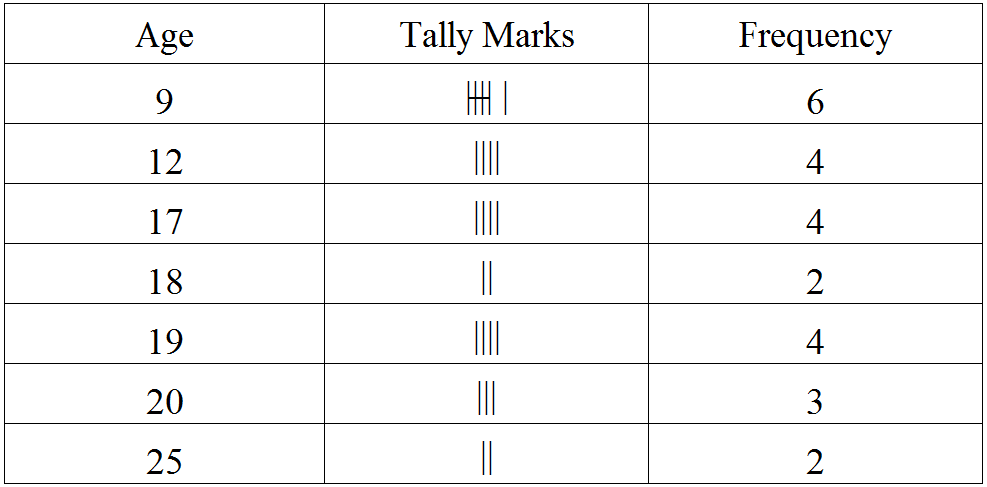
Construct a frequency distribution table for the following marks obtained by $25$ students in a history test in class $\text{VIII}$ of a school: $9, 17, 12, 20, 9, 18, 25, 17, 19, 9, 12, 9, 12, 18, 17, 19, 20, 25, 9, 12, 17, 19, 19, 20, 9.$
$i.$ What is the range of marks?
$ii.$ What is the highest mark?
$iii.$ Which mark is occurring more frequently?
Answer

The frequency distribution table is given below:

Need a full question paper?

Generate a complete, print-ready paper with questions like this in minutes — across 16+ boards, with answer keys.

Start Generating Free

Similar questions

A cricketer scored a total of $62$ runs in $96$ balls. He hits $3$ sixes, $8$ fours, $2$ twos and $8$ singles. What percentage of total runs came in:
$i.$ Sixes.
$ii.$ Fours.
$iii.$ Twos.
$iv.$ Singles.
Solve the following equation and also check your result in case: $\frac{5\text{x}}{3}-\frac{(\text{x}-1)}{4}=\frac{(\text{x}-3)}{5}$
Work out the following multiplication.
$\underline{\ \ \ \ \ 12345679\\\ \ \ \ \ \ \ \ \ \times\ \ \ \ \ 9 }\\\underline{\ \ \ \ \ \ \ \ \ \ \ \ \ \ \ \ \ \ \ \ \ \ }$
Use the result to answer the following questions.​​​​​​
$a.$ What will be $12345679 \times 45$?
$b.$ What will be $12345679 \times 63$?
$c.$ By what number should $12345679$ be multiplied to get $888888888$?
$d.$ By what number should $12345679$ be multiplied to get $999999999$?
Ravi starts for his school at $8:20a.m$. on his bicycle. If he travels at a speed of $10\ km/h$, then he reaches his school late by $8$ minutes but on travelling at $16\ km/h$ he reaches the school $10$ minutes early. At what time does the school start?
Draw a rhombus, having each side of length $3.5\ cm$ and one of the angles as $40^\circ$.
A ladder 10 m long rests against a vertical wall. If the foot of the ladder is 6 m away from the wall and the ladder just reaches the top of the wall, how high is the wall?
Solve the following equation and verify your answer: $\frac{9\text{x}-7}{3\text{x}+5}=\frac{3\text{x}-4}{\text{x}+6}$
A sum amounts to $Rs. 23762$ in $2$ years at $9\%$ per annum, compounded annually. Find the sum.
Construct a quadrilateral $ABCD$ in which $AB = 4\ cm, AC = 5\ cm, AD = 5.5\ cm$ and $\angle\text{ABC}=\angle\text{ACD}=90^\circ.$
Simplify:
$ \left(2 x^2+3 x-5\right)\left(3 x^2-5 x+4\right) $