Question
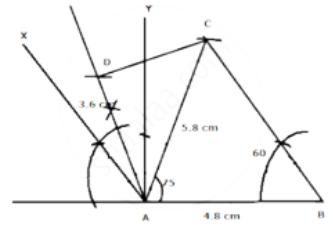
Construct a quadrilateral $ABCD$ in which $AB = 4.8\ cm, AC = 5.8\ cm, AD = 3.6\ cm, \angle A = 105^\circ $ and $\angle B = 60^\circ $
Answer

$AB = 4.8\ cm, AC = 5.8\ cm, AD = 3.6\ cm, \angle A = 105^\circ $ and $\angle B = 60^\circ $
Image
Steps of Construction:
$1)$ Draw a line segment $AB = 4.8\ cm.$
$2)$ With $A$ as centre draw rays $X$ and $Y$ to make angles $60^\circ$ and $90^\circ $ with $AB$ produced.
Then bisect the angle between them to make an angle of $105^\circ $ with $AB.$
$3)$ With $A$ as centre and radius $3.6\ cm$ cut an arc on line segment making $105^\circ $ angles wit $AB$ and mark it as $D.$
$4)$ With $B$ as centre draw a ray making and angle of $60^\circ $ with $AB$
$5)$ With $A$ as centre and radius $5.8\ cm$ cut an arc on the ray from $B$ an mark the point as $C.$
$6)$ Join $BC$ and $DC.$
$7) \text{ABCD}$ is the required quadrilateral.

Need a full question paper?

Generate a complete, print-ready paper with questions like this in minutes — across 16+ boards, with answer keys.
Start Generating Free

Similar questions

A sum of $Rs.16820$ is to be divided between two girls $A$ and $B, 27$ and $25$ years old respectively, in such a way that, if their portions be invested at $5\%$ per annum compound interest payable annually, they will receive equal amounts on reaching $40$ years of age. What is the share of each in the original sum of money?
Construct a rectangle $\text{ABCCD}, AB = 6\ cm. \angle CAB = 30^\circ .$
Insert five rational number between:$-\frac{3}{4}$ and $-\frac{2}{5}$
The difference between the simple interest and the compound interest on a sum of money for 3 years at 10% per annum is ₹558. Find the sum.
The perimeter of a rectangular field is $100\ m$. If its length is decreased by $2\ m$ and breadth increased by $3 \ m$, the area of the field is increased by $44m^2.$ Find the dimensions of the field.
Of the two numbers, 4 times the smaller one is less than 3 times the larger one by 6. Also, the sum of the numbers is larger than 6 times their difference by 5. Find the numbers.
Ankita took part in a Rangoli Competition. She made a beautiful Rangoli in the shape of a triangle ABC as shown. In the triangle, P, Q and R are mid-points of the sides AB, BC and CA respectively. She decorated it by putting a garland along the sides of Delta*PQR The lengths of the sides of the triangle are AB = 20 cm, BC = 26 cm and AC = 24 cm.
Image
Based on the above information, answer the following questions :
Q.1. The length of AP is :
(a) QB (b) QR (c) AR (d) RP
Q.2. The length of PQ is :
(a) 12 cm (b) 13 cm (c) 10 cm (d) 15 cm
Q.3. The length of the garland is :
(a) 30 cm (b) 32 cm (c) 35 cm (d) 40 cm
Q.4. Area of $\triangle PQR$ is :
(a) area of $\triangle ABC$ (b) $\frac{1}{2}$ area of $\triangle ABC$ (c) $\frac{1}{3}$ area of $\triangle ABC$ (d) $\frac{1}{4}$ area of $\triangle ABC$
Q.5. APQR is a :
(a) rectangle (b) parallelogram (c) square (d) rhombus
Prove the following:$\left(\frac{a^m}{a^n}\right)^{m+n+1} \cdot\left(\frac{a^n}{a^1}\right)^{n+1-m} \cdot\left(\frac{a^1}{a^m}\right)^{1+m-n}$
Use the graphical method to show that the straight lines given by the equations $x + y = 2, x - 2y = 5$ and $\frac{x}{3}+y=0$ pass through the same point.
Draw a graph for each of the following equations and find the coordinates of the points where the line drawn meets the $x-$axis and $y-$axis$: \frac{2 x}{5}+\frac{y}{2}=1$