Question 15 Marks
Construct a rhombus whose side $AB = 5\ cm$ and diagonal $AC = 6\ cm$. $ME$ asure $DB$ and $AD.$
Answer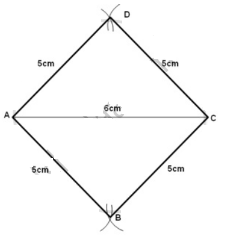
In rhombus all sides are equal.
$1)$ Draw $AC = 6\ cm.$
$2)$ With $A$ as centre and radius $5\ cm$, draw two arcs one above $ac$ and the other below $AC.$
$3)$ With $C$ as centre and radius $5\ cm$ draw two acrs one above $AC$ and the other below $AC$ intersecting the arcs of Steps $2$ in $B$ and $D$ respectively.
$4)$ Join $AB, BC, CD$ and $AD.$
$5) \text{ABCD}$ is the required rhombus.
$6)$ On measuring, $AD = 5\ cm$ and $DB = 8\ cm.$ View full question & answer→Question 25 Marks
Construct a rhombus whose diagonals $AC = 7.4\ cm$ and $BD = 6\ cm.$
Answer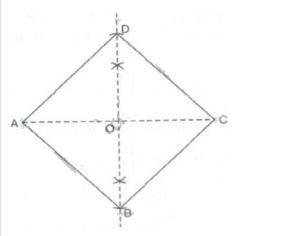
The diagonals of a rhombus bisect each other.
Steps of Construction:
$1$) Draw $AC =7.4 \ cm$
$2$) Draw perpendicular bisector to $A C$ which cuts $A C$ at $O$.
$3)$ From this perpendicular cut $O D$ and $O B$ such that
$OD = OB =\frac{1}{2} BD =\frac{1}{2} \times 6 \ cm =3 \ cm$
$4)$ Join $A B, B C, C D$ and $A D$
$5)$
$\text{ABCD}$ is the required rhombus. View full question & answer→Question 35 Marks
Construct a rhombus whose perimeter is $16\ cm$ and $BD = 6.2\ cm.$
Answer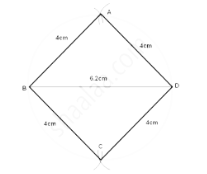
The length of all the sides of rhombus is equal.
Hence, perimeter $=$ side $\times 4$
$ \Rightarrow$ Side
$=\frac{\text { perimeter }}{4}$
$=\frac{16}{4}$
$=4 \ cm $
Steps of construction:
$1$) Draw $BD =6.2 \ cm$.
$2)$ With $B$ as centre and radius $4 \ cm$, draw two arcs one above $B D$ and the other below $B D$.
$3)$ With $D$ as centre and radius $4 \ cm$ draw two arcs one above $B D$ and the other below $B D$ intersecting the arcs of Steps $2$ in $A$ and $C$ respectively.
$4)$ Join $A B, B C, C D$ and $A D$.
$5)\text{ABCD}$ is the required rhombus. View full question & answer→Question 45 Marks
Construct a rhombus $\text{ABCD}$, given $AB = 3.8\ cm$ and $\angle A = 60^\circ $. Measure $AC.$
Answer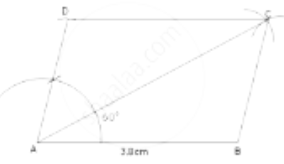
In rhombus length of all the sides is equal.
Steps of Construction:
$1)$ Draw a line segment $AB = 7.8\ cm.$
$2)$ At $A$, draw a ray making an angle of $60^\circ $ with $AB.$
$3)$ With $A$ as centre and radius $3.8\ cm$ cut an arc on the ray making an angle of $60^\circ $ with $Ab$.
Mark the point as $D.$
$4)$ With $B$ and $D$ as centres and radii $3.8\ cm$ mark two arcs cutting each other at point $C.$
$5)$ Join $DC$ and $BC.$
$6) \text{ABCD}$ is the required rhombus.
$7)$ On measuring $AC = 6.5\ cm.$ View full question & answer→Question 55 Marks
Construct a parallelogram $ABCD$ in which $AB = 4.5\ cm, \angle A = 105^\circ $ and the distance between $AB$ and $CD$ is $3.2\ cm.$
Answer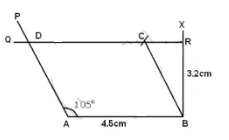
Steps of construction:
$1)$ Draw line $AB = 4.5\ cm.$
$2)$ At $B$, draw $BX$ perpendicular to $AB.$
$3)$ From $BX,$ cut $BR = 3.2\ cm =$ distance between $AB$ and $CD.$
$4)$ Through $R$, draw a line perpendicular to $BX$ to get $QR$ parallel to $AB.$
$5)$ With $A$ as centre, draw a ray $AP$ making an angle of $105$ with $AB$ and meeting $QR$ at $D.$
$6)$ With $B$ as centre, draw an arc with radius $= AD$ on $QR$ and mark it as $C.$
$7)$ Join $BC.$
$8) \text{ABCD}$ is the required parallelogram. View full question & answer→Question 65 Marks
Construct a parallelogram $\text{PQRS}$ in which $PQ = 6.4\ cm, QR = 4\ cm$ and the distance between $PQ$ and $SR$ is $3\ cm.$
Answer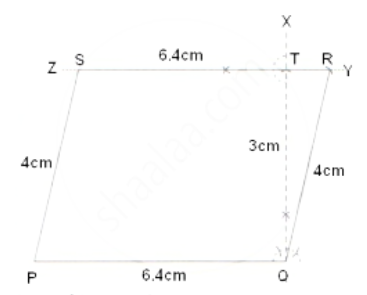
Steps of Construction:
$1)$ Draw $P Q=6.4 \ cm$.
$2)$ At $Q$ draw $Q X$ perpendicular to $P Q$.
$3)$ From $Q X$, cut $Q T=3 \ cm =$ distance between $P Q$ and $S R$.
$4)$ Through $T$, draw a perpendicular to $Q X$ to get $Z Y$ parallel to $P Q$.
$5)$ With $P$ as centre and radius $=Q R=4 \ cm$, draw an arc which cuts $Z Y$ at $S$.
$6)$ With $Q$ as centre and radius $=4 \ cm$, draw an arc which cuts $Z Y$ at $R$.
$7)\text{ABCD}$ is the required parallelogram. View full question & answer→Question 75 Marks
Construct a trapezium $\text{ABCD}$ in which $AB = 4.6\ cm, BC = 6.4\ cm, CD = 5.6\ cm, \angle B = 60^\circ $ and $AD \| BC.$
Answer$AB = 4.6\ cm, BC = 6.4\ cm, CD = 5.6\ cm, \angle B = 60^\circ $ and $AD || BC.$
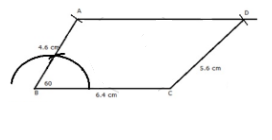
Steps of construction:
$1)$ Draw $BC = 6.4\ cm$
$2)$ With $B$ as centre, draw an angle of $60^\circ $ and cut an arc with radius $4.6\ cm.$
$3)$ From point $A$, draw a line segment parallel to $BC.$
$4)$ With $C$ as centre and radius $5.6\ cm$ cut an arc on the line segment parallel to $BC$.
Mark the point as $D.$
$5)$ Join $CD.$
$6)\text{ABCD}$ is the required trapezium. View full question & answer→Question 85 Marks
Construct a trapezium $\text{ABCD}$ in which $AB = 3.5\ cm, BC = 6\ cm, CD = 3.5\ cm, AD = 4.4\ cm$ and $AD \| BC.$
Answer$AB = 3.5\ cm, BC = 6\ cm, CD = 3.5\ cm, AD = 4.4\ cm$ and $AD \| BC.$
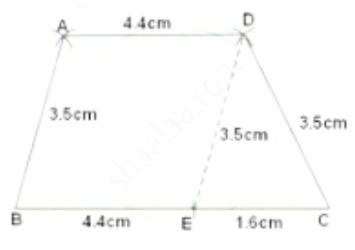
Steps of construction:
$1)$ Draw $BC = 6\ cm$
$2)$ From $BC$, cut $BE = AD = 4.4\ cm$
$3)$ Draw a $\triangle DEC$, such that $DE = AB = 3.5\ cm$ and $CD = 3.5\ cm$
$4)$Taking $B$ and $D$ as centres and radii $3.5\ cm$ and $4.4\ cm$ respectively, draw arcs cutting each other at $A.$
$5)$ Join $AB$ and $AD.$
$6)\text{ABCD}$ is the required trapezium. View full question & answer→Question 95 Marks
Construct a regular hexagon of side $4\ cm.$
Answer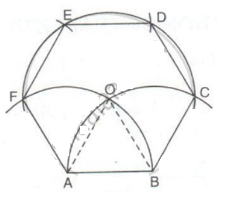
Steps of Construction:
$1)$ Draw $AB = 4\ cm.$
$2)$With centres $A$ and $B$ and radius $4\ cm$ draw arcs to cut each other at $O.$
$3)$ With centre $A$ and $B$ and radius $4\ cm$ cut the arcs in step $2$ at $C$ and $F$.
Join $AF, BC.$
$4)$ With centres $C$ and $F$ and radius $4\ cm$ cut the arc drawn in step $3$ at $D$ and $E$.
Join $CD, DE$ and $EF.$
$5)\text{ABCDEF}$ is the required regular hexagon. View full question & answer→Question 105 Marks
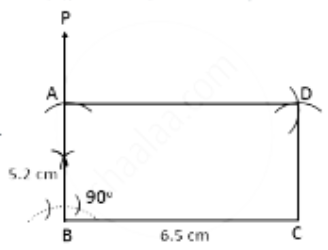
Construct a rectangle $\text{PQRS}$, when its Area $=33.8 \ cm^2$ and breadth $=6.5 \ cm$
AnswerSince area of rectangle $=33.8 \ cm^2$
And, breadth $=6.5 \ cm$
Length $=$ Area $\div$ Breadth $=33.8 \div 6.5=5.2 \ cm$
Steps of construction:
$1$. Draw $B C=6.5 \ cm$
$2$. Through $B$, draw $B P$ such that $\angle B=90^{\circ}$
$3$. From $B P$, cut $B A=5.2 \ cm$
$4$. With $A$ and $C$ as centres and radii $6.5 \ cm$ and $5.2 \ cm$ respectively, draw arcs cutting each other at $D$.
$5$. Join $A D$ and $C D$.
Thus, $\text{ABCD}$ is the required triangle
.
View full question & answer→Question 115 Marks
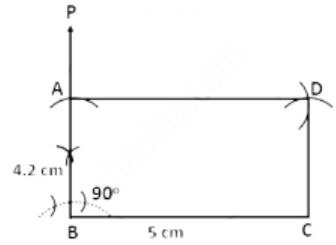
Construct a rectangle $\text{PQRS}$, when its Area $=21 \ cm^2$ and length $=4.2 \ cm$
AnswerSince area of rectangle $=21 \ cm ^2$
And, length $=4.2 \ cm$
Breadth $=$ Area $\div$ Length $=21 \div 4.2=5 \ cm$
Steps of construction:
$1$. Draw $B C=5 \ cm$
$2$. Through $B$, draw $B P$ such that $\angle B=90^{\circ}$
$3$. From $B P$, cut $B A=4.2 \ cm$
$4.$ With $A$ and $C$ as centres and radii $5 \ cm$ and $4.2 \ cm$ respectively, draw arcs cutting each other at $D$.
$5$. Join $A D$ and $C D$.
Thus, $\text{ABCD}$ is the required triangle.
View full question & answer→Question 125 Marks
Construct a rectangle $\text{ABCCD}, AB = 6\ cm. \angle CAB = 30^\circ .$
Answer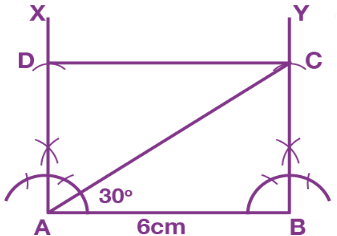
Steps of construction:
$1)$ Draw a line segment $AB = 6\ cm.$
$2)$ On $A$ and $B$ draw perpendiculars $AX$ and $BY$ to $AB.$
$3)$ With $A$ as centre and radius $= BC$ cut an arc on $AX$. Mark it as $D$.
$5)$ Join $CD.$
$6)\text{ABCD}$ is the required rectangle. View full question & answer→Question 135 Marks
Construct a rectangle $\text{ABCD}$ with perimeter $18\ cm$ and $AB = 6\ cm.$
AnswerOpposite sides of a rectangle are equal.
$\Rightarrow A B=C D$ and $B C=D A$
Perimeter of rectangle $=A B+B C+C D+D A$
$18 \ cm =A B+B C+A B+B C$
$18 \ cm =(6+B C+6+B C)$
$(18-12) \ cm =2 B C$
$B C=3 \ cm$
Therefore, $A B=C D=6 \ cm$ and $B C=D A=3 \ cm$
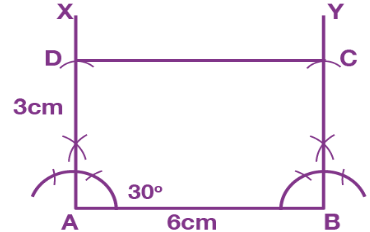
Steps of construction:
$1)$ Draw a line segment $AB = 6\ cm$
$2)$ On $A$ and $B$ draw perpendiculars $AX$ and $BY$ to $AB$.
$3)$ With $A$ and $B$ as centres and radii $3\ cm$ draw arcs on $AX$ and $BY$.
Mark them as $D$ and $C$ respectively.
$4)$ Join $CD.$
$5)\text{ABCD}$ is the required rectangle. View full question & answer→Question 145 Marks
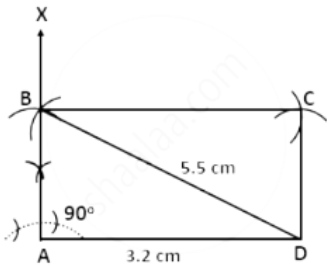
Construct a rectangle $\text{ABCD}$, when $AD = 3.2\ cm$ and diagonal $BD = 5.5\ cm$. Measure $CD.$
AnswerSteps of construction:
$1$. Draw $AD =3.2 \ cm$
$2$. Draw $\angle X A D=90^{\circ}$.
$3.$ With $D$ as centre and radius $BD =5.5 \ cm$, draw an arc to cut $AX$ at point $B$.
$4$. Join $BD.$
$5$. With $B$ as centre and radius $3.2 \ cm$ draw an arc and with $D$ as centre and radius $=A B$, draw another arc to cut the previous arc at $C$.
$6$. Join $B C$ and $C D$.
Thus, $\text{ABCD}$ is the required rectangle.
$C D=4.5 \ cm$
View full question & answer→Question 155 Marks
Construct a quadrilateral $\text{ABCD}$ in which $AD = AB = 5\ cm, BC = 3.8\ cm, CD = 3.5\ cm$, and $\angle BAD = 45^\circ $
Answer$AD = AB = 5\ cm, BC = 3.8\ cm, CD = 3.5\ cm$, and $\angle BAD = 45^\circ $
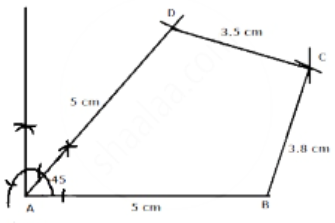
Steps of Construction:
$1)$ Draw a line segment $AB = 5\ cm.$
$2)$ With $A$ as centre draw an angle an angle of $90^\circ $ and bisect it from $\angle BAD = 45^\circ $
$3)$ With $A$ as centre and radius $5\ cm$ cut an arc on the ray making an angle of $45^\circ $ with $AB$ and mark it $D.$
$4)$ With $D$ and $B$ as centre and radii as $3.5\ cm$ and $3.8\ cm$ respectively draw arcs intersecting each other at $C.$
$5)$ Join $DC$ and $BC.$
$6)\text{ABCD}$ is the required quadrilateral. View full question & answer→Question 165 Marks
Construct a square whose area is $25 sq. \ cm.$
Answer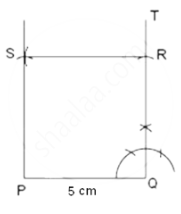
Steps of construction:
$1)$ Draw $P Q=5 \ cm$.
$2)$ Construct $\angle PQT =90^{\circ}$ at $Q$.
$3)$ From $Q T$ cut off $Q R=5 \ cm$.
$4)$ From $P$ and $R$, draw two arcs of radii $5 \ cm$ each other to cut each other at $S$.
$5)$ Join $PS$ and $RS.$
$6)\text{PQRS}$ is the required square. View full question & answer→Question 175 Marks
Construct a quadrilateral $ABCD$ in which $AB = 4.8\ cm, AC = 5.8\ cm, AD = 3.6\ cm, \angle A = 105^\circ $ and $\angle B = 60^\circ $
Answer$AB = 4.8\ cm, AC = 5.8\ cm, AD = 3.6\ cm, \angle A = 105^\circ $ and $\angle B = 60^\circ $
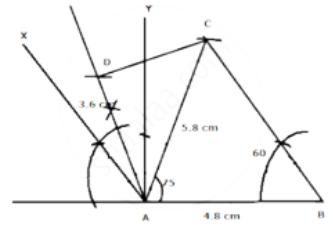
Steps of Construction:
$1)$ Draw a line segment $AB = 4.8\ cm.$
$2)$ With $A$ as centre draw rays $X$ and $Y$ to make angles $60^\circ$ and $90^\circ $ with $AB$ produced.
Then bisect the angle between them to make an angle of $105^\circ $ with $AB.$
$3)$ With $A$ as centre and radius $3.6\ cm$ cut an arc on line segment making $105^\circ $ angles wit $AB$ and mark it as $D.$
$4)$ With $B$ as centre draw a ray making and angle of $60^\circ $ with $AB$
$5)$ With $A$ as centre and radius $5.8\ cm$ cut an arc on the ray from $B$ an mark the point as $C.$
$6)$ Join $BC$ and $DC.$
$7) \text{ABCD}$ is the required quadrilateral. View full question & answer→Question 185 Marks
Construct a square with perimeter $= 18\ cm.$
Answer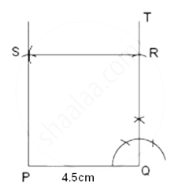
Sides of square are equal.
$ \Rightarrow$ Perimeter$=4 \times$ side
$\Rightarrow$ Side
$=\frac{\text { perimeter }}{4}$
$=\frac{18}{4}$
$=4.5 \ cm $
Steps of construction:
$1) D$ raw $P Q=4.5 \ cm$.
$2)$ Construct $\angle PQT =90^{\circ}$ at $Q$
$3)$ From $Q T$ cut off $Q R=4.5 \ cm$.
$4)$ From $P$ and $R$, draw two acrs of radii $4.5 \ cm$ each to cut each other at $S$.
$5)$ Join $PS$ and $RS.$
$6)\text{PQRS}$ is the required square. View full question & answer→Question 195 Marks
Construct a quadrilateral $\text{ABCD}$ in which $AB = 7.2\ cm, BC = 5.8\ cm, CD = 6.3\ cm, AD = 4.3\ cm$ and $\angle A = 75^\circ $
Answer$AB = 7.2\ cm, BC = 5.8\ cm, CD = 6.3\ cm, AD = 4.3c$m and $\angle A = 75^\circ $
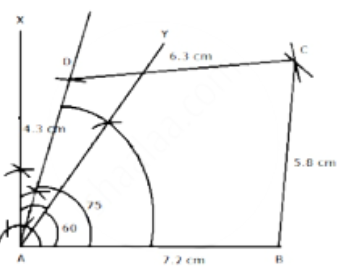
Steps of Construction:
$1)$ Draw a line segment $AB = 7.2\ cm$
$2)$ With $A$ as centre draw rays $X$ and $Y$ to make angle $90^\circ $ and $60^\circ $ with $AB$.
Then bisect the angle between them to make an angle of $75^\circ $ with $AB.$
$3)$ With $A$ as centre and radius $4.3\ cm$ cut an arc on line segment making $75^\circ $ angles wit $AB$ and mark it as $D.$
$4)$ With $D$ and $B$ as centres and radii of $6.3$ and $5.8\ cm$ respectively, draw arcs cutting each other at $C.$
$5)$ Join $DC$ and $BC.$
$6)\text{ABCD}$ is the required quadrilateral. View full question & answer→Question 205 Marks
Construct a square $\text{ABCD}$ with $AC = 6.5\ cm$
Answer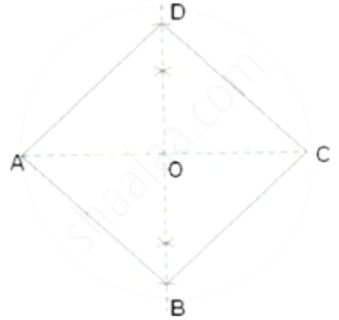
The diagonals of a square are equal and bisect each other.
Steps of Construction:
$1)$ Draw $A C=6.5 \ cm$
$2)$ Draw perpendicular bisector to $A C$ which cuts $A C$ at $O$.
$3)$From this perpendicular cut $O D$ and $O B$ such that
$OD = OB =\frac{1}{2} BD =\frac{1}{2} \times 6.5 \ cm =3.25 \ cm$
$4)$ Join $A B, B C, C D$ and $A D$
$5)\text{ABCD}$ is the required square. View full question & answer→Question 215 Marks
Construct a quadrilateral $\text{ABCD}$ in which $AB = 4.6\ cm, BD = 5\ cm, AC = 6\ cm, CD = 4.2\ cm$ and $\angle A = 90^\circ $
Answer$AB = 4.6\ cm, BD = 5\ cm, AC = 6\ cm, CD = 4.2\ cm$ and $\angle A = 90^\circ $
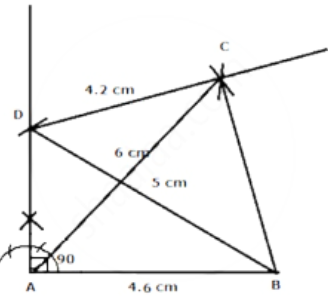
Steps of construction:
$1)$Draw a line segment $AB = 4.6\ cm$
$2)$With $A$ as centre, draw a ray making an angle of $90^\circ $ with $AB$
$3)$With $B$ as centre and radius equal to $5\ cm$ cut an arc on the ray from $A$ and mark it as $D.$
$4)$With $D$ as centre and radius $4.2\ cm$ cut an arc on right side of $AD.$
$5)$With $A$ as centre and radius $6\ cm$ cut an arc which meets the arc from $D$ at point $C.$
$6)$Join $BC.$
$7)\text{ABCD}$ is the required quadrilateral. View full question & answer→Question 225 Marks
Construct a square with each side $4.3\ cm$
Answer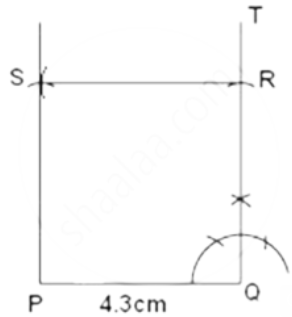
Sides of square are equal.
Steps of construction:
$1)$ Draw $P Q=4.3 \ cm$.
$2)$ Construct $\angle PQT =90^{\circ}$ at $Q$.
$3)$ From $Q T$ cut off $Q R=44.3 \ cm$.
$4)$ From $P$ and $R$, draw two arcs of radii $4.3 \ cm$ each to cut each other at $S$.
$5)$ Join $PS$ and $RS.$
$6)\text{PQRS}$ is the required square. View full question & answer→