Question
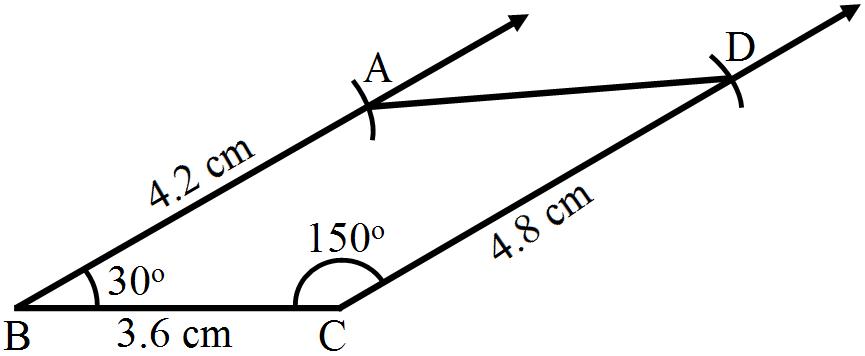
Construct a quadrilateral ABCD, where AB = 4.2cm, BC = 3.6cm, CD = 4.8cm, $\angle\text{B}=30^\circ$ and $\angle\text{C}=150^\circ.$
Answer


Steps of construction:
Step I: Draw BC = 3.6cm.
Step II: Construct $\angle\text{ABC}=30^\circ$ at B.
Step III: With B as the centre and radius 4.2cm, cut off BA = 4.2cm.
Step IV: Construct $\angle\text{BCD}=150^\circ$ at C.
Step V: With C as the centre and radius 4.8cm, cut off CD = 4.8cm.
Step VI: Join AD.
The quadrilateral so obtained is the required quadrilateral.

Need a full question paper?

Generate a complete, print-ready paper with questions like this in minutes — across 16+ boards, with answer keys.
Start Generating Free

Similar questions

Find the area of the sheet required to make a cylindrical container which is open at one side and whose diameter is 28 cm and height is 20 cm . Find the approximate area of the sheet required to make a lid of height 2 cm for this container.
Given: For cylindrical container:
diameter $( d )=28 cm$, height $\left( h _1\right)=20 cm$
For cylindrical lid: height $\left(h_2\right)=2 cm$
To find: i. Surface area of the cylinder with one side open
ii. Area of sheet required to made a lid
A tricycle is sold at a gain of 16%. Had it been sold for Rs. 100 more, the gain would have been 20%. Find the C.P. of the tricycle.
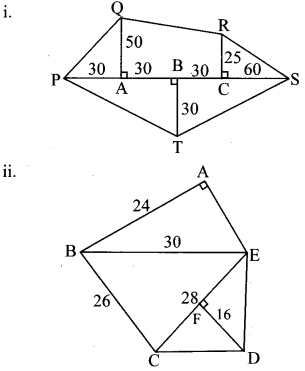
Find the areas of given plots. (All measures are in meters.)
Image
Meenakshi sells a pen for Rs. 54 and loses $\frac{1}{10}$ of her outlay. Find (i) the cost price of the pen, and (ii) the loss percent.
Find the smallest number that must be subtracted from those of the numbers which are not perfect cubes, to make them perfect cubes. What are the corresponding cube roots?
  1. 130
  2. 345
  3. 792
  4. 1331
Following is the break up of the expenditure of a family on different items of consumption:
Items
Food
Clothing
Rent
Education
Fuel etc.
Medicine
Miscellaneous
Expenditure (in Rs.)
1600
200
600
150
100
80
270
Draw a pie-diagram to represent the above data.

S.No.

Number

Power of the root

Root of the power

1.

(225)^((3)/(2))

" Cube of square root of 225

" Square root of cube of 225"

2.

(45)^((4)/(5))

3.

(81)^((6)/(7))

4.

(100)^((4)/(10))

5.

(21)^((3)/(7))

Solve the following equation and also check your result in case:
$\frac{4\text{x}}{9}+\frac{1}{3}+\frac{13}{108}\text{x}=\frac{8\text{x}+19}{18}$
Construct a quadrilateral PQRS in which PQ = 5cm, QR = 6.5cm, $\angle\text{P}=\angle\text{R}=100^\circ$ and $\angle\text{S}=75^\circ.$
Study the table given below and draw a line graph for it.
Side of the square (in cm)
2
3
4
5
6
Area (in $cm^2$)
4
9
16
25
36
Is the graph drawn, a linear graph?