Question 15 Marks
Construct a quadrilateral ABCD in which AB = 4.4cm, BC = 4cm, CD = 6.4cm, DA = 3.8cm and BD = 6.6cm.
Answer
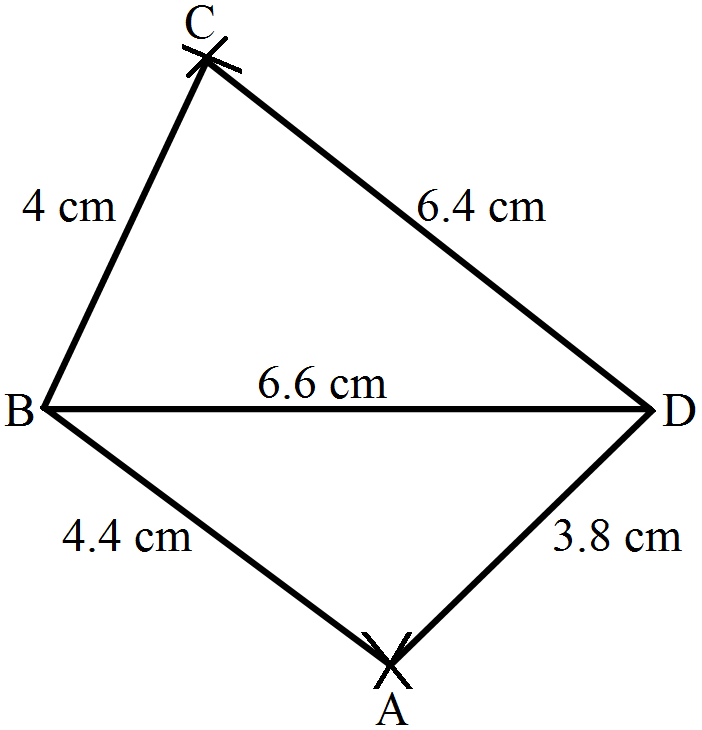
First, we draw a rough sketch of the quadrilateral ABCD and write down its dimensions along the sides.
We may divide the quadrilateral into two constructible triangles ABD and BCD.
Steps of Construction:
Step I: Draw BD = 6.6cm
Step II: With B as the centre and radius BC = 4cm, draw an arc.
Step III: With D as the centre and radius 6.4cm, draw an are to intersect th are drawn in Step II at C.
Step IV: With B as the centre and radius 4.4cm, draw an arc on the side BD opposite to that of C.
Step V: With D as the centre and radius 3.8cm, draw an arc to intersect the arc drawn in Step IV at A.
Step VI: Join BA, DA, BC and CD The quadrilateral ABCD so obtained is the required quadrilateral.
View full question & answer→Question 25 Marks
Construct a parallelogram PQRS such that PQ = 5.2cm, PR = 6.8cm and QS = 8.2cm.
Answer
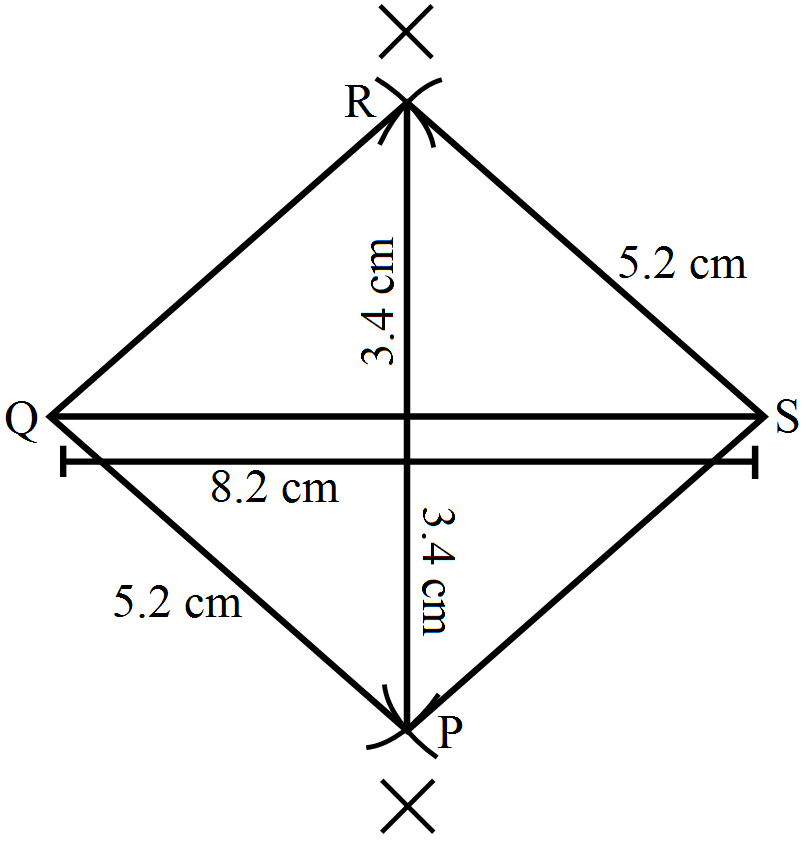
In a parallelogram opposite sides are equal. Thus, we have to construct a quadrilateral PQRS in which PQ = 5.2cm, PR = 6.8cm and QS = 8.2cm.
Steps of construction:
Step I: Draw QS = 8.2cm
Step II: With Q as the centre and radius 5.2cm, draw an arc.
Step III: With S as the centre and radius 5.2cm, draw an arc to intersect the arc drawn in Step II at C.
Step IV: With P as the centre and radius 6.8cm.
Step V: With Q as the centre and radius 5.2cm, draw an arc to intersect the arc drawn in Step IV at A.
Step VI: Join QR, QP, PS and SR.
The quadrilateral PQRS so obtained is the required quadrilateral.
View full question & answer→Question 35 Marks
Construct a quadrilateral XYZW in which XY = 5cm, YZ = 6cm, ZW = 7cm, WX = 3cm and XZ = 9cm.
Answer
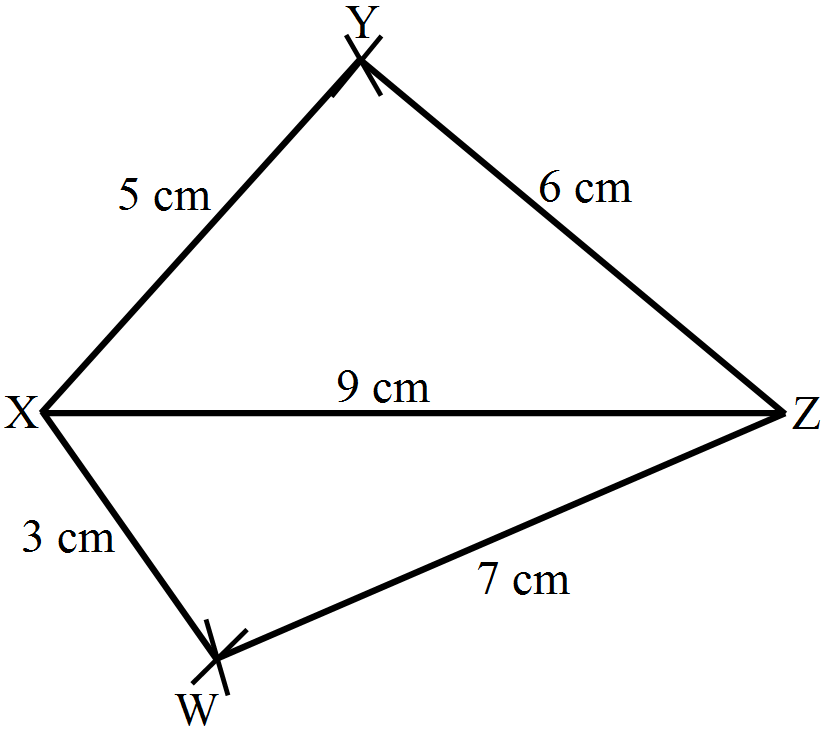 Steps of construction:
Step I:
Steps of construction:
Step I: Draw XZ = 9cm.
Step II: With X as the centre and radius 5cm, draw an arc above XZ.
Step III: With Z as the centre and radius 6cm, draw an arc to intersect the arc drawn in Step II at Y above XZ.
Step IV: With Z as the centre and radius 7cm, draw an arc below XZ.
Step V: With X as the centre and radius 3cm, draw an arc to intersect the arc drawn in Step IV at W below XZ.
Step VI: Join XY, YZ, ZW and XW.
The quadrilateral WXYZ so obtained is the required quadrilateral.
View full question & answer→Question 45 Marks
Construct a quadrilateral ABCD such that AB = BC = 5.5cm CD = 4cm, DA = 6.3cm and AC = 9.4cm Measure BD.
Answer
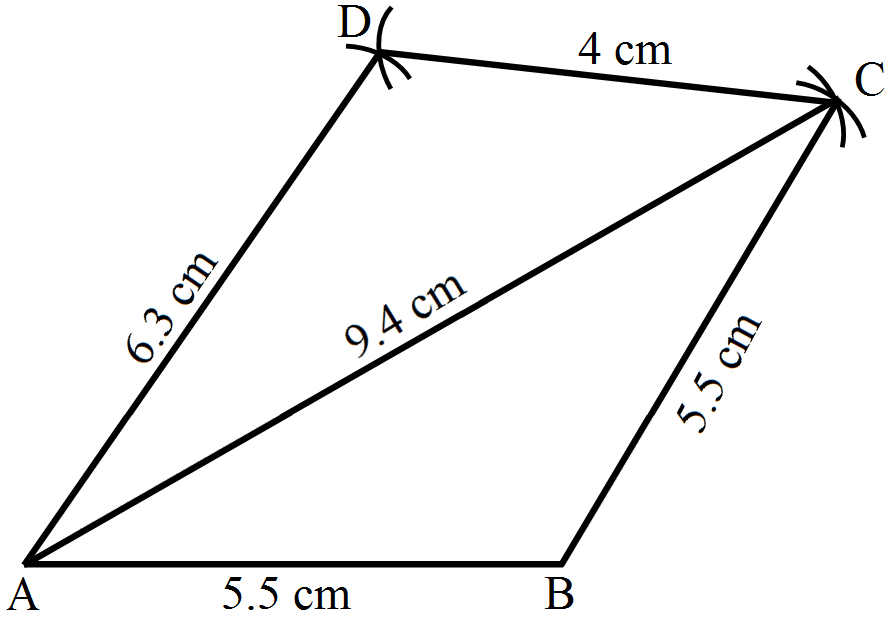 Steps of construction:
Step I:
Steps of construction:
Step I: Draw AB = 5.5cm
Step II: With B as the centre and radius BC = 5.5cm, draw an arc.
Step III: With A as the centre and radius AC = 9.4cm, draw an arc to intersect the arc drawn in Step II at C.
Step IV: With C as the centre and radius CD = 4cm, draw an arc.
Step V: With A as the centre and radius AD = 6.3 cm, draw an arc to intersect the arc drawn in Step IV at D.
Step VI: Join DA, BC, AC and CD.
The quadrilateral ABCD so obtained is the required quadrilateral.
View full question & answer→Question 55 Marks
Construct a quadrilateral ABCD in which AB = BC = 3cm, AD = CD = 5cm, and $\angle\text{B}=120^\circ.$
Answer
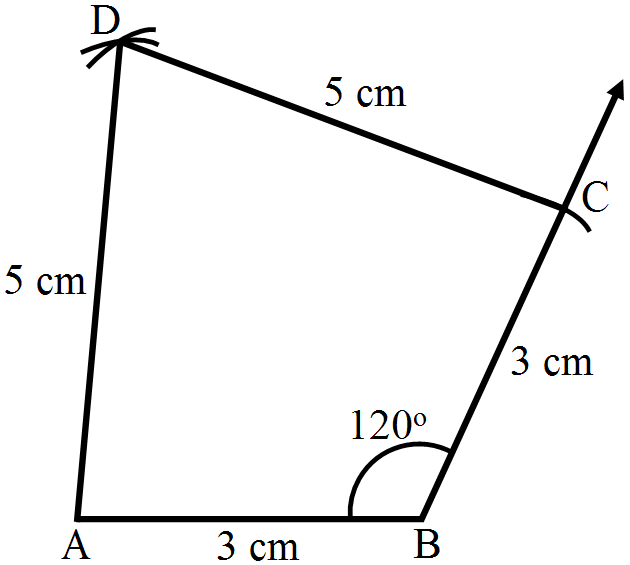 Steps of construction:
Step I: Draw AB = 3cm.
Step II: Construct $\angle\text{ABC}=120^\circ.$
Step III: With B as the centre and radius 3cm, cut off BC = 3cm.
Step IV: With C as the centre and radius 5cm, draw an arc.
Step V: With A as the centre and radius 5cm, draw an arc to intersect the arc drawn in Step IV at D.
Step VI: Join AD and CD to obtain the required quadrilateral. View full question & answer→Question 65 Marks
Construct a quadrilateral ABCD in which AB = 7.7cm, BC = 6.8cm, CD = 5.1cm, AD = 3.6cm and $\angle\text{C}=120^\circ.$
Answer
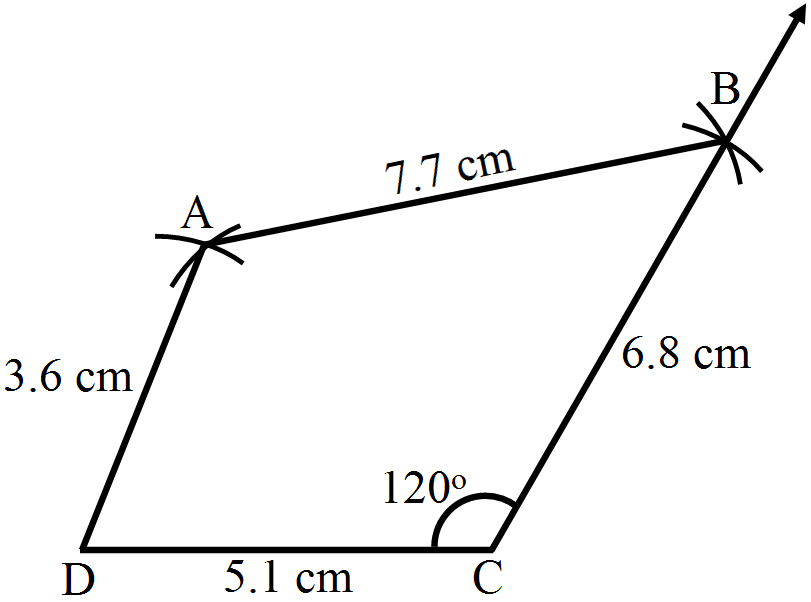 Steps of construction:
Step I: Draw DC = 5.1cm.
Step II: Construct $\angle\text{DCB}=120^\circ.$
Step III: With C as the centre and radius 6.8cm, cut off BC = 6.8cm.
Step IV: With B as the centre and radius 7.7cm, draw an arc.
Step V: With D as the centre and radius 3.6cm, draw an arc to intersect the arc drawn in Step IV at A.
Step VI: Join AB and AD to obtained the required quadrilateral. View full question & answer→Question 75 Marks
Construct a quadrilateral BDEF, where DE = 4.5cm, EF = 3.5cm, FB = 6.5cm, $\angle\text{F}=50^\circ$ and $\angle\text{E}=100^\circ.$
Answer
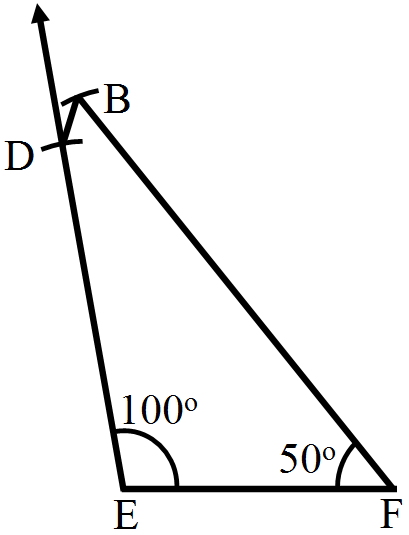 Steps of construction:
Step I: Draw EF = 3.5cm.
Step II: Construct $\angle\text{DEF}=100^\circ$ at E.
Step III: With E as the centre and radius 4.5cm, cut off DE = 4.5cm.
Step IV: Construct $\angle\text{EFB}=50^\circ$ at F.
Step V: With F as the centre and radius 6.5cm, cut off FB = 6.5cm.
Step VI: Join BD.
The quadrilateral so obtained is the required quadrilateral. View full question & answer→Question 85 Marks
Construct a quadrilateral PQRS, in which PQ = 3.5cm, QR = 2.5cm, RS = 4.1cm, $\angle\text{Q}=75^\circ$ and $\angle\text{R}=120^\circ.$
Answer
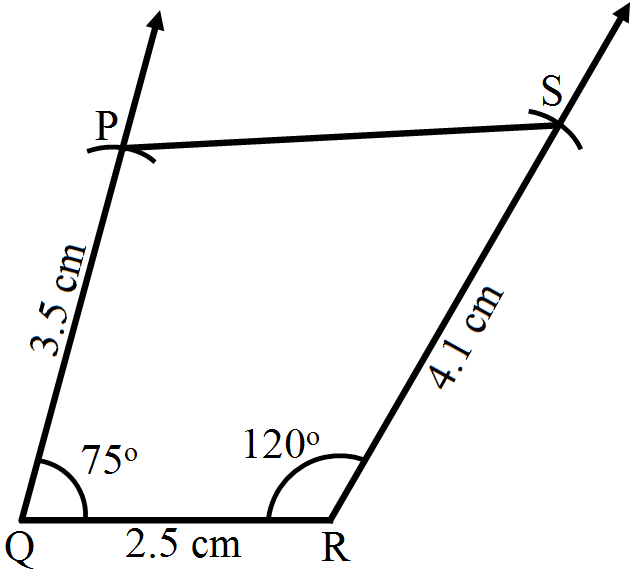 Steps of construction:
Step I: Draw QR = 2.5cm.
Step II: Construct $\angle\text{PQr}=75^\circ$ at Q.
Step III: With Q as the centre and radius 3.5cm, cut off QP = 3.5cm.
Step IV: Construct $\angle\text{QRS}=120^\circ$ at R.
Step V: With R as the centre and radius 4.1cm, cut off RS = 4.1cm.
Step VI: Join PS.
The quadrilateral so obtained is the required quadrilateral. View full question & answer→Question 95 Marks
Construct a quadrilateral ABCD in which AB = 3.8cm, BC = 3.4cm, CD = 4.5cm, AD = 5cm and $\angle\text{B}=80^\circ.$
Answer
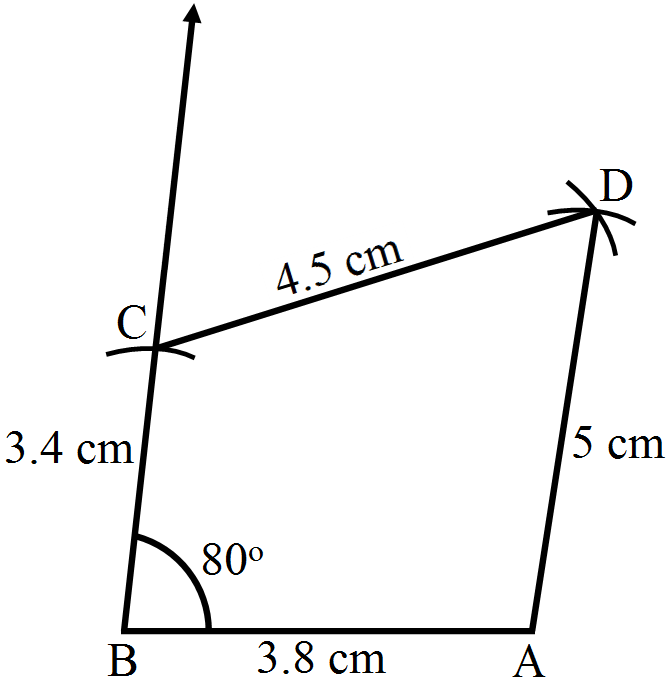 Steps of construction:
Step I: Draw AB = 3.8cm.
Step II: Construct $\angle\text{ABC}=80^\circ.$
Step III: With B as the centre and radius 3.4cm, cut off BC = 3.4cm.
Step IV: With C as the centre and radius 4.5cm, draw an arc.
Step V: With A as the centre and radius 5.3cm, draw an arc to intersect the arc drawn in Step IV at D.
Step VI: Join AD, BC and CD to obtain the required quadrilateral. View full question & answer→Question 105 Marks
Construct a quadrilateral ABCD, in which AB = 6cm, BC = 4cm, CD = 4cm, $\angle\text{B}=95^\circ$ and $\angle\text{C}=90^\circ.$
Answer
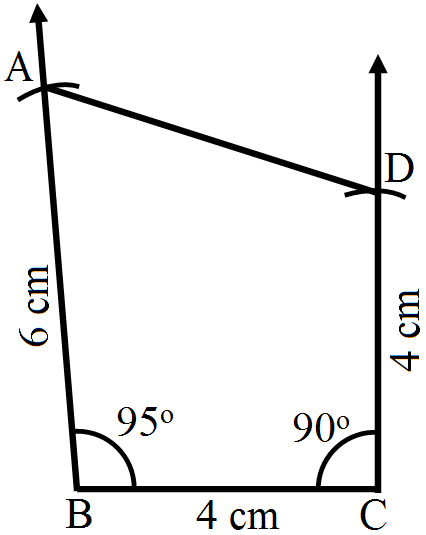 Steps of construction:
Step I: Draw BC = 4cm.
Step II: Construct $\angle\text{ABC}=95^\circ$ at B.
Step III: With B as the centre and radius 6cm, cut off BA = 6cm.
Step IV: Construct $\angle\text{BCD}=90^\circ$ at C.
Step V: With C as the centre and radius 4cm, cut off BA = 4cm.
Step VI: Join CD.
The quadrilateral so obtained is the required quadrilateral. View full question & answer→Question 115 Marks
Construct a quadrilateral ABCD in which AB = 3.8cm, BC = 3.0cm, AD = 2.3cm, AC = 4.5cm and BD = 3.8cm.
Answer
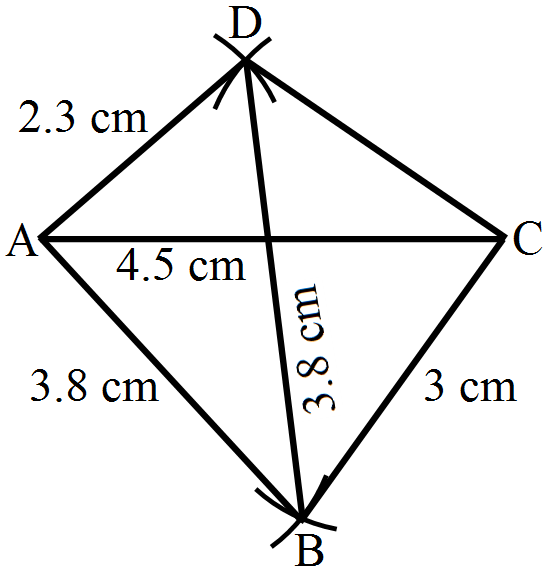 Steps of construction:
Step I:
Steps of construction:
Step I: Draw AC = 6cm.
Step II: With A as the centre and radius 3.8cm, draw an arc.
Step III: With C as the centre and radius 3.0cm, draw an arc to intersect the arc drawn in Step II at B.
Step IV: With B as the centre and radius 3.8cm, draw an arc on the other side of AC.
Step V: With A as the centre and radius 2.3cm, draw an arc to intersect the arc drawn in Step IV at D.
Step VI: Join BA, DA, BC and CD to obtain the required quadrilateral.
View full question & answer→Question 125 Marks
Construct, if possible, a quadrilateral ABCD given AB = 6cm, BC = 3.7cm, CD = 5.7cm, AD = 5.5cm and BD = 6.1cm. Give reasons for not being able to construct it, if you cannot.
Answer
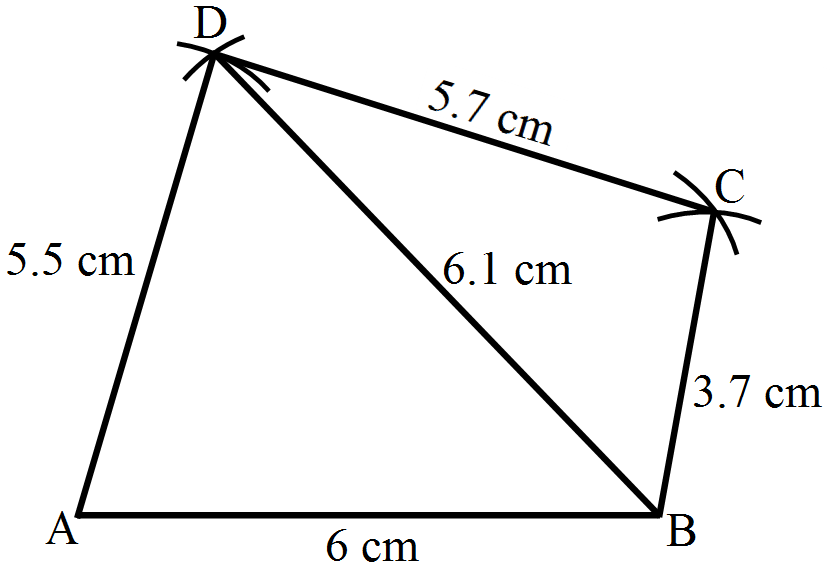 Steps of construction:
Step I:
Steps of construction:
Step I: Draw AB = 6cm.
Step II: With A as the centre and radius 5.5cm, draw an arc.
Step III: With B as the centre and radius 6.1cm, draw an arc to intersect th arc drawn in Step II at D.
Step IV: With B as the centre and radius 3.7cm, draw an arc on the side.
Step V: With D as the centre and radius 5.7cm, draw an arc to intersect the arc drawn in Step IV at C.
Step VI: Join BD, DA, BC and CD. The quadrilateral ABCD so obtained is the required quadrilateral.
View full question & answer→Question 135 Marks
Construct a quadrilateral PQRS, where PQ = 3.5cm, QR = 6.5cm, $\angle\text{P}=\angle\text{R}=105^\circ$ and $\angle\text{S}=75^\circ$
Answer
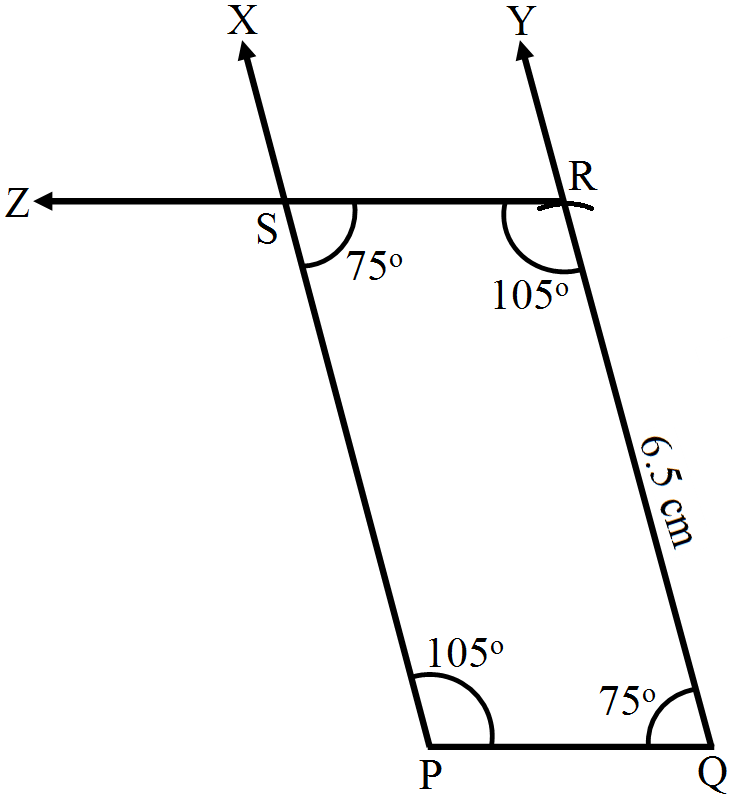 We know that the sum of all the angles in a quadrilateral is 360.
i.e., $\angle\text{P}+\angle\text{Q}+\angle\text{R}+\angle\text{S}+360^\circ$
$\Rightarrow\angle\text{Q}=75^\circ$
Steps of construction:
Step I: Draw PQ = 3.5cm.
Step II: Construct $\angle\text{XPQ}=105^\circ$ at P and $\angle\text{PQY}=75^\circ$ at Q.
Step III: With Q as the centre and radius 6.5cm, cut off QR = 6.5
Step IV: At R, draw $\angle\text{QRZ}=105^\circ$ such that it meets PX at S.
The quadrilateral so obtained is the required quadrilateral. View full question & answer→Question 145 Marks
Construct a quadrilateral PQRS, in which $\angle\text{PQR}=45^\circ,$ $\angle\text{QRS}=90^\circ,$ QR = 5cm, PQ = 9cm and Rs = 7cm.
Answer
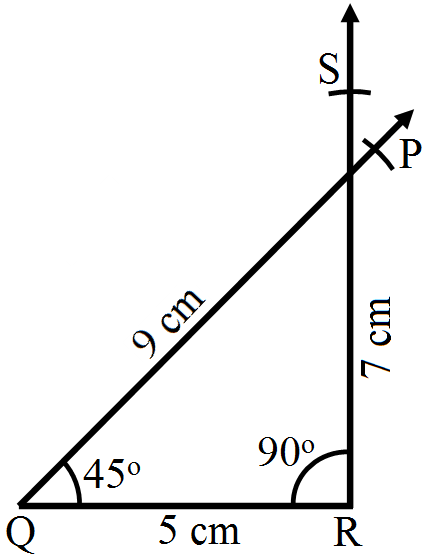 Steps of construction:
Step I: Draw QR = 5cm.
Step II: Construct $\angle\text{PQR}=45^\circ$ at Q.
Step III: With Q as the centre and radius 9cm, cut off QP = 9cm.
Step IV: Construct $\angle\text{QRS}=90^\circ$ at R.
Step V: With R as the centre and radius 7cm, cut off RS = 7cm. Since, the line segment PQ and RS intersect each other, the quadrilateral cannot be constructed. View full question & answer→Question 155 Marks
Construct a quadrilateral ABCD in which AB = 2.8cm, BC = 3.1cm, CD = 2.6cm, and DA = 3.3cm and $\angle\text{A}=60^\circ.$
Answer
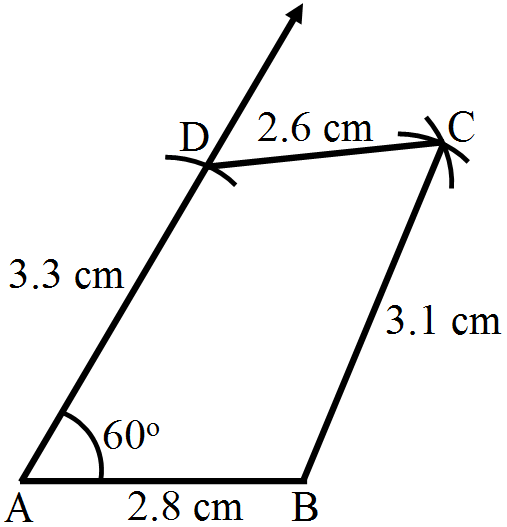 Steps of construction:
Step I: Draw AB = 2.8cm.
Step II: Construct $\angle\text{BAD}=60^\circ.$
Step III: With A as the centre and radius 3.3cm, cut off AD = 3.3cm.
Step IV: With D as the centre and radius 2.6cm, draw an arc.
Step V: With B as the centre and radius 3.1cm, draw an arc to intersect the arc drawn in Step IV at C.
Step VI: Join BC and CD to obtained the required quadrilateral. View full question & answer→Question 165 Marks
Construct a quadrilateral ABCD, in which AB = BC = 3 cm, AD = 5 cm, $\angle\text{A}=90^\circ$ and $\angle\text{B}=105^\circ.$
Answer
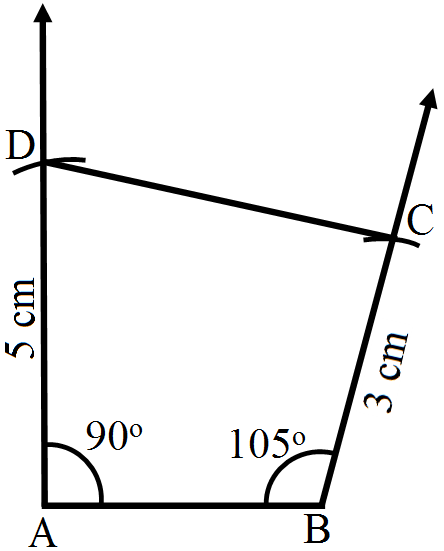 Steps of construction:
Step I: Draw AB = 3cm.
Step II: Construct $\angle\text{DAB}=90^\circ$ at A.
Step III: With A as the centre and radius 5cm, cut off AD = 5cm.
Step IV: Construct $\angle\text{ABC}=105^\circ$ at B.
Step V: With B as the centre and radius 3cm, cut off BC = 3cm.
Step VI: Join CD.
The quadrilateral so obtained is the required quadrilateral. View full question & answer→Question 175 Marks
Construct a quadrilateral ABCD, given that AB = 8cm, BC = 8cm, CD = 10cm, AD = 10cm and $\angle\text{A}=45^\circ.$
Answer
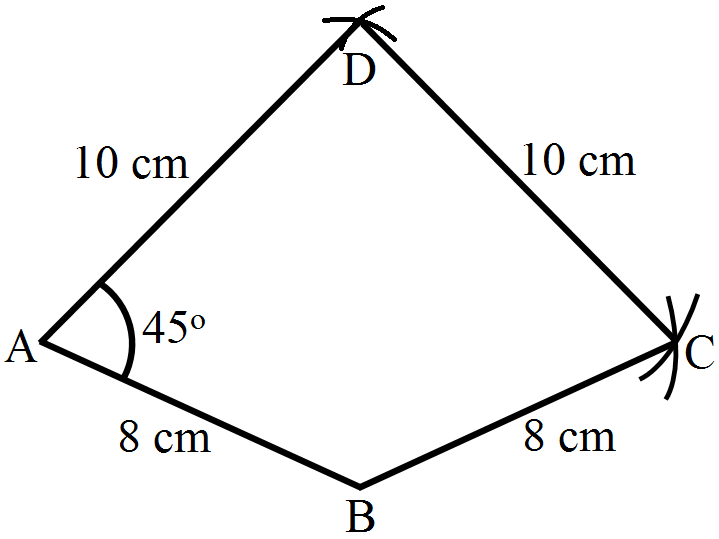 Steps of Construction:
Step I: Draw AB = 8cm.
Step II: Construct $\angle\text{BAD}=45^\circ.$
Step III: With A as the centre and radius 10cm, cut off AD = 10cm.
Step IV: With D as the centre and radius 10cm, draw an arc.
Step V: With B as the centre and radius 8cm, draw an arc to intersect the arc drawn in Step IV at C.
Step VI: Join BC and CD to obtained the required quadrilateral. View full question & answer→Question 185 Marks
Construct a rhombus with side 6cm and one diagonal 8cm. Measure the other diagonal.
Answer
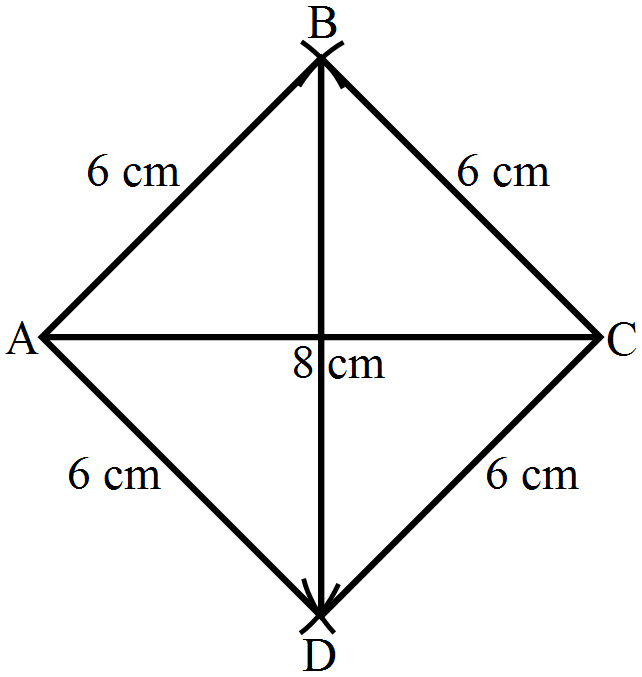 Steps of construction:
Step 1:
Steps of construction:
Step 1: Draw AC = 8cm.
Step 2: With A as the centre and radius = 6cm, draw arcs on both sides.
Step 3: With C as the centre and radius = 6cm, draw arcs on both sides, intersecting the previous arcs at points B and D.
Step 4: Join BD = 8.9cm. Thus, ABCD is the required rhombus.
View full question & answer→Question 195 Marks
Construct a quadrilateral ABCD in which AB = BC = 6cm, AD = DC = 4.5cm and $\angle\text{B}=120^\circ.$
Answer
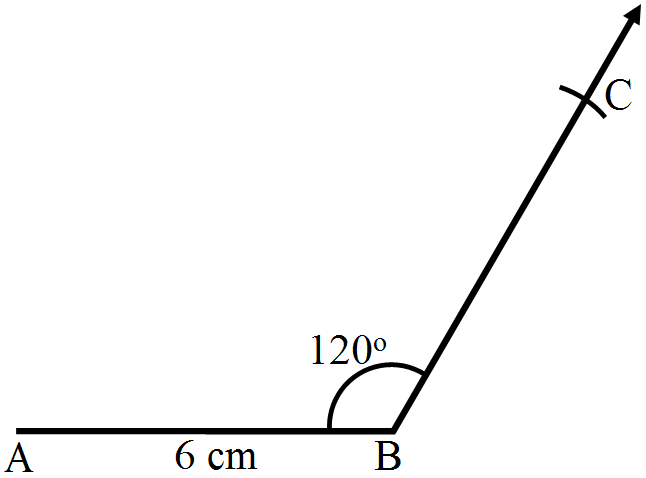 Steps of construction:
Step I: Draw AB = 6cm.
Step II: Construct $\angle\text{ABC}=120^\circ.$
Step III: With B as the centre and radius 6cm, cut off BC = 6 cm. Now, we can see that AC is about 10.3cm which is greater than AD + CD = 4.5 + 4.5 = 9cm.
We know that sum of the lengths of two sides of triangle is always greater than the third side but here, the sum of AD and CD is less than AC.
So, construction of the given quadrilateral is not possible. View full question & answer→Question 205 Marks
Construct a quadrilateral ABCD, where$\angle\text{A}=65^\circ,\text{B}=105^\circ,\text{C}=75^\circ,$ BC = 5.7 and CD = 6.8cm.
Answer
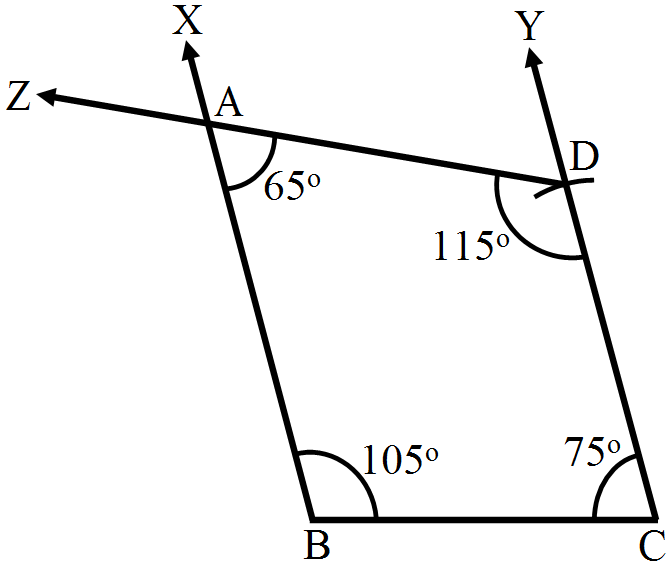 We know that the sum of all the angles in a quadrilateral is 360.
i.e.,$\angle\text{A}+\angle\text{B}+\angle\text{C}+\angle\text{D}=360^\circ$
$\Rightarrow\angle\text{D}=115^\circ$
Steps of construction:
Step I: Draw BC = 5.7cm.
Step II: Construct $\angle\text{XBC}=105^\circ$ at B and $\angle\text{BCY}=105^\circ$ at C.
Step III: With C as the centre and radius 6.8cm, cut off CD = 6.8cm.
Step IV: At D, draw $\angle\text{CDZ}=115^\circ$ such that it meets BY at A.
The quadrilateral so obtained is the required quadrilateral. View full question & answer→Question 215 Marks
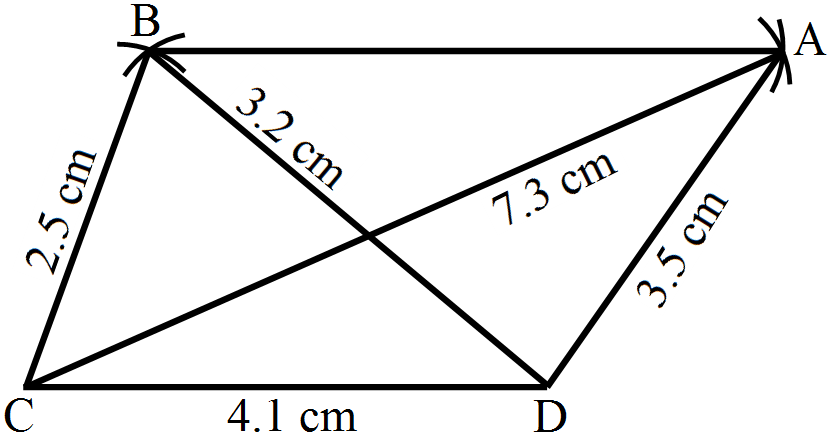
Construct a quadrilateral ABCD given AD = 3.5cm, BC = 2.5cm, CD = 4.1cm, AC = 7.3cm and BD = 3.2cm.
Answer
 Steps of construction:
Step I:
Steps of construction:
Step I: Draw CD = 4.1m.
Step II: With C as the centre and radius 7.3cm, draw an arc.
Step III: With D as the centre and radius 3.5cm, draw an arc to intersect the arc drawn in Step II at A.
Step IV: With D as the centre and radius 3.2cm, draw an arc on the other side of AC.
Step V: With C as the centre and radius 2.5cm, draw an arc to intersect the arc drawn in Step IV at B.
Step VI: Join BA, DA, BC and BD and AC to obtain the required quadrilateral.
View full question & answer→Question 225 Marks
Construct a quadrilateral ABCD, where AB = 5.5cm, BC = 3.7cm, $\angle\text{A}=60^\circ,$ $\angle\text{B}=105^\circ$ and $\angle\text{D}=90^\circ$
Answer
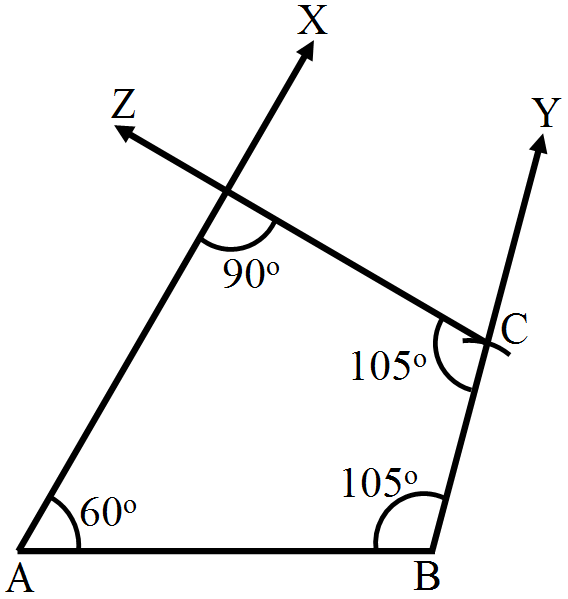 We know that the sum of all the angles in a quadrilateral is 360.
i.e., $\angle\text{A}+\angle\text{B}+\angle\text{C}+\angle\text{D}=360^\circ$
$\Rightarrow\angle\text{C}=105^\circ$
Steps of construction:
Step I: Draw AB = 5.5cm.
Step II: Construct $\angle\text{XAB}=60^\circ$ at A and $\angle\text{ABY}=105^\circ.$
Step III: With B as the centre and radius 3.7cm, cut off BC = 3.7cm.
Step IV: At C, draw $\angle\text{BCZ}=105^\circ$ such that it meets AX at D.
The quadrilateral so obtained is the required quadrilateral. View full question & answer→Question 235 Marks
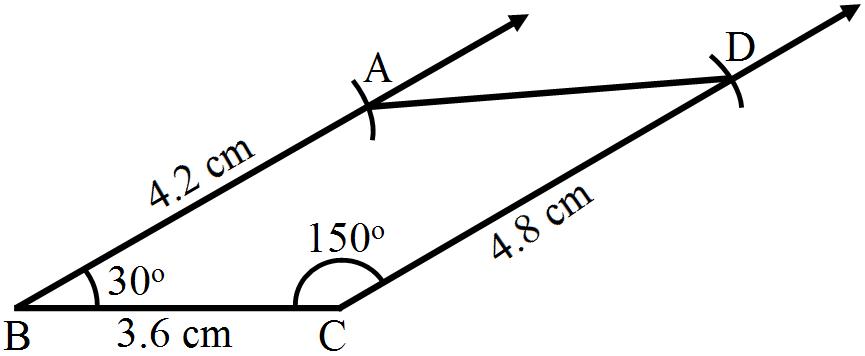
Construct a quadrilateral ABCD, where AB = 4.2cm, BC = 3.6cm, CD = 4.8cm, $\angle\text{B}=30^\circ$ and $\angle\text{C}=150^\circ.$
Answer
 Steps of construction:
Step I: Draw BC = 3.6cm.
Step II: Construct $\angle\text{ABC}=30^\circ$ at B.
Step III: With B as the centre and radius 4.2cm, cut off BA = 4.2cm.
Step IV: Construct $\angle\text{BCD}=150^\circ$ at C.
Step V: With C as the centre and radius 4.8cm, cut off CD = 4.8cm.
Step VI: Join AD.
The quadrilateral so obtained is the required quadrilateral. View full question & answer→Question 245 Marks
Construct a kite ABCD in which AB = 4cm, BC = 4.9cm and AC = 7.2cm.
Answer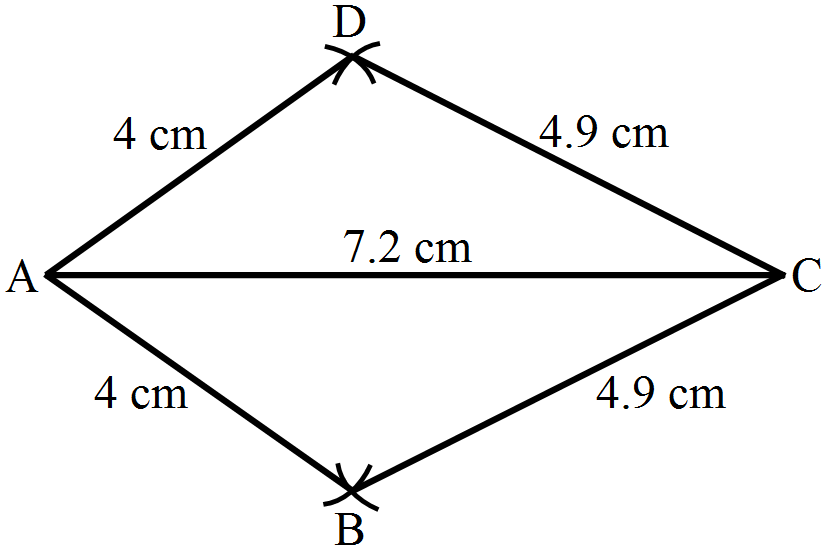 Steps of construction:
Step I:
Steps of construction:
Step I: Draw AC = 7.2cm.
Step II: With A as the centre and radius 4cm, draw arcs on both sides of the line segment AC.
Step III: With C as the centre and radius 4.9cm, draw arcs on both sides of AC intersecting the previous arcs of step II at B and D.
Step IV: Join BA, DA, BC and CD. Thus, the quadrilateral ABCD so obtained is the required kite.
View full question & answer→Question 255 Marks
Construct a quadrilateral ABCD given BC = 6.6cm, CD = 4.4cm, AD = 5.6cm and $\angle\text{C}=100^\circ$ and $\angle\text{C}=95^\circ.$
Answer
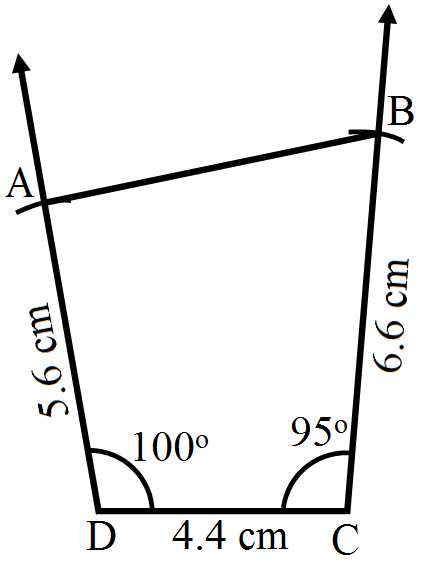 Steps of construction:
Step I: Draw DC = 4.4cm.
Step II: Construct $\angle\text{ADC}=100^\circ$ at D.
Step III: With D as the centre and radius 5.6cm, cut off DA = 5.6cm.
Step IV: Construct $\angle\text{BCD}=95^\circ$ at C.
Step V: With C as the centre and radius 6.6cm, cut off CB = 6.6cm.
Step VI: Join AB.
The quadrilateral so obtained is the required quadrilateral. View full question & answer→Question 265 Marks
Construct a quadrilateral ABCD, in which AD = 3.5cm, AB = 4.4cm, BC = 4.7cm, $\angle\text{A}=125^\circ.$ and $\angle\text{B}=120^\circ.$
Answer
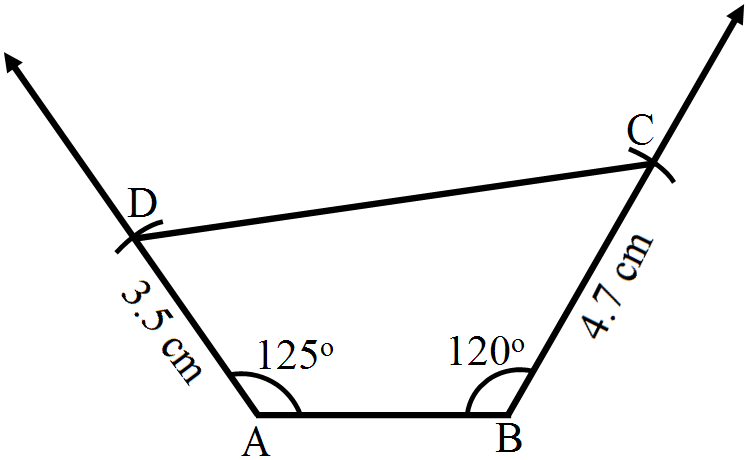 Steps of construction:
Step I: Draw QR = 2.5cm.
Step II: Construct $\angle\text{PQr}=75^\circ$ at Q.
Step III: With Q as the centre and radius 3.5cm, cut off QP = 3.5cm.
Step IV: Construct $\angle\text{QRS}=120^\circ$ at R.
Step V: With R as the centre and radius 4.1cm, cut off RS = 4.1cm.
Step VI: Join PS.
The quadrilateral so obtained is the required quadrilateral. View full question & answer→Question 275 Marks
Construct a quadrilateral ABCD in which BC = 4cm, CA = 5.6cm, AD = 4.5cm, CD = 5cm and BD = 6.5cm.
Answer
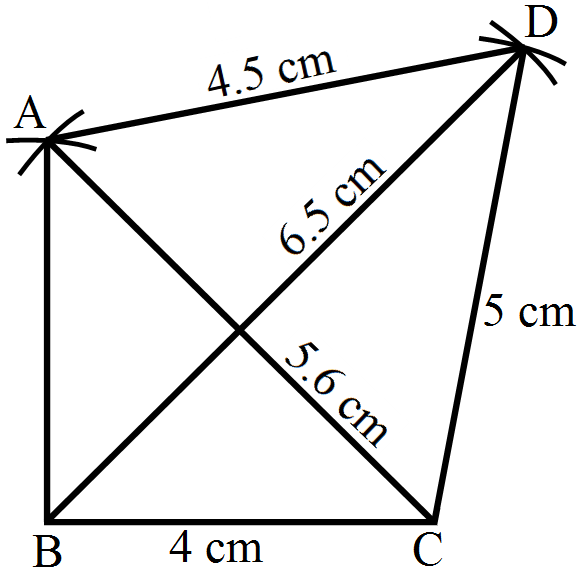 Steps of construction:
Step I:
Steps of construction:
Step I: Draw BC = 4cm.
Step II: With B as the centre and radius 6.5cm, draw an arc.
Step III: With C as the centre and radius 5cm, draw an arc to intersect the arc drawn in Step II at D.
Step IV: With C as the centre and radius 5.6cm, draw an arc on the same side.
Step V: With D as the centre and radius 4.5cm, draw an arc to intersect the arc drawn in Step IV at A.
Step VI: Join BA, AC, DA, BD and CD to obtained the required quadrilateral.
View full question & answer→Question 285 Marks
Construct a quadrilateral ABCD in which BC = 7.5cm, AC = AD = 6cm, CD = 5cm and BD = 10cm.
Answer
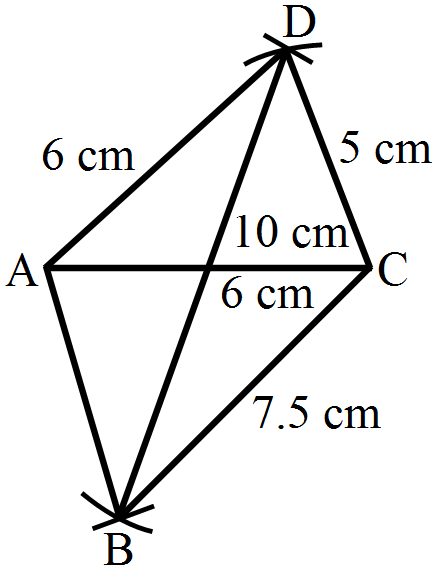 Steps of construction:
Step I:
Steps of construction:
Step I: Draw AC = 6cm.
Step II: With A as the centre and radius 6cm, draw an arc.
Step III: With C as the centre and radius 5cm, draw an arc to intersect the arc drawn in Step II at D.
Step IV: With D as the centre and radius 10cm, draw an arc on the other side of the line segment AC.
Step V: With C as the centre and radius 7.5cm, draw an arc to intersect the arc drawn in Step IV at B.
Step VI: Join BA, DA, BC and CD to obtained the required quadrilateral.
View full question & answer→Question 295 Marks
Construct a quadrilateral PQRS, in which PQ = 4cm, QR = 5cm, $\angle\text{P}=50^\circ,\angle\text{P}=110^\circ$ and $\angle\text{R}=70^\circ.$
Answer
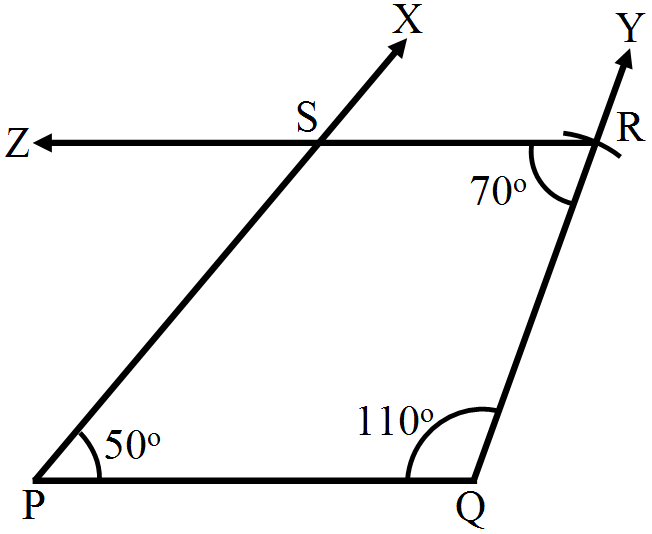 Steps of construction:
Step I: Draw PQ = 4cm.
Step II: Construct $\angle\text{XPQ}=50^\circ$ at P and $\angle\text{PQY}=110^\circ$ at Q.
Step III: With Q as the centre and radius 5cm, cut off QR = 5cm.
Step IV: At R, draw $\angle\text{QRZ}=70^\circ$ such that it meets PX at S.
The quadrilateral so obtained is the required quadrilateral. View full question & answer→Question 305 Marks
Construct a quadrilateral ABCD given AD = 5cm, AB = 5.5cm, BC = 2.5cm, AC = 7.1cm and BD = 8cm.
Answer
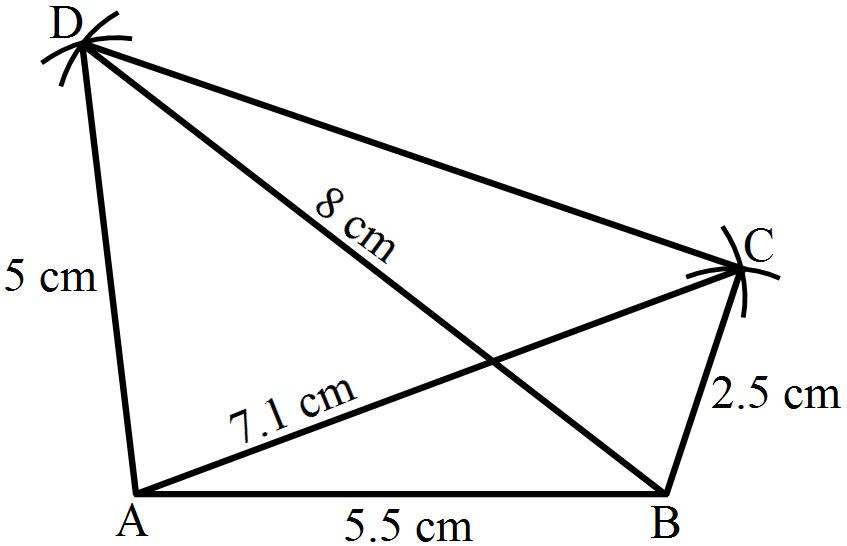 Steps of construction:
Step I:
Steps of construction:
Step I: Draw AB = 5.5cm.
Step II: With A as the centre and radius 7.1cm, draw an arc.
Step III: With B as the centre and radius 2.5cm, draw an arc to intersect the arc drawn in Step II at C.
Step IV: With B as the centre and radius 8cm, draw an arc.
Step V: With A as the centre and radius 5cm, draw an arc to intersect the arc drawn in Step IV at D.
Step VI: Join DA, DB, BC, AC and CD to obtain the required quadrilateral.
View full question & answer→Question 315 Marks
Construct a quadrilateral ABCD when BC = 5.5cm, CD = 4.1cm, $\angle\text{A}=70^\circ,\text{AB}=110^\circ$ and $\angle\text{D}=85^\circ.$
Answer
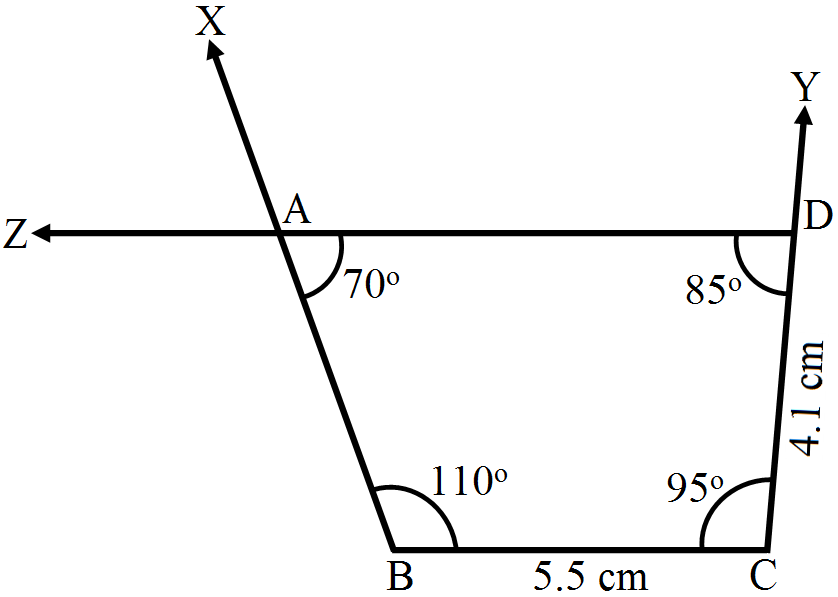 We know that the sum of all the angles in a quadrilateral is 360.
i.e.,$\angle\text{A}+\angle\text{B}+\angle\text{C}+\angle\text{D}=360^\circ$
$\Rightarrow\angle\text{C}=95^\circ$
Steps of construction:
Step I: Draw BC = 5.5cm.
Step II: Construct $\angle\text{XBC}=110^\circ$ at A and $\angle\text{BCY}=95^\circ$
Step III: With C as the centre and radius 4.1cm, cut off CD = 4.1cm.
Step IV: At D, draw $\angle\text{CDZ}=85^\circ$ such that it meets BY at A.
The quadrilateral so obtained is the required quadrilateral. View full question & answer→