Question
Construct a rectangle $\text{ABCD}$, when:Area $= 24 \ cm^2$ and base $= 4.8 \ cm^2$.

Answer

Given that the base $=4.8 \ cm ^2$ and Area $=24 \ cm ^2$
We know that the area of the rectangle $=$ base $\times$ Height.
Therefore,
$24=4.8 \times$ height
Height $=5$
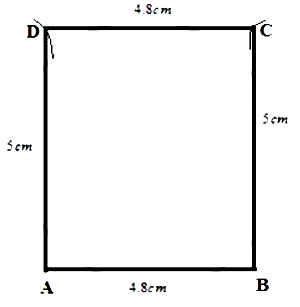
With base $=4.8 \ cm ^2$ and height $=5 \ cm ^2$,
the rectangle is shown below:

Steps:
$1$. Draw base $A B=4.8 \ cm ^2$.
$2$. With $A$ and $B$ as a center draw an arc taking radius $5 \ cm ^2$ at $D$ and $C$.
$3$. Now join $A D, B C$, and $D C$.
$\text{ABCD}$ is the required rectangle.

Need a full question paper?

Generate a complete, print-ready paper with questions like this in minutes — across 16+ boards, with answer keys.
Start Generating Free

Similar questions

Solve the following pairs of equations$:\ \frac{x}{3}+\frac{y}{4}=11,\frac{5 x}{6}-\frac{y}{3}=-7$
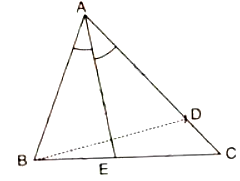
In the following diagram; $A D=A B$ and $A E$ bisect angle $A$.

Prove that:$(i) BE = DE;(ii)\angle A B D>\angle C$
Solve :$\frac{3}{x}-\frac{2}{y}=0$ and $\frac{2}{x}+\frac{5}{y}=19$ Hence, find $'a\ '$ if $\mathrm{y}=\mathrm{ax}+ 3.$
Draw a graph of the equation $3x - y = 7$. From the graph find the value of$:\ (i) y$, when $x = 1;(ii) x$, when $y = 8$
A wire when bent in the form of a square encloses an area of $484\ m^2$. Find the largest area enclosed by the same wire when bent to from:$(i)$ An equilateral triangle.$(ii)$ A rectangle of length $16\ m.$
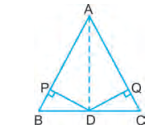
In the given figure, $A B=A C$; $D$ is the mid-point of $B C$; $DP \perp BA$ and $DQ \perp CA$.
Prove that:
(i) $DP = DQ$
(ii) $AP = AQ$
(iii) AD bisects $\angle A$.
Image
Find two numbers such that the sum of thrice the first and the second is 142 and four times the first exceeds the second by 138.
On a certain sum of money, invested at the rate of $10$ percent per annum compounded annually, the interest for the first year plus the interest for the third year is $Rs. 2,652.$ Find the sum.
Arrange $-\frac{5}{7}, \frac{7}{12},-\frac{2}{3}$ and $\frac{11}{18}$ in ascending order of their magnitudes.Also, find the difference between the largest and smallest of these rational numbers. Express this difference as a decimal fraction correct to one decimal place.
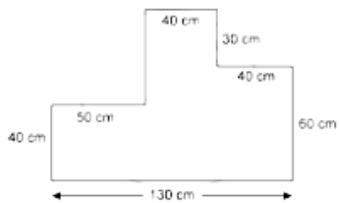
The given figure is a cross$-$section of a victory stand used in sports. All measurements are in centimetres. Assume all angles in the figure are right angles. If the width of the stand is $60 \ cm$, find The space it occupies in $cm^3.$
Image