Questions

[5 marks sum]

🎯

Test yourself on this topic

9 questions · timed · auto-graded

Question 15 Marks
Draw parallelogram $\text{ABCD}$ with the following data:$A B=6 \ cm , A D=5 \ cm$ and $\angle D A B=45^{\circ}$.Let $A C$ and $D B$ meet in $O$ and let $E$ be the mid$-$point of $B C$. Join $O E$.Prove that:(i) $OE \| AB;(ii)OE =\frac{1}{2} AB$.
Answer
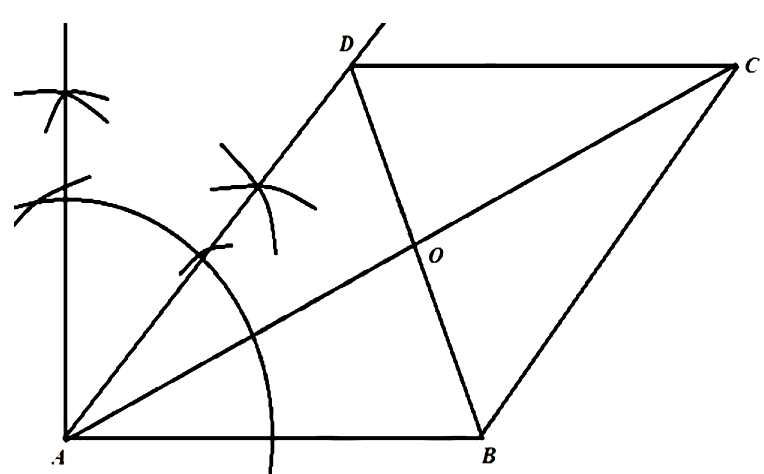
To draw the parallelogram follows the steps:
$1$. First, draw a line $A B$ of measure $6 \ cm$.
Then draw an angle of measure $45^{\circ}$ at point $A$ such that $\angle D A B=45^{\circ}$ and $A D=5 \ cm$.
$2$. Now draw a line $C D$ parallel to the line $A B$ of measure $6 \ cm$.
Then join $BC$ to construct the parallelogram as shown below:
$3$. Now it is given that $E$ is the mid$-$point of $BC$.
We join $OE$.
 Now we are to prove that $OE \| AB$ and $OE =\frac{1}{2} AB$.
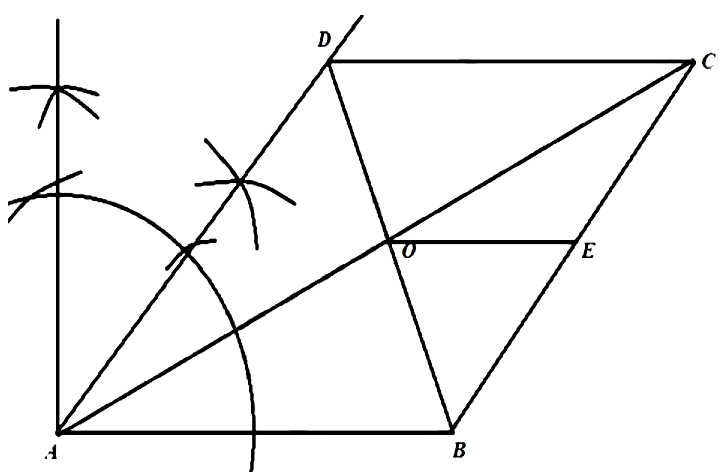
$4$. Since $O$ is the mid$-$point of $A C$ and $E$ is the midpoint of $B C$,
$\therefore$ the line is parallel to $A B$ and $O E=\frac{1}{2} A B$
View full question & answer
Question 25 Marks
The perpendicular distance between the pair of opposite sides of a parallelogram are $3 \ cm$ and $4 \ cm$, and one of its angles measures $60^o$. Using a ruler and compasses only,construct the parallelogram.
Answer

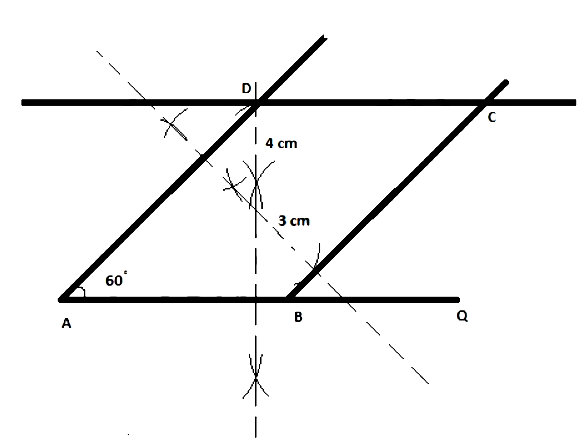
Steps:
$1$. Draw a baseline $AQ.$
$2$. A take some random distance in compass and draw one are below and above the line.
Now without changing the distance in compass draw one are below and above the line.
These arcs intersect each other above and below the line.
Draw the line passing through these intersecting points, you will get perpendicular to the line $A Q$.
$3$. Take distance of $4 \ cm$ in compass and mark an arc on the perpendicular above the line.
Draw a line parallel to line $A Q$ passing through this arc.
$4$. From point $A$ measure an angle of $60$ degrees and draw the line which intersects the above$-$drawn line at some point label it as $ D.$
$5$. Using the procedure given in step $2$ again draw a perpendicular to line $A D$.
$6$. Take distance of $3 \ cm$ in compass and mark an arc on the perpendicular above the line.
​​​​​​​Draw a line parallel to line $AD$ passing through this arc which intersects the line $AQ$ at some point label it as $B$ and to other lines at point $C$.
$\text{ABCD}$ is the required parallelogram.
View full question & answer
Question 35 Marks
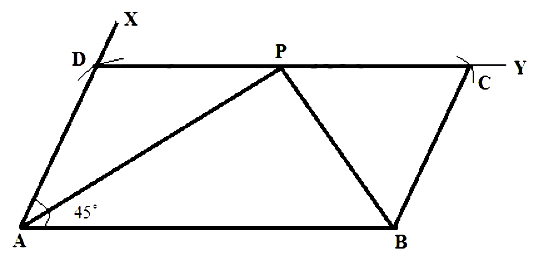
Using ruler and compasses only, construct a parallelogram $\text{ABCD}$ using the following data$: AB = 6 \ cm, AD = 3 \ cm$ and $\angle DAB = 45^o$. If the bisector of $\angle DAB$ meets $DC$ at $P$,prove that $\angle APB$ is a right angle.
Answer

Steps:
$1$. draw $A B=6 \ cm$.
$2$. With $A$ as a center draw a line $A X$ such that $\angle B A X=45^{\circ}$.
$3$. With $A$ as a center and radii, $3 \ cm$ draw an arc on $AD$.
$4$. now with $D$ and $B$ as a center and radii $6 \ cm$ and $3 \ cm$ draw arcs cutting each other at $C$.
$5$. Join $DC$ and $BC$.
$\text{ABCD}$ is the required parallelogram.
Here
$\angle PAB =\angle APD\dots ...[$ Alternate angles $]$
$\angle C P B=\angle PBA \dots...[$ Alternate angles $]$
Now,
$\angle DPA +\angle APB +\angle CPB =180^{\circ} \ldots \ldots . \text { (i) }$
Also, considering $\text{APB},$
$\angle PAB +\angle PBA +\angle APB =180^{\circ} \ldots \ldots . \text { (ii) }$
Therefore, from $(i)$ and $(ii)$
$\angle APB =90^{\circ}$
Hence proved.
View full question & answer
Question 45 Marks
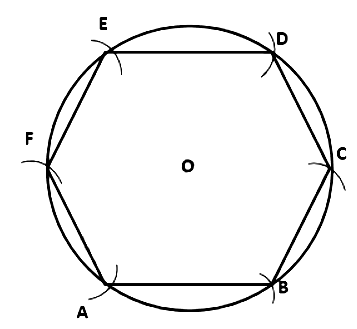
Construct a regular hexagon of side $3.2 \ cm$
Answer
The length of the side of a regular hexagon is equal to the radius of its circumcircle.
Steps of construction:
$1.$ Draw a circle of radius $3.2 \ cm$
$2$. Taking any point $A$ on the circumference of the circle as a centre, draw arcs of same radii $($i.e. $3.2 \ cm)$ which cut the circumference at $B$ and $F$.
$3$. With $B$ and $F$ as centres, again draw two arcs of same radii which cut the circumference at $C$ and $E$ respectively.
$4$. With $C$ or $E$ as a centre, draw one more arc of the same radius which cuts the circumference at point $D.$
In this way, the circumference of the circle is divided into six equal parts.
$5$. Join $A B, B C, C D, D E, E F$ and $F A$.

$\text{A B C D E F}$ is the required regular hexagon.
View full question & answer
Question 55 Marks
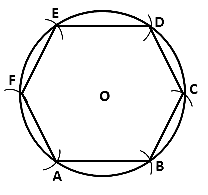
Construct a regular hexagon of side $2.5 \ cm$
Answer
The length of the side of a regular hexagon is equal to the radius of its circumcircle.
Steps of construction:
$1$. Draw a circle of radius $2.5 \ cm$
$2$. Taking any point $A$ on the circumference of the circle as the centre, draw arcs of same radii $($i.e. $2.5 \ cm)$ which cut the circumference at $B$ and $F.$
$3$. With $B$ and $F$ as centres, again draw two arcs of same radii which cut the circumference at $C$ and $E$ respectively.
$4$. With $C$ or $E$ as the centre, draw one more arc of the same radius which cuts the circumference at point $D$.
In this way, the circumference of the circle is divided into six equal parts.
$5$. Join $AB , BC , CD , DE , EF$ and $FA$.

$\text{ABCDEF}$ is the required regular hexagon.
View full question & answer
Question 65 Marks
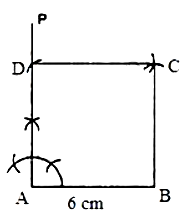
Construct a square ABCD, when: Perimeter $= 24 \ cm.$
Answer
The perimeter of a square
$P=4 a$
Where $a$ is the length of each side
We have Perimeter $=24 \ cm$
Therefore,
$24=4 a$
$ 4=6$
Therefore the sides of the squares are of length $6 \ cm$.

Steps:
$1$. Draw a line segment $A b=6 \ cm$.
$2$. Draw $A P \perp A B$.
$3$. From $A P$ cut off $A D=6 \ cm$.
$4$. With $B$ as a center and radius, $6 \ cm$ draw an arc.
$5$. With $D$ as center and radius, $6 \ cm$ draw another arc cutting the former arc at $C$.
$6$. Join $B C$ and $C D$.
$\text{ABCD}$ is the required square.
View full question & answer
Question 75 Marks
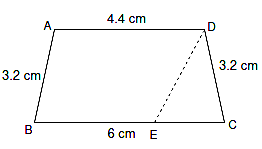
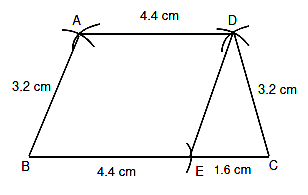
Construct a trapezium $\text{ABCD}$, when:$AB= CD = 3.2 \ cm, BC = 6.0 \ cm, AD = 4.4 \ cm$ and $AD \| BC.$
Answer
Rough diagram$-$

Steps:
$1$. Draw $BC =6 \ cm$.
$2$. From $B C$ cut $B E=A D=4.4 \ cm$.
$3$. Draw triangle $D E C$ such that $D E=A B=2 \ cm$ and $C D=3.2 \ cm$.
$4$. Taking $B$ and $D$ as a center and radii $3.2 \ cm$ and $4.4 \ cm$ respectively, draw arcs cutting each other at $A$.
$5$. Join $A B$ and $A D$.
$\text{ABCD}$ is the required trapezium.
Construction -
​​​​​​​
View full question & answer
Question 85 Marks
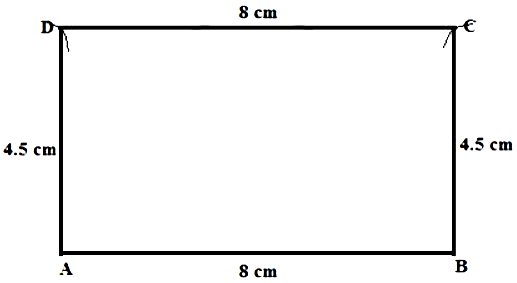
Construct a rectangle $\text{ABCD}$, when:Area $= 36 \ cm^2$ and height $= 4.5 \ cm$.
Answer
Given that the height $=4.5 \ cm$ and Area $=36 \ cm ^2$
We know that the area of rectangle $=$ base $\times$ Height
Therefore,
$36=$ base $\times 4.5$
Base $=8 \ cm$
With height $=4.5$ and base $=8 \ cm$,
the rectangle is shown below:

Steps:
$1$. Draw base $A B=8 \ cm$.
$2$. With $A$ and $B$ as a center draw arc taking radius $=4.5 \ cm$ at $D$ and $C$
$3$. Now join $AD , BC$, and $DC$.
$\text{ABCD}$ is the required rectangle.
View full question & answer
Question 95 Marks
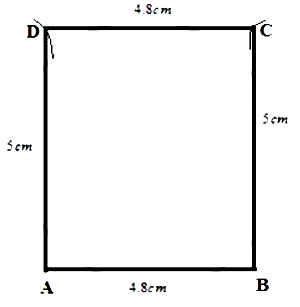
Construct a rectangle $\text{ABCD}$, when:Area $= 24 \ cm^2$ and base $= 4.8 \ cm^2$.
Answer
Given that the base $=4.8 \ cm ^2$ and Area $=24 \ cm ^2$
We know that the area of the rectangle $=$ base $\times$ Height.
Therefore,
$24=4.8 \times$ height
Height $=5$
With base $=4.8 \ cm ^2$ and height $=5 \ cm ^2$,
the rectangle is shown below:

Steps:
$1$. Draw base $A B=4.8 \ cm ^2$.
$2$. With $A$ and $B$ as a center draw an arc taking radius $5 \ cm ^2$ at $D$ and $C$.
$3$. Now join $A D, B C$, and $D C$.
$\text{ABCD}$ is the required rectangle.
View full question & answer
[5 marks sum] - MATHEMATICS STD 9 Questions - Vidyadip