Question
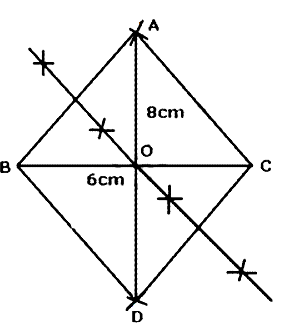
Construct a rhombus ABCD whose diagonals AC and BD are 8 cm and 6 cm respectively. Find by construction a point P equidistant from AB and AD and also from C and D. 
Answer


Steps of Construction:
(i) Draw BC = 6 cm.
(ii) Draw AD = 8 on perpendicular to BC.
(iii) With B as centre draw arcs on AD.
(iv) With C as centre draw arcs on AD. ABCD is the required rhombus.
(v) Draw perpendicular bisectors of AB, and CD, which meet at 0.
(vi) Since AD and BC are diagonals of rhombus and meet at 0.
AO = OD
O is the point equidistant from AB, AD and C, D.

Need a full question paper?

Generate a complete, print-ready paper with questions like this in minutes — across 16+ boards, with answer keys.
Start Generating Free

Similar questions

The volume of a conical tent is $1232 \mathrm{~m}^3$ and the area of the base floor is $154 \mathrm{~m}^2$. Calculate the:
(a) radius of the floor.
(b) height of the tent.
(c) length of the canvas required to cover this conical tent, if its width is 2 m .
A computer was available for $Rs. 27,216$, which included two successive discounts of $20\%$ and $10\%$ on the basic price and a sales tax of $8\%$ on the remaining price. Find the basic price of the computer.
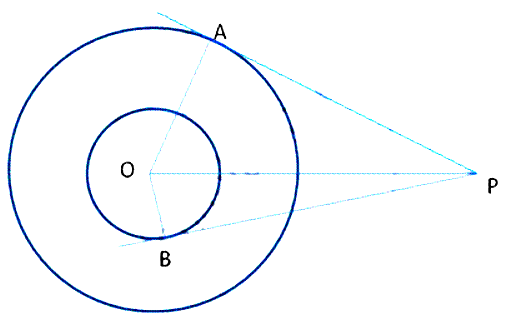
In followinf fig., two concentric circles with centre 0 are of radii 5 cm and 3 cm. from an external point P, tangents PA and PB are drawn to these circles. If AP = 12cm, find BP.
An alloy consists of $27 \frac{1}{2} kg$ of copper and $2 \frac{3}{4} kg$ of tin. Find the ratio by weight of tin to the alloy
The sum of the ages of a father and his son is $45$ years. Five years ago, the product of their ages (in year) was $124.$ determine their presnet ages.
Gayatri invested $Rs.25,000$ for $3$ years and 6 months in a bank which paid
$10\%$ p.a- compound interest. Calculate the amount to the nearest.Ts $-10,$ that she
received at the end of the period.
Prove.$\frac{\sin A+\cos A}{\cos A-\cos A}+\frac{\sin A-\cos A}{\sin A+\cos A}=\frac{2}{2 \sin ^2 A-1}$
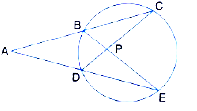
In the given figure, AC = AE Show that:
(i) CP = EP
(ii) BP = DP

 
Find $x$ from the following equations $: \frac{\sqrt{x+4}+\sqrt{x-10}}{\sqrt{x+4}-\sqrt{x-10}}=\frac{5}{2}$
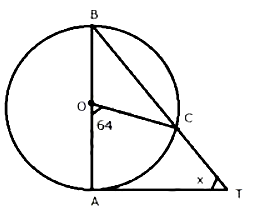
In the given figure, AB is the diameter of the circle, with centre O, and AT is the tangent. Calculate the numerical value of x.