Questions

[4 marks sum]

🎯

Test yourself on this topic

17 questions · timed · auto-graded

Question 14 Marks
AB and CD are two intersecting lines. Find a point equidistant from AB and CD, and also at a distance of 1.8 cm from another given line EF.
Answer
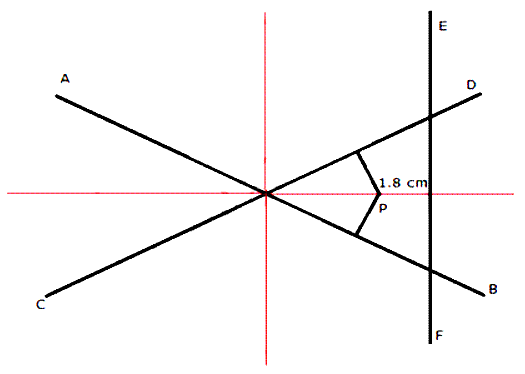
Draw angle bisector of AB and CD . Draw perpendio..ilars from AB and CD on angle bisector, say P. Pis the required point which is equidistant from AB and CD and at a distAnce of 1.8 cm from FF.
View full question & answer
Question 24 Marks
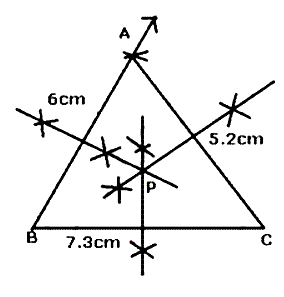
Construct a triangle ABC, such that AB= 6 cm, BC= 7.3 cm and CA= 5.2 cm. Locate a point which is equidistant from A, B and C.
Answer

Steps of construction:
(i) Draw a line segment BC= 7.3 cm.
(ii) With Bas centre and radius 6 cm draw an arc.
(iii) With C as centre and radius 5.2 cm draw another arc which intersects the first arc at A.
(iv) Join AB and AC.
(v) Draw perpendicuIar bisector of BC , AB and AC.
In triangIe ABC, P is the point of intersection of AB , AC and BC.
Therefore, PA = PB, PB = PC, PC = PA.
Thus, circum-centre of a triangle is the point which is equidistant from all its vertices.
View full question & answer
Question 34 Marks
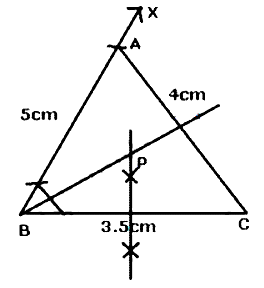
Using only ruler and compasses, construct a triangle ABC 1 with AB = 5 cm, BC = 3.5 cm and AC= 4 cm. Mark a point P, which is equidistant from AB, BC and also from Band C. Measure the length of PB.
Answer

Steps of construction:
(i) Draw a line segment BC = 3. 5 cm.
(ii) With Bas centre and radius 5 cm draw an arc.
(iii) With C as centre and radius 4 cm draw another arc which intersects the first arc at A.
(iv) Join AB and AC.
(v) Dr aw perpendi cu I ar bi sector of BC.
(vi) Dr aw the angle bi sector of angle ABC which intersects the perpendicular bisector of BC at P.
Pis the required point which is equidistant from AB, BC, Band C.
The length of PB = 2.5 cm
View full question & answer
Question 44 Marks
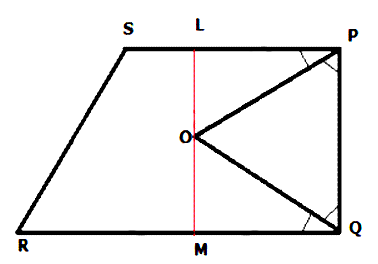
In a quadrilateral PQRS, if the bisectors of ∠ SPQ and ∠ PQR meet at O, prove that O is equidistant from PS and QR.
Answer

OP bisects ∠ SPQ and OQ bisects ∠ PQR.
Draw OM perpendirular to RQ and OL perpendirular to SP
Now in Δ OQM and Δ OLP
∠ OLP = ∠ OMQ
∠ OPL = ∠OQM
OP= OQ
Therefore, Δ OQM and Δ OLP are oongruent.
Hence, OL = OM
O is equidistant from PS and QR. Proved.
View full question & answer
Question 54 Marks
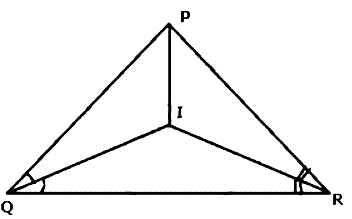
In Δ PQR, bisectors of ∠ PQR and ∠ PRQ meet at I. Prove that I is equidistant from the three sides of the triangle , and PI bisects ∠ QPR .
Answer

Since I lies on bisector of ∠ R, I is equidistant from PR and QR.
Again I lies on the bisector of ∠ Q , I is equidistant from PQ and QR.
Hence , I is equi distant from alI sides of the triangle.
Therefore, I lies on the bisector of ∠ P i.e ∠ QPR .
View full question & answer
Question 64 Marks
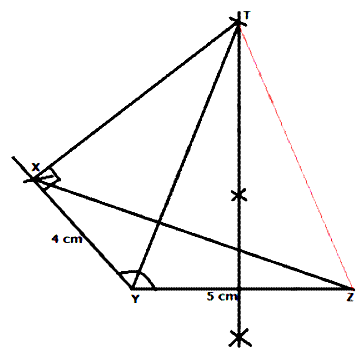
Construct a Δ XYZ in which XY= 4 cm, YZ = 5 cm and ∠ Y = 1200. Locate a point T such that ∠ YXT is a right angle and Tis equidistant from Y and Z. Measure TZ. 
Answer

Steps of Construction:
(i) Draw YZ = 5 cm
(ii) Draw an arc with angle Y= 120 ° and radius 4 cm.
(iii) Join XZ.
(iv) Draw perpendicular bisector of YZ.
(v) With X as centre and angle X as 90° , join X to the perpendicular bisectcr at T. T is the required point.
(vi) Measure TY. TY = 6.8 cm = TZ as T lies on perpendicular bisector of YZ.
View full question & answer
Question 74 Marks
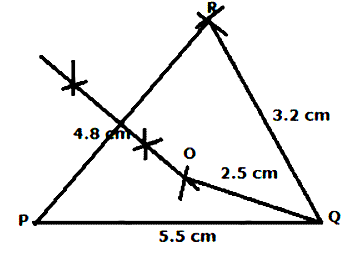
Construct a ti.PQR, in which PQ=S. 5 cm, QR=3. 2 cm and PR=4.8 cm. Draw the locus of a point which moves so that it is always 2.5 cm from Q. 
Answer

Steps of oonstruction:
(i) Draw PQ = 5.5 cm
(ii) With P as centre and radius 4.8 cm draw an arc.
(iii) With Q as centre and radius 3.2 cm cut another arc which meets the first arc at R. Join PR and QR. PQR is the required triangle.
(iv) Draw perpendicular bisector of PR.
(v) Q as centre and radius as 2.5 cm, draw an arc which intersects the perpendicular bisector of PR at O.
O is the required point which is at a distance of 2.5 cm from Q.
View full question & answer
Question 84 Marks
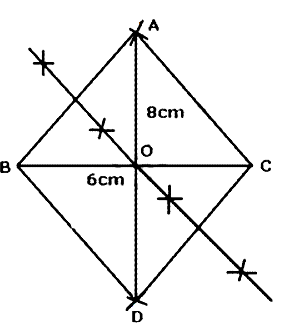
Construct a rhombus ABCD whose diagonals AC and BD are 8 cm and 6 cm respectively. Find by construction a point P equidistant from AB and AD and also from C and D. 
Answer

Steps of Construction:
(i) Draw BC = 6 cm.
(ii) Draw AD = 8 on perpendicular to BC.
(iii) With B as centre draw arcs on AD.
(iv) With C as centre draw arcs on AD. ABCD is the required rhombus.
(v) Draw perpendicular bisectors of AB, and CD, which meet at 0.
(vi) Since AD and BC are diagonals of rhombus and meet at 0.
AO = OD
O is the point equidistant from AB, AD and C, D.
View full question & answer
Question 94 Marks
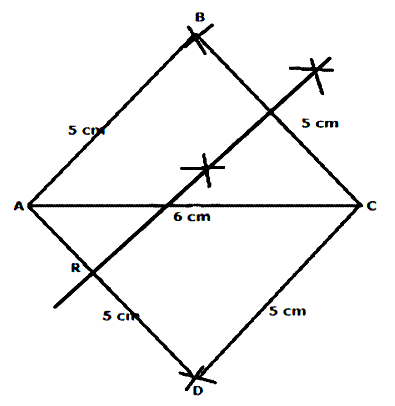
Construct a rhombus ABCD with sides of length 5 cm and diagonal AC of length 6 cm. Measure ∠ ABC. Find the point R on AD such that RB = RC. Measure the length of AR. 
Answer

Steps of Construction:
(i) Draw AC= 6 cm.
(ii) With A as centre, draw two arcs of 5 cm on both sides of line AC.
(iii) With C as centre, draw two arcs of 5 cm on both sides of line AC.
(iv) All the arcs meet at Band D. Join AB, AD, BC and BD. ABCD is the required rhombus.
(v) On measuring, ∠ ABC = 78>.
(vi) Draw perpendicular bisector of BC meeting AD at R. R is the pdnt equidistant from Band C, hence RB = RC.
(vii) On measuring, R = 1.2 cm
View full question & answer
Question 104 Marks
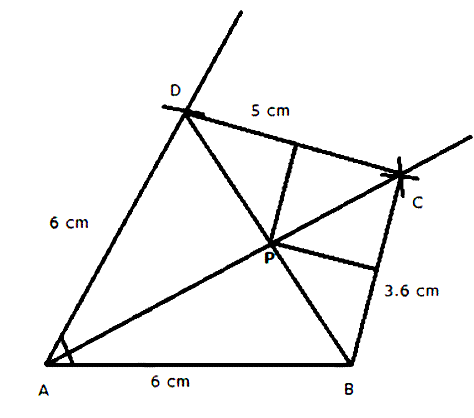
Without using set squares or protractor, construct a quadrilateral ABCD in which ∠ BAD = 45° , AD = AB = 6 cm, BC= 3.6 cm and CD=5 cm. Locate the point P on BD which is equidistant from BC and CD. 
Answer

Steps of construction:
(i) Draw a line AB = 6 cm.
(ii) Draw a ray making an angle of 45° with AB.
(iii) With a as centre, draw AD = 6 cm on the ray.
(iv) Draw an angle bisector of angle BAD.
(v) With Bas centre cut an arc BC = 3.6 cm on the angle bisector.
(vi) With Das centre cut an arc CD = 5 cm on the angle bisector. ABCD is the required quadrilateral.
(vii) Join BD.
(viii) Draw perpendicular bisectors of CD and BC which meet BD on P. Pis the required point.
View full question & answer
Question 114 Marks
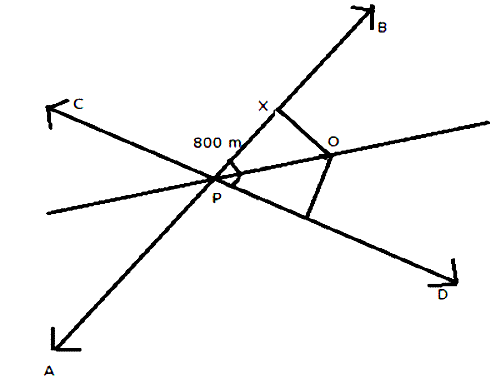
Two straight roads $AB$ and $CD$ cross each other at Pat an angle of $75^\circ . X$ is a stone on the road $AB, 800m$ from $P$ towards $B.$ BY taking an appropriate scale draw a figure to locate the position of a pole, which is equidistant from $P$ and $X,$ and is also equidistant from the roads.
Answer


Steps of construction:
$(i)$ Draw two lines $AB$ and $CD$ crossing at an angle of $75^{\circ}$
$(ii)$ Draw an angle bisector for $\angle BPD$
$(iii)$ Draw perpendicular from $X$ on angle bisector meeting at $0 .$
$(iv)$ From point $Y , PX = PY$, draw a perpendicular on angle bisector meeting at $0 .$
$(v) 0$ is the point which is equidistant from $P , X$ and both the roads.
$\cos \theta=\frac{\text { hypotenuse }}{\text { base }}$
$\cos \frac{75}{2}=\frac{ PO }{ PX }$
$\cos (37.5)=\frac{ PO }{800}$
$0.980243=\frac{ PO }{800}$
$PO =784.19 m$
View full question & answer
Question 124 Marks
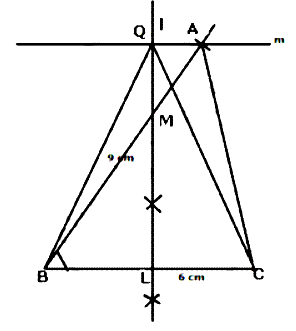
In Δ ABC, B and Care fixed points. Find the locus of point A which moves such that the area of Δ ABC remains the same. 
Answer

Steps of Construction:
(i) ABC is the required triangle.
(ii) Draw perpendicular bisector of BC which intersects BA in M, then any point on LM is equidistant from Band C.
(iii) Through A, draw a line m 11 BC.
(iv) The perpendicular bisector of BC and the parallel line m intersect each other at Q.
(v) Then triangle QBC is equal in area to triangle ABC. mis the locus of all points through which any triangle with base BC will be equal in area of triangle ABC.
View full question & answer
Question 134 Marks
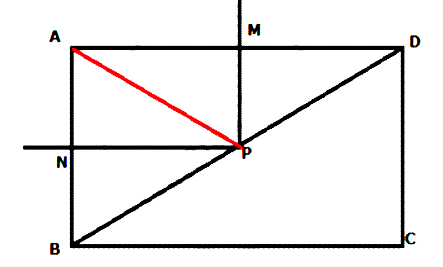
In a quadrilateral ABCD, if the perpendicular bisectors of AB and AD meet at P, then prove that BP = DP. 
Answer

In Δ AMPand Δ DMP
MP = MP
AM = MD
∠ AMP = ∠ DMP = 90°
Therefore, Δ AMPand Δ DMP are congruent.
DP= AP ....... (i)
In Δ ANP and Δ BNP
NP= NP
AN= NB
∠ANP = ∠BNP = 90°
Therefore, Δ ANP and Δ BNP are congruent.
BP= AP ....... (ii)
From (i) and (ii)
BP= DP
Hence, proved.
View full question & answer
Question 144 Marks
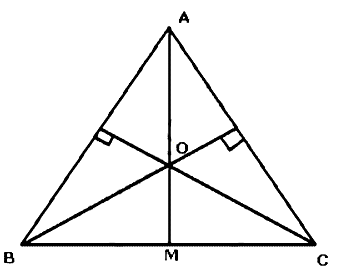
In  Δ ABC, the perpendicular bisector of AB and AC meet at 0. Prove that O is equidistant from the three vertices. Also, prove that if M is the mid-point of BC then OM meets BC at right angles. 
Answer

Since O lies on the perpendirular bisector of AB, O is equidistant from A and B.
OA = OB ........ (i)
Again, O lies on the perpendirular bisector of AC, O is equidistant from A and C.
OA = OC ......... (ii)
From (i) and (ii)
OB= OC
Now in Δ OBM and Δ OCM,
OB = OC (proved)
OM=OM
BM =CM ( M is mid-point of BC)
Therefore, Δ OBM and Δ OCM are congruent.
∠ OMB= ∠ OMC
But BMC is a straight line, so
∠ OMB =∠ OMC = 90°
Thus, OM meets BC at right angles.
View full question & answer
Question 154 Marks
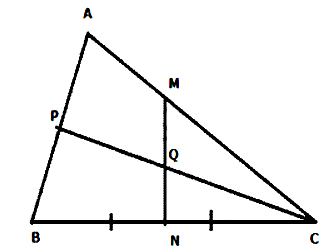
In the given figure ABC is a triangle. CP bisects angle ACB and MN is perpendicular bisector of BC. MN cuts CP at Q. Prove Q is equidistant from B and C, and also that Q is equidistant from BC and AC.
Answer

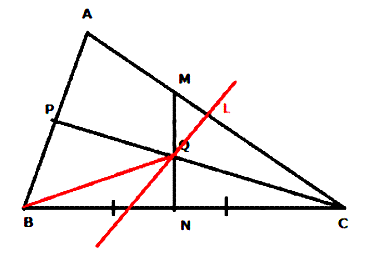
Join BQ and draw perpendicular bisector of AC cutting AC at L.
In Δ QBN and ΔQCN
QN = QN
BN =NC
∠ QNB = ∠ QNC = 90 degree.
Therefore, ∠ QBN and ∠.QCN are congruent .
Hence Q is equidistant from B and C.
In Δ QNC and Δ QLC
QC= QC
∠ QLC = ∠ QNC = 90 degree.
∠ QCL =∠ QCN (PC being angle bisector)
Therefore, .Δ QNC and Δ QLC are congruent.
Therefore, QL = QN.
Hence Q is equidistant from BC and AC.
View full question & answer
Question 164 Marks
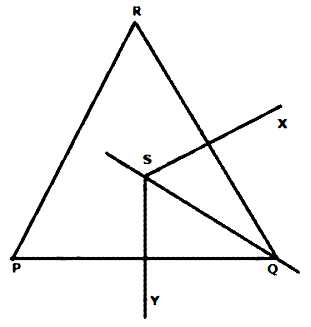
In  Δ PQR, s is a point on PR such that ∠ PQS = ∠  RQS . Prove thats is equidistant from PQ and QR. 
Answer

Steps of Construction:
(i) Draw line segment PQ.
(ii) With P and Q as centre draw intersecting arcs at R.
(iii) Join PR and RQ.
(iv) Draw angle bisector of angle Q.
(v) Draw perpendicular bisectors of PQ and RQ which meet the angle bisector at S. S is the required point.
(vi) In Δ QSY and Δ QSX
SQ= SQ
∠ SQY = ∠ SQX
∠ SYQ = ∠ SXQ = 90 degrees.
Therefore, Δ QSY and Δ QSX are congruent.
Hence, SY = SX and therefore S is equidistant from PQ and RQ.
View full question & answer
Question 174 Marks
Draw a straight line AB of 9 cm. Draw the locus of all points which are equidistant from A and B. Prove your statement. 
Answer

Steps of oonstruction:
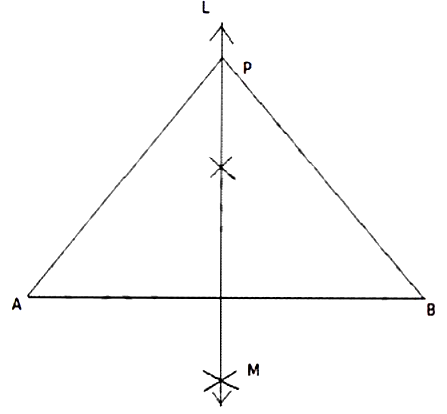
(i) Draw a line segment AB of 9 cm.
(ii) Draw perpendicular bisector LM of AB. LM is the required locus.
Proof:
(i) Take any point on LM say P.
(ii) Join PA and PB.
Since, Plies on the right bisector of line AB.
Therefore, Pis equidistant from A and B.
i.e. PA = PB
Hence, Perpendicular bisector of AB is the locus of all points which are equidistant from A and B.
View full question & answer
[4 marks sum] - Mathematics STD 10 Questions - Vidyadip