Question
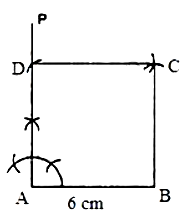
Construct a square ABCD, when: Perimeter $= 24 \ cm.$

Answer

The perimeter of a square
$P=4 a$
Where $a$ is the length of each side
We have Perimeter $=24 \ cm$
Therefore,
$24=4 a$
$ 4=6$
Therefore the sides of the squares are of length $6 \ cm$.

Steps:
$1$. Draw a line segment $A b=6 \ cm$.
$2$. Draw $A P \perp A B$.
$3$. From $A P$ cut off $A D=6 \ cm$.
$4$. With $B$ as a center and radius, $6 \ cm$ draw an arc.
$5$. With $D$ as center and radius, $6 \ cm$ draw another arc cutting the former arc at $C$.
$6$. Join $B C$ and $C D$.
$\text{ABCD}$ is the required square.

Need a full question paper?

Generate a complete, print-ready paper with questions like this in minutes — across 16+ boards, with answer keys.
Start Generating Free

Similar questions

Solve, using cross-multiplication :$0.4 x-1.5 y=6.5; 0.3 x+0.2 y=0.9$
$"$The volume of a cylinder $V$ is equal to the product of $\pi$ and square of radius $r$ and the height $h "$. Express this statement as a formula. Make $r$ the subject formula. Find $r _{ x }$, when $V =44 \ cm ^3, \pi=\frac{22}{7}, h =14 \ cm$.
In $\triangle ABC, BE$ and $CF$ are medians. $P$ is a point on $BE$ produced such that $BE = EP$ and $Q$ is a point on $CF$ produced such that $CF = FQ$. Prove that : $A$ is the mid $-$ point of $PQ$.
Prove that the perimeter of a triangle is greater than the sum of its three medians.
Represent the number $\sqrt{7}$ on the number line.
When the length of each side of a cube is increased by $3 \ cm$, its volume is increased by $2457 \ cm^3$. Find its side. How much will its volume decrease, if the length of each side of it is reduced by $20\%$?
A rectangular tank $30 \ cm \times 20 \ cm \times 12 \ cm$ contains water to a depth of $6 \ cm$ . A metal cube of side $10 \ cm$ is placed in the tank with its one face resting on the bottom of the tank. Find the volume of water, in liters, that must be poured in the tank so that the metal cube is just submerged in the water.
$E, F, G,$ and $H$ are the midpoints of the sides of a parallelogram $\text{ABCD}$.Show that the area of quadrilateral $\text{EFGH}$ is half of the area of parallelogram $\text{ABCD}.$
Evaluate the following:$\left(\frac{64}{216}\right)^{\frac{2}{3}} \times\left(\frac{16}{36}\right)^{-\frac{3}{2}}$
Solve for $x:2^{2x- 1} -9 \times 2^{x - 2} + 1= 0$