Question
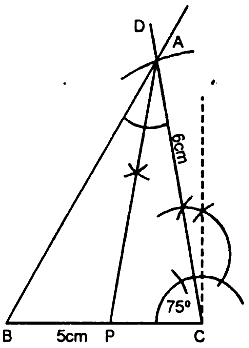
Construct a triangle ABC given BC = 5 cm, AC = 6 cm and ∠C = 75°. Draw the bisector of the interior angle at A. Let this bisector meet BC at P ; measure BP
Answer

Steps of Construction:
(1) Draw BC = 5 cm.
(2) With the help of compass from centre C. Draw an angle ∠C = 75°.
(3) From CD, cut an arc AC = 6 cm.

(4) Join AB.
(5) From A draw an bisector AP.
(6) On measuring BP = 2.6 cm.

Need a full question paper?

Generate a complete, print-ready paper with questions like this in minutes — across 16+ boards, with answer keys.
Start Generating Free

Similar questions

When Ajit travelled 15 km, he found that one-fourth of his journey was still left. What was the full length of the journey?
A girl got $375$ marks out of $500$ in the first term examination, $560$ marks out of $800$ in the second term examination, and $840$ marks out of $1200$ in the third term examination. Find:
(i) her percentage score in the first term examination.
(ii) her percentage score in the second term examination.
(iii) her percentage score in the third term examination.
(iv) the total marks secured in all the three examinations.
(v) the total marks scored in all the three examinations.
(vi) her percentage score on the whole in all three examinations.
Arrange the given fractions in descending order of magnitude:
$\frac{5}{7}, \frac{3}{8}, \frac{9}{11}$
Find three consecutive integers such that their sum is 78.
$\text { Show that } \frac{3}{7} \text { lies between } \frac{2}{5} \text { and } \frac{5}{7} \text {. }$
Two adjacent angles forming a linear pair are in the ratio 7:5, find the angles.
Evaluate:
$3 \frac{5}{6}-1 \frac{4}{15}-\left(3 \frac{2}{9}-1 \frac{3}{5}\right)$
Construct traingle ABC, when : AB = 5.4 cm, ∠A = 30° and ∠B = 90°. Measure ∠C and side BC.
Find the $L.C.M$. of the following group of numbers, using
  1. the prime factor method and
  2. the common division method
$100, 150$ and $200$
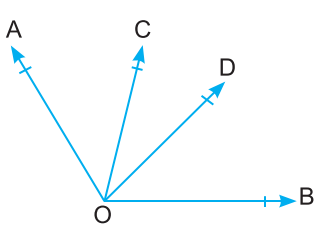
Look at the adjoining figure and state which of the following statements are true and which are false :
(i) Point C is in the interior of $\angle AOC$.
(ii) Point C is in the interior of $\angle AOD$.
(iii) Point D is in the interior of $\angle AOC$.
(iv) Point B is in the exterior of $\angle AOD$.
(v) Point C lies on $\angle AOB$.
Image