Question
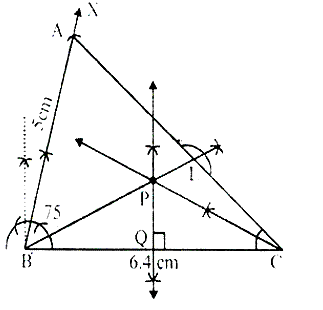
Construct a triangle ABC in which angle ABC = 75°, AB= 5cm and BC =6.4cm. Draw perpendicular bisector of side BC and also the bisector of angle ACB. If these bisectors intersect each other at point P; prove that P is equidistant from B and C; and also from AC and BC.

Answer


Steps of Construction:
i) Draw a line segment BC = 6.4 cm
ii) At B, draw a ray BX making an angle of 75° with BC and cut off BA = 5 cm.
iii) Join AC.
ΔABC is the required triangle.
iv) Draw the perpendicular bisector of BC.
v) Draw the angle bisector of angle ACB which intersects the perpendicular bisector of BC at P.
vi) Join PB and draw PL ⊥ AC.
Proof: In and ΔPBQ and ΔPCQ
PQ = PQ (Common)
∠AQB = ∠PQC (Each = 90°)
BQ = QC (PQ is the perpendicular bisector of BC)
∴ By side Angle side criterion of congruence
ΔPBQ ≅ ΔPCQ (SAS Postulate)
The Corresponding parts of the congruent triangle are congruent
∴ PB = PC (CPCT)
Hence, P is equidistant from B and C.
∠PQC = ∠PLC ( Each = 90°)
∠PCQ = ∠PCL (Given)
PC = PC (Common)
Again in ΔPQC and ΔPLC ∴ By Angle – Angle side criterion of congruence,
ΔPQC ≅ ΔPLC (AAS postulate)
The corresponding parts of the congruent triangles are congruent
∴PQ = PL (CPCT)
Hence, P is equidistant from AC and BC.

Need a full question paper?

Generate a complete, print-ready paper with questions like this in minutes — across 16+ boards, with answer keys.

Start Generating Free

Similar questions

A hollow metallic cylindrical tube has an internal radius of 3.5 cm and height 21 cm. The thickness of the metal tube is 0.5 cm. The tube is melted and cast into a right circular cone of height 7 cm. Find the radius of the cone, correct to one decimal place.
Prove that the line segment joining the midpoints of two parallel chords of a circle passes through its centre.
Karan buys 125 shares of Rs 100 each of 'Reliance Technologies Ltd.' which pays a dividend of 6%. He buys them at such a price that he gets 4% of his money. At what price did Karan buy the share?
Solve the following linear in-equation and graph the solution set on a real number line:
$\frac{1}{3}(2 x-1)<\frac{1}{4}(x+5)<\frac{1}{6}(3 x+4), x \in R$
Construct an isosceles right-angled triangle, having hypotenuse= 8 cm. Draw its lines of symmetry.
In Δ ABC, the perpendicular bisector of AB and AC meet at 0. Prove that O is equidistant from the three vertices. Also, prove that if M is the mid-point of BC then OM meets BC at right angles.
Construct a Δ XYZ in which XY= 4 cm, YZ = 5 cm and ∠ Y = 1200. Locate a point T such that ∠ YXT is a right angle and Tis equidistant from Y and Z. Measure TZ.
The daily wages of 80 workers in a project are given below.
Wages
(in Rs.)
400-450 450-500500-550550-600600-650650-700700-750
No. of
Workers
26121824135
Use a graph paper to draw an ogive for the above distribution. (Use a scale of 2 cm = Rs.
50 on x-axis and 2 cm = 10 workers on y-axis). Use your ogive to estimate:
1)the median wage of the workers
2)the lower quartile wage of workers
3)the numbers of workers who earn more than Rs. 625 daily
A solid, consisting of a right circular cone, standing on a hemisphere, is placed upright, in a right circular cylinder, full of water, and touches the bottom. Find the volume of water left in the cylinder, having given that the radius of the cylinder is $3 \ cm$ and its height is $6 \ cm;$ the radius of the hemisphere is $2 \ cm$ and the height of the cone is $4 \ cm.$ Give your answer to the nearest cubic centimeter.
A buoy is made in the form of hemisphere surmounted by a right cone whose circular basecoincides with the plane surface of hemisphere. The radius of the base of the cone is $3.5$ metres and its volume is two third of the hemisphere. Calculate the height of the cone and the surfacearea of the buoy, correct to two places of decimal