Questions

[5 marks sum]

🎯

Test yourself on this topic

4 questions · timed · auto-graded

Question 15 Marks

Use ruler and compass only for the following question. All construction lines and arcs must be clearly shown.

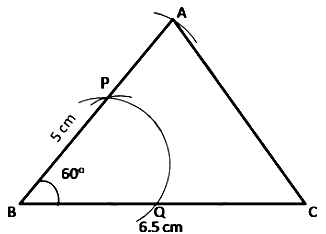
(i) Construct a ΔABC in which BC = 6.5 cm, ∠ABC = 60°, AB = 5 cm.

(ii) Construct the locus of points at a distance of 3.5 cm from A.

(iii.) Construct the locus of points equidistant from AC and BC.

(iv)Mark 2 points X and Y which are at a distance of 3.5 cm from A and also equidistant from AC and BC. Measure XY.

Answer
i. Steps of construction:
1. Draw BC = 6.5 cm using a ruler.
2. With B as center and radius equal to approximately half of BC, draw an arc that cuts the segment BC at Q.
3. With Q as center and same radius, cut the previous arc at P.
4. Join BP and extend it.
5. With B as center and radius 5 cm, draw an arc that cuts the arm PB to obtain point A.
6. Join AC to obtain ΔABC.
ii. With A as center and radius 3.5 cm, draw a circle.
The circumference of a circle is the required locus.
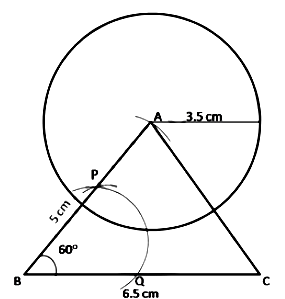
iii. Draw CH, which is bisector of Δ ACB. CH is the required locus.
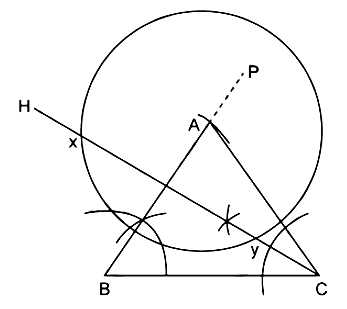
iv. Circle with center A and line CH meet at points X and Y as shown in the figure. xy = 8.2 cm (approximately)
View full question & answer
Question 25 Marks
Construct a triangle ABC in which angle ABC = 75°, AB= 5cm and BC =6.4cm. Draw perpendicular bisector of side BC and also the bisector of angle ACB. If these bisectors intersect each other at point P; prove that P is equidistant from B and C; and also from AC and BC.
Answer

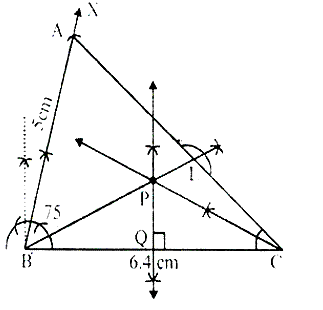
Steps of Construction:
i) Draw a line segment BC = 6.4 cm
ii) At B, draw a ray BX making an angle of 75° with BC and cut off BA = 5 cm.
iii) Join AC.
ΔABC is the required triangle.
iv) Draw the perpendicular bisector of BC.
v) Draw the angle bisector of angle ACB which intersects the perpendicular bisector of BC at P.
vi) Join PB and draw PL ⊥ AC.
Proof: In and ΔPBQ and ΔPCQ
PQ = PQ (Common)
∠AQB = ∠PQC (Each = 90°)
BQ = QC (PQ is the perpendicular bisector of BC)
∴ By side Angle side criterion of congruence
ΔPBQ ≅ ΔPCQ (SAS Postulate)
The Corresponding parts of the congruent triangle are congruent
∴ PB = PC (CPCT)
Hence, P is equidistant from B and C.
∠PQC = ∠PLC ( Each = 90°)
∠PCQ = ∠PCL (Given)
PC = PC (Common)
Again in ΔPQC and ΔPLC ∴ By Angle – Angle side criterion of congruence,
ΔPQC ≅ ΔPLC (AAS postulate)
The corresponding parts of the congruent triangles are congruent
∴PQ = PL (CPCT)
Hence, P is equidistant from AC and BC.
View full question & answer
Question 35 Marks
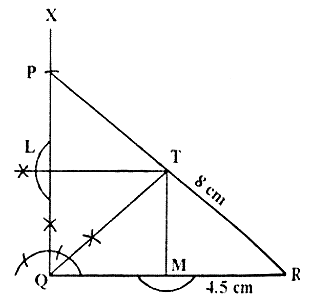
Construct a right angled triangle PQR, in which ∠Q = 90°, hypotenuse PR = 8 cm and QR = 4.5 cm. Draw bisector of angle PQR and let it meets PR at point t. Prove that T is equidistant from PQ and QR.
Answer

Steps of Construction:
i) Draw a line segment QR = 4.5 cm
ii) At Q, draw a ray QX making an angle of 90°
iii) With centre R and radius 8 cm, draw an arc which intersects QX at P.
iv) Join RP.
ΔPQR is the required triangle.
v) Draw the bisector of ∠PQR which meets PR in T.
vi) From T, draw perpendicular PL and PM respectively on PQ and QR.
Proof: In ΔLTQ and ΔMTQ
∠TLQ = ∠TMQ (Each = 90°)
∠LQT = ∠TQM (QT is angle bisector)
QT = QT (Common)
∴ By Angle – Angle – side criterion of congruence,
∴ΔLTQ ≅ ΔMTQ (AAS postulate)
The corresponding parts of the congruent triangles are congruent
∴ TL = TM (CPCT)
Hence, T is equidistant from PQ and QR.
View full question & answer
Question 45 Marks
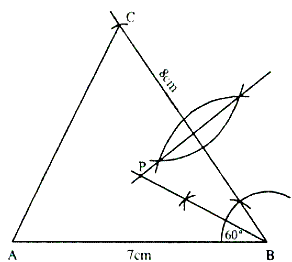
Construct a triangle ABC, with AB = 7cm, BC = 8cm and ∠ABC = 60°. Locate by construction the point P such that:
(i) P is equidistant from B and C.
(ii) P is equidistant from AB and BC.
Measure and record the length of PB.
Answer
Steps of Construction:
1) Draw a line segment AB = 7 cm.
2) Draw angle ∠ABC = 60° with the help of compass.
3) Cut off BC = 8 cm.
4) Join A and C.
5) The triangle ABC so formed is the required triangle.
i) Draw the perpendicular bisector of BC. The point situated on this line will be equidistant from B and C.
ii) Draw the angle bisector of ∠ABC . Any point situated on this angular bisector is equidistant from lines AB and BC.
The point which fulfills the condition required in (i) and (ii) is the intersection point of bisector of line BC and angular bisector of ∠ABC.
P is the required point which is equidistant from AB and AC as well as from B and C.
On measuring the length of line segment PB, it is equal to 4.5 cm.
View full question & answer
[5 marks sum] - Mathematics STD 10 Questions - Vidyadip