Question
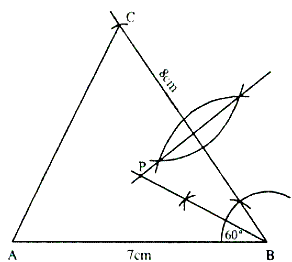
Construct a triangle ABC, with AB = 7cm, BC = 8cm and ∠ABC = 60°. Locate by construction the point P such that:
(i) P is equidistant from B and C.
(ii) P is equidistant from AB and BC.
Measure and record the length of PB.
Answer

Steps of Construction:
1) Draw a line segment AB = 7 cm.
2) Draw angle ∠ABC = 60° with the help of compass.
3) Cut off BC = 8 cm.
4) Join A and C.
5) The triangle ABC so formed is the required triangle.
i) Draw the perpendicular bisector of BC. The point situated on this line will be equidistant from B and C.
ii) Draw the angle bisector of ∠ABC . Any point situated on this angular bisector is equidistant from lines AB and BC.
The point which fulfills the condition required in (i) and (ii) is the intersection point of bisector of line BC and angular bisector of ∠ABC.
P is the required point which is equidistant from AB and AC as well as from B and C.
On measuring the length of line segment PB, it is equal to 4.5 cm.

Need a full question paper?

Generate a complete, print-ready paper with questions like this in minutes — across 16+ boards, with answer keys.

Start Generating Free

Similar questions

Divide Rs 50,760 into two parts such that if one part is invested in 8% Rs 100 shares at 8% discount and the other in 9% Rs 100 shares at 8% premium, the annual incomes from both the investments are equal.
The radius of a solid right circular cylinder decreases by $20\%$ and its height increases by $10\%.$ Find the percentage change in its : curved surface area.
The difference between the outer curved surface area and the inner curved surface area of a hollow cylinder is $352 cm^2$. If its height is $28 \ cm$ and the volume of material in it is $704 cm^3$; find its external curved surface area.
Marks obtained by $40$ students in a short assessment is given below, where $a$ and $b$ are two missing data.
Marks $5 $ $6$ $7$ $8$ $9$
Number of Students $6$ $a$ $16$ $13$ $b$
If the mean of the distribution is $7.2,$ find $a $ and $b.$
Prove the following identity :$\left[\frac{1}{\left(\sec ^2 \theta-\cos ^2 \theta\right)}+\frac{1}{\left(\operatorname{cosec} 2 \theta-\sin ^2 \theta\right)}\right]\left(\sin ^2 \theta \cos ^2 \theta\right)=\frac{1-\sin ^2 \theta \cos ^2 \theta}{2+\sin ^2 \theta \cos ^2 \theta}$
The fourth term of an $A.P.$ is $11$ and the term exceeds twice the fourth term by $5$ the $A.P$ and the sum of first $50$ terms.
Find the values of a and b in the polynomial $f(x) = 2x^3 + ax^2 + bx + 10$, if it is exactly divisible by $(x+2)$ and $(2x-1).$
Draw line segments OA = 4.5 cm, OB = 3.2 cm such that ∠ AOB = 45°. Construct a circle touching OA at A and passing through B.
Sixteen cards are labelled as a, b, c, ……………. m, n, o, p. They are put in a box and shuffled.a boy is asked to draw a card from the box. What is the probability that the card drawn is:
(1) a vowel
 (2) a consonant
(3) none of the letters of the word media
A vertical pole and a vertical tower are on the same level ground in such a way that from the top of the pole, the angle of elevation of the top of the tower is $60^\circ$ and the angle of depression of the bottom of the tower is $30^\circ.$ Find: the height of the tower, if the height of the pole is $20\ m.$